- Stock: Out Of Stock
- Brand: ACI Pharmaceuticals
- Product ID: Telmisartan
🔒 100% Secure Payment | bKash | Nagad | SSLCommerz | COD
⭐ Become a FREE Member: 7% Extra Savings • Free Delivery • Refill Reminders • Priority Support
This Item is for pre order
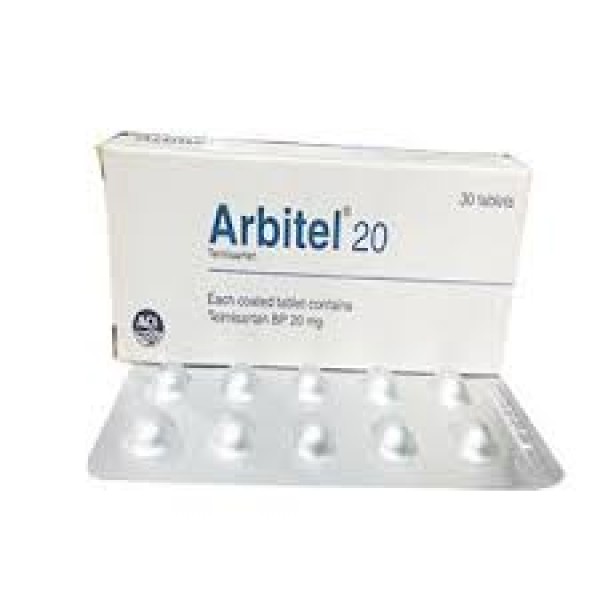
Arbitel 20 mg Tablet (Telmisartan 20 mg) – ACI Limited
| Brand Name | Arbitel 20 mg Tablet |
|---|---|
| Generic Name | Telmisartan 20 mg |
| Strength | 20 mg |
| Dosage Form | Tablet |
| Manufacturer | ACI Limited, Bangladesh |
| Drug Class | Angiotensin II Receptor Blocker (ARB) — Antihypertensive |
| Prescription Required | Yes (Rx) |
| Storage | Store below 30°C, dry place. Protect from moisture. |
1. About Arbitel 20 mg (Telmisartan)
Arbitel 20 mg Tablet contains Telmisartan 20 mg, an Angiotensin II Receptor Blocker (ARB) used for hypertension management and cardiovascular risk reduction, manufactured by ACI Limited, Bangladesh. Telmisartan is distinguished among ARBs by its exceptionally long half-life (~24 hours), providing true once-daily dosing with sustained 24-hour blood pressure control — including effective coverage of the critical early morning surge period when cardiovascular events peak.
Arbitel 20 mg is the lowest available dose of telmisartan — used for initiation of therapy in elderly patients, patients with renal impairment, or those sensitive to antihypertensive effects. It is also used for dose titration when starting telmisartan in combination with other antihypertensives. In diabetic patients, telmisartan provides additional renoprotective benefits through RAAS blockade, making it a preferred ARB in diabetic hypertension management.
2. Mechanism of Action
Telmisartan is a selective, competitive antagonist of the AT1 receptor (type 1 angiotensin II receptor). By blocking AT1 receptors in blood vessels, adrenal glands, heart, and kidneys, telmisartan prevents the effects of angiotensin II: vasoconstriction, aldosterone secretion, sodium/water retention, and cardiac/renal remodelling. The result is vasodilation, reduced blood pressure, reduced cardiac afterload, and reduced renal efferent pressure (renoprotective). Unlike ACE inhibitors, telmisartan does not affect bradykinin degradation — so it does not cause cough. Telmisartan also has partial PPAR-γ agonist activity, which may contribute to improved insulin sensitivity and metabolic benefits in diabetic patients.
3. Indications
- Hypertension (primary/essential): Monotherapy or combination for blood pressure control
- Cardiovascular risk reduction: Reduces risk of MI, stroke in high-risk patients (ONTARGET trial)
- Diabetic nephropathy: Renoprotection in type 2 diabetes with microalbuminuria/proteinuria
- Heart failure: ARBs used when ACE inhibitors not tolerated
- Elderly hypertension initiation: 20 mg starting dose for gradual, safe blood pressure reduction
4. Dosage and Administration
Hypertension: Starting dose 20–40 mg once daily; usual maintenance 40–80 mg once daily. The 20 mg dose is used for initiation in elderly or renally impaired patients. Titrate to 40 mg then 80 mg as needed.
Cardiovascular risk reduction: 80 mg once daily (target dose based on ONTARGET).
Take at the same time each day, with or without food. Do not crush or chew.
5. Contraindications
- Hypersensitivity to telmisartan or excipients
- Pregnancy (all trimesters — RAAS blockers teratogenic/fetotoxic)
- Combination with aliskiren in patients with diabetes or renal impairment (eGFR <60 ml/min)
- Severe hepatic impairment (Child-Pugh C)
- Biliary obstructive disease
6. Warnings and Precautions
Hypotension: First-dose hypotension more likely in volume-depleted patients (diuretic use, restricted salt diet, vomiting/diarrhoea). Start 20 mg in these patients; correct volume depletion first. Particular caution in elderly.
Renal function: RAAS blockers can cause acute kidney injury in patients with bilateral renal artery stenosis or single-kidney stenosis. Monitor renal function and electrolytes (hyperkalaemia risk) especially in CKD and diabetic patients.
Hyperkalaemia: ARBs reduce aldosterone → potassium retention. Monitor K+ in CKD, diabetes, or when combined with other K+-sparing agents or K+ supplements.
Hepatic impairment: Telmisartan eliminated primarily in bile. Use with caution in mild-moderate hepatic impairment (dose cap 40 mg/day). Contraindicated in severe hepatic impairment.
7. Side Effects
Common: Dizziness (especially postural), headache, fatigue, back pain, upper respiratory tract infection.
Uncommon: Hyperkalaemia, orthostatic hypotension, bradycardia, nausea, elevated creatinine (especially in bilateral RAS).
Rare: Angioedema (rare, much less than ACE inhibitors), anaemia, thrombocytopenia, hepatic enzyme elevation.
Not expected (vs ACE inhibitors): Dry cough — telmisartan does NOT cause cough. Patients switched from ACE inhibitors due to cough find telmisartan well-tolerated.
8. Drug Interactions
- Diuretics/antihypertensives: Additive hypotension — start low, monitor BP
- NSAIDs (ibuprofen, diclofenac): Reduce antihypertensive effect; increase renal impairment risk
- Potassium-sparing diuretics/supplements: Hyperkalaemia risk
- Lithium: Telmisartan increases lithium levels (toxicity risk) — monitor
- Digoxin: Telmisartan increases digoxin Cmax by ~50% — monitor digoxin levels
- ACE inhibitor combination (dual RAAS): Not recommended — excess hypotension and renal impairment risk
9. Pharmacokinetics
Oral bioavailability dose-dependent: ~42% at 40 mg, ~58% at 160 mg. Food slightly reduces absorption (not clinically significant). Protein binding >99.5%. Hepatic glucuronidation to inactive metabolite. Biliary/faecal excretion ~97% (minimal renal elimination). t½ ~24 hours — longest among ARBs — providing smooth 24-hour blood pressure control from once-daily dosing. No dose adjustment needed for renal impairment.
10. Telmisartan’s Unique Advantages Among ARBs
Telmisartan has several distinguishing properties that make it a first-choice ARB in many clinical scenarios: (1) 24-hour coverage: The longest half-life among ARBs (24h vs. 6–9h for losartan, 9–13h for valsartan) provides coverage throughout the night and early morning BP surge — when MIs and strokes peak. (2) Renoprotection in diabetes: ARBs are the preferred antihypertensives for T2DM patients with microalbuminuria or nephropathy — reducing proteinuria and slowing CKD progression. (3) No dose adjustment in CKD: Primarily biliary elimination means no accumulation even in severe renal impairment. (4) No cough: Unlike ACE inhibitors (15–25% cough rate in Bangladeshi/Asian patients), telmisartan does not cause dry cough. (5) PPAR-γ agonism: Telmisartan has mild PPAR-γ partial agonist activity, potentially improving insulin sensitivity — an advantage for diabetic hypertensive patients.
11. Telmisartan in Diabetic Hypertension (Bangladesh Context)
Hypertension affects approximately 50–60% of type 2 diabetic patients in Bangladesh. ARBs are the preferred antihypertensive class in diabetic patients with CKD or microalbuminuria due to their RAAS-blocking renoprotective effect. Telmisartan’s combination of 24-hour BP control, renoprotection, CKD-safe pharmacokinetics (biliary elimination), absence of cough (important in Asian populations), and potential metabolic benefits from PPAR-γ activity makes it an ideal choice. Starting with Arbitel 20 mg allows safe initiation in elderly, frail, or dehydrated diabetic patients without risking severe first-dose hypotension.
12. ACI Limited Arbitel Range
ACI Limited manufactures a complete Arbitel (Telmisartan) range for flexible hypertension management: Arbitel 20 mg (initiation/elderly), Arbitel 40 mg (standard starting dose), Arbitel 80 mg (full target dose), Arbitel AM (+ Amlodipine for combined CCB/ARB therapy), and Arbitel Plus (+ Hydrochlorothiazide for combined ARB/diuretic therapy). The range covers every step of the hypertension treatment pathway.
13. Storage
- Store below 30°C in a cool, dry place away from moisture
- Keep in original packaging. Keep out of reach of children.
- Do not use after expiry date.
Frequently Asked Questions (FAQ)
Q1: What is Arbitel 20 mg (Telmisartan) used for?
Arbitel 20 mg is used for hypertension (high blood pressure) management, particularly as a starting dose in elderly patients, those with kidney disease, or those sensitive to blood pressure medications. Telmisartan is an ARB (Angiotensin Receptor Blocker) that relaxes blood vessels by blocking the effects of angiotensin II. Unlike ACE inhibitors, it does not cause dry cough — making it preferred for Bangladeshi patients who frequently experience ACE-inhibitor-induced cough. It also provides kidney protection in diabetic patients with microalbuminuria or nephropathy.
Q2: Why is Telmisartan (Arbitel) preferred over other ARBs?
Telmisartan has the longest half-life among all ARBs (~24 hours vs. 6–9 hours for losartan), providing true 24-hour blood pressure control from a single daily dose — including coverage of the early morning cardiovascular risk period. It is also eliminated primarily through bile/faeces rather than kidneys, so no dose adjustment is needed in renal impairment — a key advantage for diabetic nephropathy patients. Additionally, telmisartan has partial PPAR-γ agonist activity which may improve insulin sensitivity, making it the preferred ARB for T2DM patients.
Q3: Can Telmisartan (Arbitel) be taken during pregnancy?
No — telmisartan and all ARBs/RAAS blockers are absolutely contraindicated in pregnancy. They are classified Pregnancy Category D/X. During the 2nd and 3rd trimesters, ARBs can cause foetal renal toxicity, oligohydramnios, skull hypoplasia, limb contractures, and neonatal renal failure. If a woman planning pregnancy is on telmisartan, she should switch to a safer alternative (methyldopa, labetalol, nifedipine) before conception. Women of childbearing age should use effective contraception while on Arbitel.
Q4: Can Telmisartan (Arbitel) be used in diabetic patients with kidney disease?
Yes — ARBs like telmisartan are the preferred antihypertensives for diabetic patients with kidney disease. They reduce proteinuria (protein in urine) and slow the progression of diabetic nephropathy by reducing efferent arteriolar pressure in the kidney. Unlike metformin which is contraindicated in severe CKD, telmisartan requires no dose adjustment in renal impairment (biliary elimination). Monitor potassium levels and renal function during treatment, and avoid combining with ACE inhibitors or aliskiren in diabetic patients with CKD.