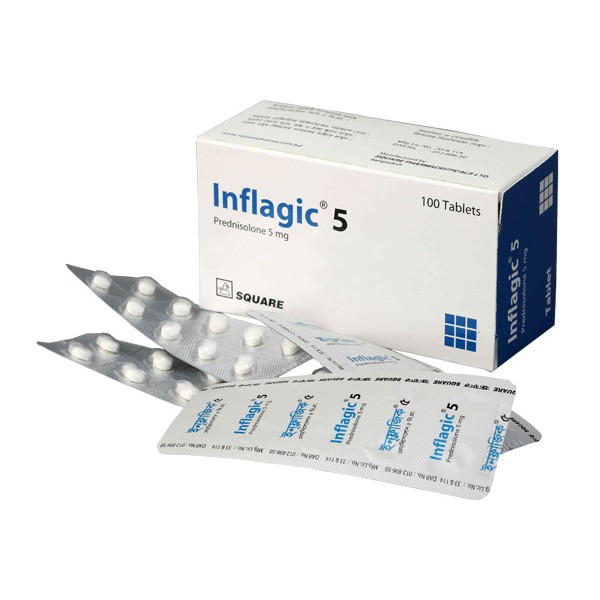
- Stock: In Stock
- Product ID: Prednisolone
Available Options
🔒 100% Secure Payment | bKash | Nagad | SSLCommerz | COD
⭐ Become a FREE Member: 7% Extra Savings • Free Delivery • Refill Reminders • Priority Support
| Generic Name | Prednisolone |
|---|---|
| Strength | 20 mg |
| Dosage Form | Tablet |
| Manufacturer | Square Pharmaceuticals PLC |
| Therapeutic Class | Glucocorticoids |
| Pack Size | 5 x 10 (50's) |
Overview
Inflagic Tablet contains Prednisolone 20 mg, a synthetic adrenocortical glucocorticoid with potent anti-inflammatory, immunosuppressive, and anti-allergic properties. Prednisolone directly inhibits Phospholipase A2, an enzyme responsible for producing inflammatory mediators such as Leukotrienes, SRS-A, and Prostaglandins. It is rapidly and well absorbed from the gastrointestinal tract, 70–90% protein-bound in plasma, and eliminated with a half-life of 2 to 4 hours. Metabolism occurs mainly in the liver and excretion via the urine. Inflagic is indicated for a wide range of conditions including rheumatic disorders, endocrine disorders, dermatologic diseases, allergic states, respiratory diseases, hematologic disorders, edematous states (nephrotic syndrome), and gastrointestinal diseases such as ulcerative colitis and regional enteritis.
Dosage and Administration
Anti-inflammatory (Adults): 5 to 60 mg per day in divided doses, 1 to 4 times daily.
Acute Asthma (Adults): 40–60 mg/day PO in a single daily dose or divided every 12 hours for 3–10 days.
Allergic Conditions (Adults): Tapering dose over 6 days, starting at Day 1 with 10 mg before breakfast, 5 mg after lunch and dinner, and 10 mg at bedtime, progressively reducing to 5 mg before breakfast on Day 6.
Nephrotic Syndrome (Adults): Initial: 2 mg/kg/day (max 80 mg/day) in 3–4 divided doses until urine is protein-free for 3 consecutive days (max 28 days); then 1–1.5 mg/kg/dose every other day for 4 weeks. Maintenance: 0.5–1 mg/kg/dose every other day for 3–6 months.
Pediatric (Asthma): Doses vary by age — from 10 mg every 12 hours (acute) for children under 1 year to 40 mg every 12 hours (acute) for those above 12 years.
Pediatric (Anti-inflammatory / Immunosuppression): 0.05 to 2 mg/kg/day in 1 to 4 divided doses.
Interaction
The efficacy of Inflagic is reduced by Aminoglutethimide, Antacids, Barbiturates, Carbamazepine, Griseofulvin, Mitotane, Phenylbutazone, Phenytoin, Primidone, and Rifampin. Inflagic reduces serum potassium; concurrent use with Digitalis can cause cardiac arrhythmias if hypokalemia occurs. Immunization should be managed with caution during corticosteroid therapy.
Contraindications
Inflagic is contraindicated in systemic infections unless specific anti-infective therapy is employed, in patients with hypersensitivity to any ingredient, and in ocular herpes simplex due to the risk of corneal perforation.
Side Effects
Fluid and electrolyte disturbances (sodium retention, fluid retention, potassium loss, hypertension), musculoskeletal effects (muscle weakness, osteoporosis, vertebral compression fractures, aseptic necrosis), gastrointestinal effects (peptic ulcer, pancreatitis, abdominal distention), dermatologic effects (impaired wound healing, thin skin, petechiae), neurological effects (convulsions, vertigo, headache, increased intracranial pressure), endocrine effects (Cushingoid state, menstrual irregularities, growth suppression in children, manifestations of latent diabetes mellitus), ophthalmic effects (posterior subcapsular cataracts, glaucoma), and metabolic effects (negative nitrogen balance).
Pregnancy and Lactation
Not recommended during pregnancy unless considered essential by the physician. Corticosteroids appear in breast milk and could suppress growth, interfere with endogenous corticosteroid production, or cause other unwanted effects in nursing infants. Use during lactation with caution.
Precautions and Warnings
Patients on immunosuppressant doses should avoid exposure to chickenpox or measles. Corticosteroids may mask signs of infection and decrease resistance to new infections. Prolonged use may produce posterior subcapsular cataracts, glaucoma, and secondary ocular infections. Large doses may cause hypertension, salt and water retention, and potassium loss. Patients should not be vaccinated against smallpox while on corticosteroid therapy. Children on corticosteroids are more susceptible to infections; chickenpox and measles can have severe or fatal outcomes in non-immune children.
Storage Conditions
Store in a cool and dry place, protected from light. Keep out of the reach of children.
Frequently Asked Questions
Q: What conditions is Inflagic 20 mg used to treat?
Inflagic (Prednisolone 20 mg) is used for a broad range of conditions including rheumatoid arthritis, ankylosing spondylitis, acute gouty arthritis, adrenal insufficiency, severe allergic reactions, bronchial asthma, nephrotic syndrome, ulcerative colitis, regional enteritis, and various dermatologic and hematologic disorders. It works by suppressing inflammation and modulating the immune response.
Q: How long should Inflagic be taken and can it be stopped suddenly?
The duration of Inflagic therapy depends on the condition being treated and the physician's guidance. Corticosteroids should never be stopped abruptly after prolonged use, as this can cause adrenal insufficiency. The dose must be tapered gradually under medical supervision. Always follow your physician's instructions regarding dose reduction and discontinuation.