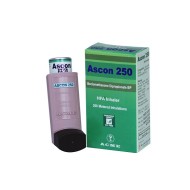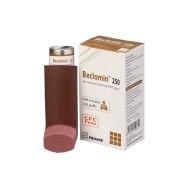

- Stock: Pre-Order
- Brand: Eskayef Bangladesh Ltd.
- Product ID: Beclomethasone Dipropionate
🔒 100% Secure Payment | bKash | Nagad | SSLCommerz | COD
⭐ Become a FREE Member: 7% Extra Savings • Free Delivery • Refill Reminders • Priority Support
This Item is for pre order
Azbec 250 Inhaler (Beclomethasone Dipropionate 250mcg) — Clinical Overview
| Attribute | Details |
|---|---|
| Brand Name | Azbec 250 |
| Generic Name | Beclomethasone Dipropionate |
| Strength | 250 mcg per actuation |
| Dosage Form | Pressurised Metered Dose Inhaler (pMDI) |
| Drug Class | Inhaled Corticosteroid (ICS) |
| Manufacturer | Eskayef Bangladesh Ltd. |
| Route of Administration | Inhalation |
About Azbec 250 Inhaler
Azbec 250 Inhaler is beclomethasone dipropionate 250 micrograms per actuation pressurised metered dose inhaler (pMDI), manufactured by Eskayef Bangladesh Ltd. The 250 mcg per actuation strength represents a higher-dose beclomethasone formulation compared to Azbec 100, designed for patients requiring medium-to-high dose inhaled corticosteroid (ICS) therapy — typically those with moderate-to-severe persistent asthma who require more than 400 mcg/day of beclomethasone to maintain adequate disease control. Azbec 250 allows patients to achieve these higher doses with fewer actuations per day, potentially improving convenience and compliance.
Beclomethasone dipropionate (BDP) in conventional CFC-containing pMDIs (as opposed to newer HFA formulations) deposits primarily in the large airways, with the 250 mcg/actuation strength providing a clinically meaningful dose in each puff. Eskayef Bangladesh Ltd. has long been a leading supplier of inhaled respiratory medicines in Bangladesh, and Azbec 250 is an essential product for respiratory specialists and general practitioners managing moderate-to-severe asthma in adult patients.
When Azbec 250 is Preferred Over Azbec 100
The choice between Azbec 100 (100 mcg/actuation) and Azbec 250 (250 mcg/actuation) depends on the prescribed total daily dose of beclomethasone: for total daily doses of 400 mcg or below, Azbec 100 (2 puffs twice daily = 400 mcg/day) is preferred — fewer dose steps reduce over-dosing risk; for total daily doses of 500–1000 mcg/day, Azbec 250 (2–4 puffs twice daily) provides the required dose in fewer actuations; for doses above 800 mcg/day, specialist supervision is required and GINA guidelines recommend reassessing the diagnosis, checking inhaler technique, and ensuring adherence before increasing ICS dose further. Practical prescribing: a patient on 500 mcg/day BDP would take 1 puff of Azbec 250 twice daily (2 actuations/day) rather than 5 puffs of Azbec 100 — simpler and more convenient. Step-up from Azbec 100 to Azbec 250 is appropriate when asthma control is inadequate on maximum low-dose ICS despite good technique and adherence.
Beclomethasone in COPD — An Evidence-Based Role
While beclomethasone pMDIs are primarily indicated for asthma, inhaled corticosteroids (including beclomethasone) have a defined role in certain COPD patients. Current GOLD (Global Initiative for Chronic Obstructive Lung Disease) guidelines recommend adding ICS to long-acting bronchodilator therapy in COPD patients who: have frequent exacerbations (2 or more per year despite dual bronchodilator therapy); have blood eosinophil counts above 300 cells/μL; have an asthma-COPD overlap (ACO) diagnosis with features of both conditions. In Bangladesh, where spirometry facilities are limited and many patients have concurrent asthma and smoking-related COPD, prescribing an ICS like Azbec 250 alongside a long-acting bronchodilator is clinically common. ICS therapy in COPD reduces exacerbation frequency, hospital admissions, and slows FEV1 decline in the eligible patient groups listed above.
Monitoring and Dose Reduction Strategy
Patients on Azbec 250 Inhaler should have asthma control reviewed every 3–6 months by their physician. Asthma control assessment includes: frequency of reliever (salbutamol) inhaler use — target less than 2 uses per week for symptom relief; nocturnal awakening due to asthma — target none; limitation of daily activities — target none; and peak expiratory flow or spirometry. When asthma is well controlled for at least 3 consecutive months, dose step-down should be attempted. Step-down from Azbec 250: if currently on 2 puffs twice daily (1000 mcg/day), reduce to 2 puffs once daily (500 mcg/day) or step down to Azbec 100; if control is maintained at lower dose, continue step-down. Dose reduction should be gradual (25–50% reduction every 3 months), not abrupt. Never abruptly stop inhaled corticosteroid therapy in patients with moderate-to-severe asthma — this can precipitate life-threatening exacerbations.
Frequently Asked Questions (FAQ)
Q1: What is the difference between Azbec 100 and Azbec 250?
Both contain the same active ingredient (beclomethasone dipropionate) but at different strengths per actuation. Azbec 100 delivers 100 mcg per puff and is used for mild-to-moderate asthma (GINA steps 2–3) at total daily doses of 200–800 mcg. Azbec 250 delivers 250 mcg per puff and is prescribed for patients requiring medium-to-high dose ICS therapy — typically moderate-to-severe asthma — where the higher per-actuation dose allows the target daily dose to be reached with fewer puffs, improving convenience. Your physician will prescribe the appropriate strength based on your asthma severity and total daily dose requirements.
Q2: I have been using Azbec 250 for several months and my asthma is now well controlled — can I stop?
Do not stop Azbec 250 without physician guidance, even if you feel completely well. Beclomethasone works by continuously suppressing airway inflammation — if you stop, inflammation returns gradually, increasing the risk of exacerbations, sometimes weeks after stopping. Instead, discuss a planned step-down with your physician: if control is excellent for 3+ months, your doctor may reduce the dose to Azbec 100 or reduce the number of puffs. Stepping down with supervision is appropriate; stopping abruptly is not.
Q3: My doctor prescribed Azbec 250 plus a long-acting bronchodilator — is this combination safe?
Yes — the combination of an inhaled corticosteroid (Azbec 250) and a long-acting beta-2 agonist (LABA, such as salmeterol or formoterol) or long-acting muscarinic antagonist (LAMA, such as tiotropium) is the cornerstone of GINA step 3–4 asthma management and is well established as safe and effective. The ICS reduces airway inflammation and reduces the risk of asthma-related serious adverse events from LABA use. The LABA provides sustained bronchodilation. Many patients are on fixed-dose ICS/LABA combination inhalers — if you find managing multiple inhalers difficult, ask your physician whether a combination product is available and appropriate.
Q4: Can Azbec 250 Inhaler be used by elderly patients with asthma?
Yes, with appropriate monitoring. Elderly asthma patients often have comorbidities (osteoporosis, glaucoma, cataracts, hypertension, diabetes) that may be relevant when considering high-dose ICS. At doses up to 1000 mcg/day of beclomethasone, systemic effects are generally minimal, but long-term high-dose ICS use in elderly patients with osteoporosis risk may warrant bone density monitoring and calcium/vitamin D supplementation. Oropharyngeal side effects (thrush, hoarseness) are prevented by rinsing the mouth after each use. Spacer devices are particularly important in elderly patients who may have difficulty coordinating inhalation with actuation. Azbec 250 is generally safe and effective in the elderly when used at the minimum effective dose.
Medical Disclaimer: Azbec 250 Inhaler is a prescription medication for moderate-to-severe persistent asthma management. Dosing and step-up/step-down decisions must be made by a qualified physician. Never abruptly stop inhaled corticosteroid therapy. Always carry a short-acting reliever inhaler for acute symptoms.