- Stock: Out Of Stock
- Brand: Square Pharmaceuticals
- Product ID: Furosemide
🔒 100% Secure Payment | bKash | Nagad | SSLCommerz | COD
⭐ Become a FREE Member: 7% Extra Savings • Free Delivery • Refill Reminders • Priority Support
This Item is for pre order
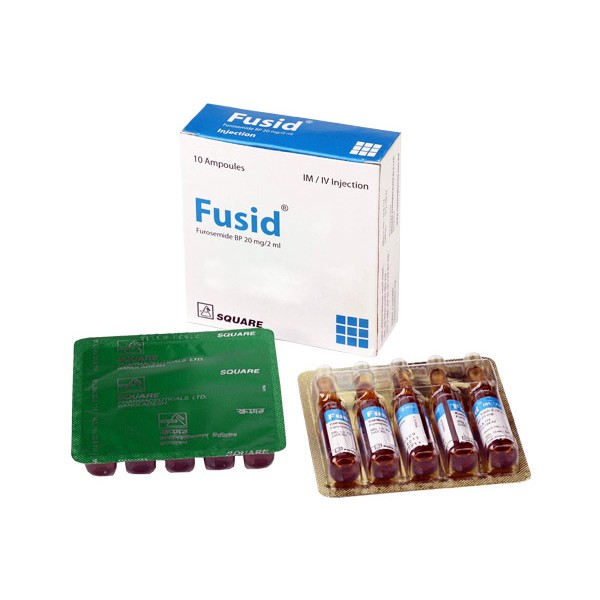
| Generic Name | Furosemide |
|---|---|
| Strength | 20 mg/2 ml |
| Dosage Form | Injection |
| Manufacturer | Square Pharmaceuticals PLC |
| Therapeutic Class | Loop Diuretics |
| Pack Size | 2 × 5 ampoules (10 ampoules per pack) |
Overview
Fusid Injection (Furosemide 20 mg/2 ml) is a potent loop diuretic used parenterally for rapid relief of fluid overload. Furosemide inhibits the Na⁺-K⁺-2Cl⁻ co-transporter in the thick ascending limb of the loop of Henle, producing a rapid and profound diuresis. It is indicated for oedema associated with congestive heart failure, acute pulmonary oedema, renal impairment, nephrotic syndrome, and hepatic cirrhosis, as well as for hypertensive crises requiring rapid blood pressure reduction.
Dosage and Administration
For adults: the usual initial dose is 20–40 mg administered slowly by intravenous injection (over at least 1–2 minutes) or intramuscular injection. In acute pulmonary oedema, an initial dose of 40 mg IV is commonly used. If the response is inadequate, the dose may be doubled and repeated after 20 minutes. For chronic conditions, doses may be given once or twice daily. In patients with severe oedema or renal impairment, higher doses (up to 250 mg by slow IV infusion) may be required. For children: 0.5–1 mg/kg body weight per dose. Administer under medical supervision.
Interaction
ACE inhibitors and angiotensin receptor blockers may cause a severe first-dose hypotensive effect — reduce furosemide dose before initiation. Lithium levels may be increased by furosemide, leading to toxicity. Concurrent use with nephrotoxic antibiotics (aminoglycosides) or cisplatin increases the risk of nephrotoxicity and ototoxicity. NSAIDs may reduce the diuretic effect. Digoxin toxicity may be potentiated by hypokalaemia induced by furosemide.
Contraindications
Contraindicated in anuria, states of electrolyte depletion (hyponatraemia, hypokalaemia, hypovolaemia), hypersensitivity to furosemide or sulphonamides, and in hepatic pre-coma or coma with cirrhosis. Use with extreme caution in patients with gout, diabetes mellitus, or prostatic hypertrophy.
Side Effects
Fluid and electrolyte imbalances (hypokalaemia, hyponatraemia, hypomagnesaemia, hypocalcaemia) are the most common adverse effects. Ototoxicity (tinnitus, hearing loss) can occur, particularly with rapid IV injection or high doses. Other effects include dehydration, hypotension, hyperuricaemia, hyperglycaemia, muscle cramps, and rarely blood dyscrasias or allergic skin reactions.
Pregnancy and Lactation
Furosemide crosses the placental barrier and is excreted in breast milk. It should be used during pregnancy only if clearly necessary, particularly avoiding use in the first trimester. It inhibits lactation and is excreted in breast milk; breastfeeding is not recommended during treatment.
Precautions and Warnings
IV injections must be given slowly (at least 1–2 minutes) to avoid ototoxicity. Monitor serum electrolytes, BUN, and creatinine regularly, particularly in patients with renal impairment or those on prolonged therapy. Potassium supplementation or a potassium-sparing diuretic may be required. Use with caution in elderly patients due to increased risk of falls from hypotension. This formulation is for hospital or clinical use and must be administered by a healthcare professional.
Storage Conditions
Store in a dry place, protected from light. Keep out of reach of children. Do not use if the solution is discoloured. Do not freeze.
Frequently Asked Questions
Q: Why is the injection form used instead of tablets?
A: Fusid Injection is used when rapid diuresis is required (e.g., acute pulmonary oedema), when the patient cannot take oral medication, or when oral absorption is impaired (e.g., severe gut oedema). IV furosemide acts within 5 minutes, whereas tablets take 30–60 minutes.
Q: How quickly does Fusid Injection work?
A: Following intravenous injection, diuresis begins within 5 minutes, peaks at approximately 30 minutes, and the effect lasts for about 2 hours. Intramuscular administration has a slower onset of 30 minutes with a duration of approximately 4 hours.