- Stock: In Stock
- Brand: Square Pharmaceuticals
- Product ID: Nitroglycerin
🔒 100% Secure Payment | bKash | Nagad | SSLCommerz | COD
⭐ Become a FREE Member: 7% Extra Savings • Free Delivery • Refill Reminders • Priority Support
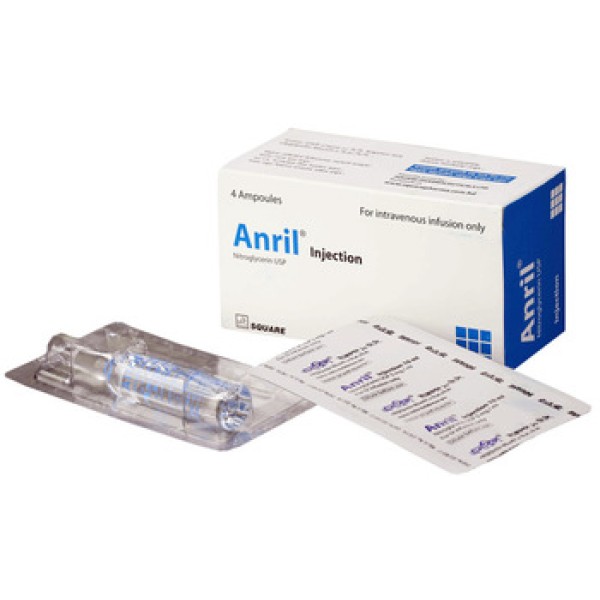
Anril 50 mg/10 ml Injection
| Generic Name | Nitroglycerin (IV Infusion) |
| Strength | 50 mg/10 ml |
| Dosage Form | IV Infusion (Ampoule) |
| Manufacturer | Square Pharmaceuticals PLC |
| Therapeutic Class | Nitrates: Coronary vasodilators |
| Pack Size | 4 x 1 (10 ml Ampoule) |
Overview
Anril 50 mg/10 ml Injection is a Nitroglycerin-based IV infusion manufactured by Square Pharmaceuticals PLC, used in hospital settings for peri-operative hypertension, congestive heart failure with acute myocardial infarction, and refractory angina pectoris.
Indications
Anril Injection is indicated for the treatment of peri-operative hypertension; for controlling congestive heart failure in the setting of acute myocardial infarction; for treatment of angina pectoris in patients who have not responded to sublingual nitroglycerin and beta blockers; and for induction of intraoperative hypotension.
Pharmacology
The principal pharmacological action of nitroglycerin is relaxation of vascular smooth muscle and consequent dilatation of peripheral arteries and veins. Dilatation of the veins promotes peripheral pooling of blood and decreases venous return to the heart, thereby reducing left ventricular end-diastolic pressure and pulmonary capillary wedge pressure (preload). Arteriolar relaxation reduces systemic vascular resistance, systolic arterial pressure, and mean arterial pressure (afterload). Dilatation of the coronary arteries also occurs.
Dosage and Administration
Not for direct intravenous injection. Nitroglycerin injection is a concentrated, potent drug which must be diluted in 5% Dextrose Injection or 0.9% Sodium Chloride Injection prior to infusion, and should not be mixed with other drugs.
Initial Dilution: Aseptically transfer the contents of one nitroglycerin ampoule (50 mg) into a 500 ml glass bottle of either 5% Dextrose Injection or 0.9% Sodium Chloride Injection. This yields a final concentration of 100 mcg/ml.
Maintenance Dilution: Consider the fluid requirements of the patient and the expected duration of infusion when selecting the appropriate dilution. After initial dosage titration, the concentration may be increased, if necessary, to limit fluid given to the patient. The nitroglycerin concentration should not exceed 400 mcg/ml.
Interaction
The vasodilating effects of nitroglycerin may be additive with those of other vasodilators. Administration of nitroglycerin infusions through the same infusion set as blood can result in pseudoagglutination and hemolysis. Nitroglycerin in 5% dextrose or 0.9% sodium chloride should not be mixed with any other medication. Intravenous nitroglycerin interferes, in some patients, with the anticoagulant effect of heparin; concomitant heparin therapy should be guided by frequent measurement of activated partial thromboplastin time.
Contraindications
Allergic reactions to organic nitrates are extremely rare but do occur; nitroglycerin injection is contraindicated in patients allergic to it. It is also contraindicated in patients with pericardial tamponade, restrictive cardiomyopathy, or constrictive pericarditis, since cardiac output is dependent upon venous return in these conditions.
Side Effects
Adverse reactions are generally dose-related, resulting from nitroglycerin's vasodilator activity. Headache, which may be severe, is the most commonly reported side effect and may recur with each daily dose, especially at higher doses. Transient lightheadedness, occasionally related to blood pressure changes, may also occur. Hypotension occurs infrequently but may be severe enough to warrant discontinuation. Syncope, crescendo angina, and rebound hypertension have been reported but are uncommon. Rarely, ordinary doses have caused methemoglobinemia.
Pregnancy and Lactation
Pregnancy Category C. It is not known whether nitroglycerin is excreted in human milk. Because many drugs are excreted in human milk, caution should be exercised when nitroglycerin injection is administered to a nursing mother.
Precautions and Warnings
Severe hypotension and shock may occur with even small doses. Anril Injection should be used with caution in patients who may be volume-depleted or already hypotensive. Hypotension induced by nitroglycerin may be accompanied by paradoxical bradycardia and increased angina pectoris. Nitrate therapy may aggravate angina caused by hypertrophic cardiomyopathy. Tolerance can develop with long-term exposure, and abrupt withdrawal in tolerant individuals has been associated with chest pain, myocardial infarction, and sudden death, demonstrating true physical dependence.
Use in Special Populations
Safety and effectiveness in children have not been established.
Overdose Effects
Overdose effects are generally the result of nitroglycerin's capacity to induce vasodilatation, venous pooling, reduced cardiac output, and hypotension. Manifestations may include increased intracranial pressure with persistent throbbing headache, confusion, and moderate fever; vertigo; palpitation; visual disturbances; nausea and vomiting (possibly with colic and bloody diarrhea); syncope (especially in upright posture); air hunger and dyspnea followed by reduced ventilatory effort; diaphoresis with flushed or cold, clammy skin; heart block and bradycardia; paralysis; coma; seizures; and death.
Storage Conditions
Keep below 30°C temperature, away from light and moisture. Keep out of the reach of children.
Frequently Asked Questions
What is Anril 50 mg/10 ml Injection used for?
It is used in hospital settings for peri-operative hypertension, congestive heart failure with acute myocardial infarction, refractory angina pectoris, and to induce controlled intraoperative hypotension.
How is Anril Injection administered?
It must never be given as a direct IV injection. The ampoule contents are diluted in 5% Dextrose or 0.9% Sodium Chloride solution and administered as a continuous IV infusion under medical supervision, with the dose titrated to the patient's response.
Disclaimer: This information is for educational purposes only and is not a substitute for professional medical advice. Always consult a registered physician before starting, stopping, or changing any medication.