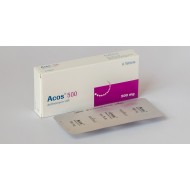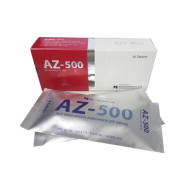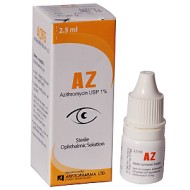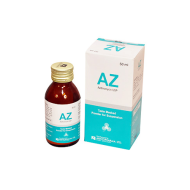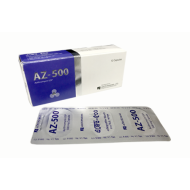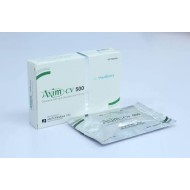
- Stock: In Stock
- Brand: Orion Pharma Limited
- Product ID: Azithromycin
Available Options
🔒 100% Secure Payment | bKash | Nagad | SSLCommerz | COD
⭐ Become a FREE Member: 7% Extra Savings • Free Delivery • Refill Reminders • Priority Support
Azalid 500 Tab (Azithromycin 500mg) — Clinical Overview
| Attribute | Details |
|---|---|
| Brand Name | Azalid 500 |
| Generic Name | Azithromycin |
| Strength | 500 mg |
| Dosage Form | Film-coated Tablet |
| Drug Class | Macrolide Antibiotic (Azalide) |
| Manufacturer | Orion Pharma Limited, Bangladesh |
| Route of Administration | Oral (with or without food) |
About Azalid 500 Tablet
Azalid 500 Tab contains azithromycin 500mg as a film-coated tablet, manufactured by Orion Pharma Limited, Bangladesh. Azithromycin is a member of the azalide subclass of macrolide antibiotics — a semisynthetic derivative of erythromycin with structurally enhanced properties including superior acid stability, greater tissue penetration, extended half-life of approximately 68 hours, and reduced gastrointestinal side effects compared to older macrolides. The 500mg strength represents the maximum single-unit oral dose of azithromycin used in Bangladesh clinical practice, appropriate for adult patients and adolescents meeting adult-weight criteria.
Because Azalid 500 is formulated as a film-coated tablet, it offers the flexibility to be taken with or without food — a significant practical advantage over capsule formulations. The coating also makes the tablet easier to swallow and masks any bitter taste of the active ingredient. Orion Pharma Limited, as a WHO-GMP certified manufacturer, ensures the product meets international quality standards for potency, dissolution, and bioavailability.
Azithromycin in Sexually Transmitted Infections (STIs)
Azalid 500 Tab plays an important role in STI management in Bangladesh. The primary STI indications include: Chlamydia trachomatis urogenital infection — azithromycin 1g single dose (two Azalid 500 tablets taken together at one time, on an empty stomach for best absorption) is the WHO first-line recommended treatment, achieving cure rates above 95% in uncomplicated infection; non-gonococcal urethritis and cervicitis — same 1g single dose regimen, or alternatively 500mg daily for 3 days; lymphogranuloma venereum (LGV) — azithromycin is an alternative to doxycycline for genital LGV; Mycoplasma genitalium urethritis — azithromycin extended regimen (500mg day 1, then 250mg daily for 4 days) may be used though resistance is increasing. For gonorrhoea, azithromycin is no longer used as monotherapy due to widespread resistance — current WHO guidance recommends ceftriaxone monotherapy for gonorrhoea; always follow current local STI guidelines.
Antibiotic Stewardship in STI Management
Responsible use of Azalid 500 Tab in STI management requires: (1) Confirmatory or presumptive diagnosis before treatment — treatment based on clinical presentation alone (syndromic management) is acceptable in settings where laboratory testing is unavailable, following national syndromic management guidelines. (2) Partner notification — all recent sexual partners of patients diagnosed with chlamydia or other STIs should be notified and offered testing and treatment; this is the most effective way to prevent reinfection and break transmission chains. (3) Test of cure — for chlamydia, test of cure is not routinely recommended after single-dose azithromycin treatment in uncomplicated infection, but may be appropriate in pregnancy or if symptoms persist. (4) Avoiding empirical use for non-STI indications without clinical justification. (5) Completing the full prescribed course — even if symptoms resolve early — as incomplete courses may not achieve full eradication and may contribute to resistance development.
Pharmacokinetics — Why a Single Dose Works for Some Infections
The ability of a single 1g azithromycin dose to cure Chlamydia trachomatis infection is a direct consequence of the drug's extraordinary pharmacokinetic properties. After a single 1g oral dose, azithromycin: achieves peak plasma concentrations within 2–3 hours; distributes extensively into tissues including the genital tract, cervix, uterus, fallopian tubes, and male urethra (concentrations 10–100 times higher than plasma); accumulates intracellularly in phagocytes that transport it to sites of infection; and maintains tissue concentrations above the MIC for Chlamydia (approximately 0.125 mg/L) for 7–10 days after a single dose. This pharmacodynamic coverage period is longer than the minimum treatment duration needed to eradicate Chlamydia from infected epithelial cells, explaining why a single well-dosed azithromycin dose can achieve high cure rates.
Renal Dosing and Geriatric Use
Azalid 500 Tab requires no dose adjustment in mild-to-moderate renal impairment (creatinine clearance above 10 mL/min) — only approximately 6% of the dose is excreted renally unchanged, with the remainder eliminated via biliary excretion. In severe renal impairment (CrCl below 10 mL/min), use with caution — limited pharmacokinetic data are available. No overall differences in safety or efficacy have been observed between elderly patients and younger adults, though elderly patients may have a higher likelihood of cardiac conditions that increase QT prolongation risk. Age-related reduction in hepatic clearance may result in slightly higher drug exposure in elderly patients with hepatic insufficiency. Dose adjustment in elderly patients is not routinely required based on age alone.
Frequently Asked Questions (FAQ)
Q1: Can I take both Azalid 500 tablets at the same time for a 1g single dose?
Yes — for indications requiring a 1g single dose (Chlamydia treatment, non-gonococcal urethritis), both 500mg tablets are taken together at the same time. For best absorption, take the 1g dose on an empty stomach (at least 1 hour before or 2 hours after food) — the single high dose produces the peak concentration needed for single-dose efficacy. Taking on an empty stomach is particularly important for the single-dose regimen, even though Azalid 500 Tablets can generally be taken with food for multi-day regimens.
Q2: How quickly does Azalid 500 Tab work for a chest infection?
Symptom improvement for community-acquired pneumonia and lower respiratory tract infections typically begins within 24–48 hours of the first dose. Complete resolution of symptoms, including full energy recovery, usually takes 5–10 days from the start of treatment, as tissue healing and immune clearance of bacterial debris continue after the organism has been eliminated. Azithromycin's long tissue half-life means the drug continues working for up to 7 days after the last tablet. If fever persists beyond 72 hours of starting Azalid 500 Tab, contact a physician — the infection may be caused by a resistant organism or require additional treatment.
Q3: Are there any foods that interact with Azalid 500 Tab?
Film-coated azithromycin tablets like Azalid 500 Tab can be taken with food without significantly reducing absorption — this distinguishes them from capsule formulations. There are no specific foods that cause major interactions. However, antacids containing aluminium or magnesium (e.g., antacid suspensions) should be taken at least 2 hours apart from Azalid 500 Tab as they can reduce the peak plasma concentration (Cmax) by approximately 24%. Grapefruit and grapefruit juice do not significantly interact with azithromycin (unlike their interactions with some other drugs).
Q4: Can Azalid 500 Tab cause permanent hearing loss?
Hearing loss (including tinnitus, hearing impairment, and deafness) has been rarely reported with azithromycin, primarily with prolonged high-dose use rather than standard short courses. In most reported cases, the hearing loss was reversible upon discontinuation. Standard 3-day or 5-day courses at therapeutic doses carry very low risk of hearing adverse effects. If you notice any new ringing in the ears, difficulty hearing, or vertigo during a course of Azalid 500 Tab, inform your physician promptly. The risk is higher with long-term prophylactic azithromycin use (e.g., for COPD prophylaxis), where periodic audiometry monitoring is recommended.
Medical Disclaimer: Azalid 500 Tab is a prescription antibiotic. This information is provided for educational reference only. STI diagnosis and treatment should be managed by a qualified healthcare professional. Antibiotic resistance is a global emergency — use antibiotics only when clinically indicated and as prescribed.