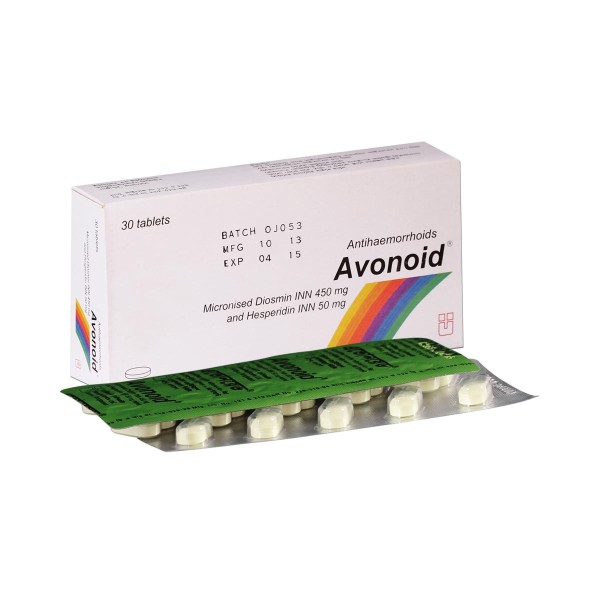
- Stock: In Stock
- Brand: Unimed Unihealth MFG. Ltd.
- Product ID: Micronised Diosmin + Hesperidin
🔒 100% Secure Payment | bKash | Nagad | SSLCommerz | COD
⭐ Become a FREE Member: 7% Extra Savings • Free Delivery • Refill Reminders • Priority Support
Product Overview
| Brand Name | AVONOID Tablet |
|---|---|
| Generic Name | Diosmin 450 mg + Hesperidin 50 mg (Micronised Purified Flavonoid Fraction) |
| Manufacturer | ACI Limited, Bangladesh |
| Strength | Diosmin 450 mg + Hesperidin 50 mg per tablet |
| Dosage Form | Tablet |
| Therapeutic Class | Venotonic / Phlebotonic — Micronised Purified Flavonoid Fraction (MPFF) |
| MRP (Bangladesh) | ৳8.00 per tablet |
| Prescription Status | Physician guidance recommended |
AVONOID for Haemorrhoid Management
AVONOID Tablet is a micronised purified flavonoid fraction (MPFF) manufactured by ACI Limited, Bangladesh, containing Diosmin 450 mg and Hesperidin 50 mg per tablet. It is widely used in clinical practice for the management of haemorrhoidal disease — one of the most common anorectal conditions affecting adults in Bangladesh. Haemorrhoids (piles) occur when the venous plexuses of the anal canal become engorged, prolapsed, or thrombosed, resulting in bleeding, prolapse, pain, and pruritus. The pathophysiology of haemorrhoids shares elements with chronic venous insufficiency — venous hypertension, increased capillary permeability, endothelial inflammation, and connective tissue laxity. MPFF targets these mechanisms pharmacologically, providing both symptomatic relief in acute haemorrhoidal episodes and long-term protection against recurrence. In patients with diabetes, where constipation from autonomic neuropathy and prolonged straining may exacerbate haemorrhoidal disease, AVONOID offers a safe and effective non-operative treatment option.
Mechanism of Action in Haemorrhoidal Disease
Haemorrhoidal disease is fundamentally a disorder of the venous and microvascular structures of the anal cushions. Increased venous pressure — from straining, constipation, pregnancy, or prolonged sitting — leads to venous dilation, impaired venous return, and haemorrhoidal engorgement. Inflammation within the haemorrhoidal tissue, mediated by prostaglandins, cytokines, and leukocyte adhesion, drives the symptoms of pain, burning, and oedema. AVONOID (MPFF) addresses haemorrhoidal disease through its complementary venotonic and anti-inflammatory actions: it normalises venous tone and reduces venous distensibility in the haemorrhoidal plexus; inhibits prostaglandin E2 and thromboxane B2 synthesis, reducing local inflammation; decreases endothelial expression of adhesion molecules, limiting leukocyte recruitment and the inflammatory cascade; and improves capillary resistance, reducing anorectal mucosal bleeding tendency. Clinical trials have demonstrated that MPFF significantly reduces the duration and severity of acute haemorrhoidal attacks, reduces rectal bleeding, and decreases the risk of recurrence when used as maintenance therapy.
Clinical Evidence in Haemorrhoid Treatment
AVONOID (MPFF) has a robust evidence base for haemorrhoidal disease supported by multiple randomised controlled trials. A Cochrane systematic review of flavonoid treatment in haemorrhoids found that MPFF significantly reduces the risk of bleeding (by approximately 67%), the risk of persistent symptoms (by 47%), and the overall risk of complication and surgical intervention (by 35%) compared to placebo or no treatment. The MPFF label in haemorrhoids includes both acute attack management and long-term prophylaxis against recurrence. For acute haemorrhoidal attacks, high-dose MPFF (3 g/day for 4 days, then 2 g/day for 3 days) rapidly controls bleeding and reduces symptoms within the first week. For maintenance, 2 tablets (1 g MPFF) daily has been shown to reduce recurrence rates. MPFF is the only orally administered pharmacological agent with evidence-based guideline endorsement (European Society of Coloproctology, International Consultation on Urological Diseases) for haemorrhoidal disease management.
Dosage: Acute Attack and Maintenance
For acute haemorrhoidal episodes in adults, the recommended dosing protocol is three tablets (Diosmin 1350 mg + Hesperidin 150 mg) twice daily (morning and evening) for the first four days, then two tablets twice daily for the subsequent three days — completing a 7-day acute course. For long-term maintenance and prevention of recurrence, the maintenance dose is two tablets (Diosmin 900 mg + Hesperidin 100 mg) once daily with the main meal. In diabetic patients prone to constipation — which is both a cause and an aggravating factor for haemorrhoids — concurrent management of constipation with dietary fibre, adequate hydration, and if needed lactulose, is essential alongside AVONOID therapy. Tablets should be taken whole with water at mealtimes.
Haemorrhoids and Diabetes: A Compounding Risk
Diabetes mellitus increases the risk and severity of haemorrhoidal disease through several mechanisms. Autonomic neuropathy reduces the sensitivity of the anorectum, causing patients to strain more forcefully and ignore early straining signals — increasing haemorrhoidal pressure. Colonic dysmotility from enteric neuropathy results in chronic constipation and hard stools, directly increasing intra-haemorrhoidal pressure during defecation. Peripheral vascular disease in diabetes impairs the microvasculature of the anal cushions, reducing tissue integrity and healing capacity. Diabetic patients also have impaired wound healing — making surgical haemorrhoidectomy higher risk — which further reinforces the value of effective non-operative pharmacological management with MPFF to delay or avoid surgery. Furthermore, rectal bleeding in a diabetic patient must be thoroughly evaluated to exclude colorectal pathology before attributing it solely to haemorrhoids.
Adverse Effects and Safety in Diabetic Patients
AVONOID (MPFF) is among the best-tolerated pharmacological agents in its class. The most common adverse effects reported in clinical trials are mild gastrointestinal symptoms — nausea, dyspepsia, or soft stools — occurring in fewer than 5% of patients and resolving with continued use or dose timing adjustment. MPFF has no significant effects on blood glucose, insulin sensitivity, or lipid profiles at standard doses, making it safe in patients with diabetes. It does not interact with metformin, insulin, sulfonylureas, DPP-4 inhibitors, SGLT-2 inhibitors, or common antihypertensives. It does not affect coagulation at therapeutic doses, making it safe in patients on antiplatelet therapy or anticoagulants — though the theoretical platelet-modulating effects of very high-dose flavonoids should prompt awareness. MPFF is well tolerated in elderly diabetic patients without dose adjustment.
Storage
Store AVONOID Tablets at room temperature below 30°C, protected from moisture, heat, and direct sunlight. Keep out of reach of children. Do not use after the printed expiry date.
Frequently Asked Questions (FAQ)
Q1: How quickly does AVONOID work for acute haemorrhoid (piles) attacks?
A: In acute haemorrhoidal attacks, clinical trials show that high-dose MPFF (3 g/day for 4 days) significantly reduces bleeding, pain, and swelling within the first 3–4 days of treatment. Most patients experience noticeable relief within one week of starting the acute treatment course.
Q2: Can AVONOID replace surgery for haemorrhoids?
A: For grade I–III haemorrhoids without complications, MPFF can effectively manage symptoms and reduce recurrence, potentially avoiding or deferring surgery. For grade IV haemorrhoids or those with prolapse requiring manual reduction, surgical or procedural intervention is generally required. Your surgeon or gastroenterologist can advise on the appropriate treatment.
Q3: Is AVONOID safe for diabetic patients with haemorrhoids?
A: Yes. MPFF has no clinically significant interactions with antidiabetic medications or antihypertensives. It does not affect blood glucose. Diabetic patients are particularly good candidates for AVONOID therapy given the higher risks of surgical haemorrhoidectomy in this population due to impaired wound healing.
Q4: Do I need a prescription for AVONOID?
A: AVONOID (MPFF) is available without a prescription in Bangladesh, though physician guidance is recommended — particularly for accurate diagnosis (to exclude other causes of rectal bleeding), appropriate dose selection for acute versus chronic management, and to coordinate with other aspects of diabetes care.
Medical Disclaimer: This information is provided for educational purposes only. Rectal bleeding should always be medically evaluated before self-treating. Always consult a physician or pharmacist before starting any new medication. DiabetesStore.com.bd does not assume liability for clinical decisions made based on this content.