- Stock: Pre-Order
- Brand: Aristopharma
- Product ID: Ceftriaxone
🔒 100% Secure Payment | bKash | Nagad | SSLCommerz | COD
⭐ Become a FREE Member: 7% Extra Savings • Free Delivery • Refill Reminders • Priority Support
This Item is for pre order
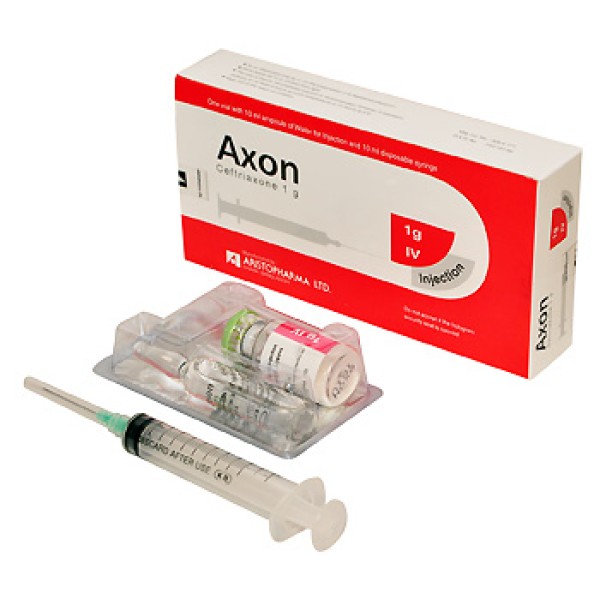
Axon 1 gm Injection (Ceftriaxone 1 g) — Clinical Overview
| Brand Name | Axon 1 gm Injection |
|---|---|
| Generic Name | Ceftriaxone Sodium |
| Manufacturer | ACI Limited, Bangladesh |
| Strength | 1 g (1000 mg) per vial |
| Dosage Form | Powder for Injection (IV/IM) |
| Drug Class | Third-Generation Cephalosporin Antibiotic |
| Administration | Intravenous (IV) or Intramuscular (IM) |
| Dosing Frequency | Once Daily (most indications) |
About Axon 1 gm Injection
Axon 1 gm Injection is the standard adult dose formulation of ceftriaxone sodium manufactured by ACI Limited, Bangladesh. At 1 g once daily via IV or IM, ceftriaxone achieves plasma concentrations that remain above the minimum inhibitory concentration (MIC) for the vast majority of susceptible pathogens throughout the 24-hour dosing interval. This is the most commonly prescribed strength of ceftriaxone in Bangladesh for adult patients with moderate-to-severe bacterial infections across all major infection sites.
The 1 g vial is routinely stocked in Bangladeshi hospitals, clinics, and pharmacies, serving as the cornerstone of empirical parenteral antibiotic therapy for community-acquired infections — from typhoid fever and complicated UTI to community-acquired pneumonia, skin and soft tissue infections, and critically, diabetic foot infections (DFI). At Diabetes Store, Axon 1 gm Injection is among the most relevant injectable antibiotics for patients with diabetes who develop serious infections requiring hospitalisation or outpatient parenteral therapy.
Mechanism and Pharmacokinetics
Ceftriaxone exerts bactericidal activity by inhibiting bacterial cell wall synthesis through irreversible binding to penicillin-binding proteins (PBPs 1a, 1b, 2, 3). Its pharmacokinetic profile makes it uniquely convenient for serious infection management:
- Half-life: 6–9 hours (longest of all commonly used beta-lactams), enabling once-daily dosing for most indications — critical for outpatient parenteral therapy programmes
- Volume of distribution: 5.8–13.5 L; excellent penetration into most tissues including lungs, bile, bone, joint fluid, and skin
- CSF penetration: Excellent — achieves therapeutic levels in cerebrospinal fluid when meninges are inflamed; enabling treatment of bacterial meningitis
- Protein binding: 83–96% (albumin-bound); displaces bilirubin — significant in neonates, avoid in jaundiced newborns
- Excretion: Dual — 40–67% renal (unchanged), 33–67% biliary; no dose adjustment needed until severe combined renal and hepatic failure
Primary Indications at 1 g Once Daily
- Community-acquired pneumonia (CAP): Standard empirical parenteral coverage for adults; combined with azithromycin for atypical coverage in severe CAP
- Enteric fever (typhoid, paratyphoid): 1 g once daily IV for 10–14 days — first-line parenteral treatment in Bangladesh; superior to chloramphenicol and ampicillin for MDR typhoid
- Complicated UTI and pyelonephritis: Once-daily IV/IM effective for gram-negative uropathogens (E. coli, Klebsiella) pending culture; step down to oral fluoroquinolone if sensitive
- Diabetic foot infection (DFI, moderate-severe): Covers gram-positive (MSSA) and gram-negative organisms in polymicrobial DFI; combined with metronidazole for anaerobic cover and vancomycin/linezolid if MRSA suspected
- Septicaemia: Broad empirical cover pending blood cultures; highly effective for gram-negative bacteraemia from urinary, biliary, or soft tissue sources
- Bacterial meningitis (prophylaxis and non-pneumococcal): 2 g (two vials) once or twice daily preferred for treatment; 1 g for close-contact prophylaxis (H. influenzae, N. meningitidis)
- Bone and joint infections (osteomyelitis): Long-course IV/IM therapy for gram-negative osteomyelitis; particularly relevant for diabetic foot osteomyelitis
Diabetic Foot Infection — Key Role of Ceftriaxone
Diabetic foot infection is the leading cause of non-traumatic lower limb amputation in Bangladesh. The microbiology of DFI is typically polymicrobial, with ceftriaxone covering the aerobic gram-positive and gram-negative component of the infection:
- Mild DFI: oral antibiotics (amoxiclav, clindamycin) — Axon 1 gm IV not required
- Moderate DFI: Axon 1 gm IV/IM once daily + metronidazole 500 mg IV TID — standard regimen
- Severe DFI / limb-threatening: Axon 1 gm IV + metronidazole + antipseudomonal cover (piperacillin-tazobactam) ± vancomycin for MRSA risk
- Diabetic foot osteomyelitis: IV ceftriaxone for 4–6 weeks may achieve cure without amputation in selected cases
Dosage and Administration
- Standard adult dose: 1 g IV or IM once daily
- Severe infections (meningitis, endocarditis): 2–4 g/day in 1–2 divided doses
- Reconstitution (IM): Dissolve 1 g in 3.5 ml of 1% lidocaine; administer deep IM
- Reconstitution (IV push): Dissolve in 10 ml sterile water; give over 2–4 minutes
- IV infusion: Dilute in 50–100 ml NS or D5W; infuse over 30 minutes
- Critical incompatibility: NEVER mix or co-infuse with calcium-containing solutions — ceftriaxone-calcium precipitates can occlude IV lines and cause embolism
Frequently Asked Questions (FAQ)
Why is ceftriaxone 1 g given only once daily?
Ceftriaxone has an exceptionally long plasma half-life of 6–9 hours compared to most other beta-lactam antibiotics (which have half-lives of 1–2 hours). This allows plasma concentrations to remain above the minimum inhibitory concentration (MIC) for susceptible organisms throughout a 24-hour interval at the 1 g dose. Once-daily dosing also simplifies antibiotic administration, enables outpatient parenteral therapy programmes, and reduces nursing workload — a major operational advantage in Bangladesh's busy clinical settings.
Is Axon 1 gm injection used for diabetic foot infections?
Yes — ceftriaxone 1 g once daily is a core component of the parenteral antibiotic regimen for moderate-to-severe diabetic foot infections. It covers the gram-negative (E. coli, Klebsiella, Proteus) and gram-positive (Streptococcus, MSSA Staphylococcus) organisms typically involved. For complete polymicrobial coverage, ceftriaxone is usually combined with metronidazole (for anaerobic bacteria) and, in high-risk settings, an antibiotic covering MRSA and Pseudomonas aeruginosa. For diabetic foot osteomyelitis, prolonged IV ceftriaxone therapy may enable limb salvage.
What is the difference between Axon 1gm IV and Axon IM 1gm?
Both contain the same drug (ceftriaxone sodium 1 g) and can be given either IV or IM after reconstitution. The distinction in product naming reflects the intended primary route of administration and reconstitution instructions — IM formulations are reconstituted with lidocaine solution to reduce injection pain. The antibiotic content and clinical efficacy are identical regardless of whether IV or IM administration is used.
How does ceftriaxone interact with diabetes medications?
Ceftriaxone has no pharmacokinetic or pharmacodynamic interactions with antidiabetic medications. It does not affect insulin secretion, insulin sensitivity, or the metabolism of metformin, sulphonylureas, DPP-4 inhibitors, SGLT-2 inhibitors, or GLP-1 receptor agonists. The most clinically important interaction in diabetic patients is indirect: effective antibiotic therapy reduces the hyperglycaemia caused by active infection, so blood glucose and insulin requirements typically fall as the infection is controlled. Monitor blood glucose closely and reduce insulin doses proactively to prevent hypoglycaemia during recovery.