- Stock: Out Of Stock
- Brand: Beximco Pharmaceutical
- Product ID: Amoxicillin + Clavulanic Acid
Available Options
🔒 100% Secure Payment | bKash | Nagad | SSLCommerz | COD
⭐ Become a FREE Member: 7% Extra Savings • Free Delivery • Refill Reminders • Priority Support
This Item is for pre order
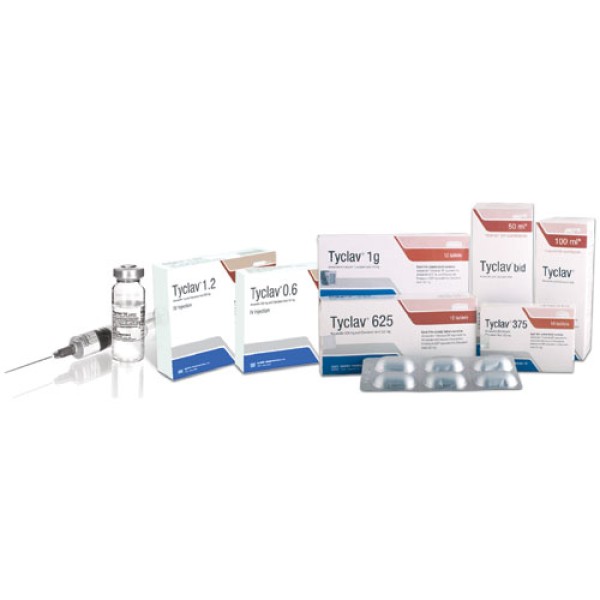
Tyclav Suspension 156.25mg/5ml — Co-Amoxiclav Oral Suspension | Beximco Pharmaceuticals
| Generic Names | Amoxicillin Trihydrate 125 mg + Potassium Clavulanate 31.25 mg per 5 ml |
| Concentration | 156.25 mg total co-amoxiclav per 5 ml (125mg amoxicillin + 31.25mg clavulanate) |
| Dosage Form | Powder for Oral Suspension (reconstituted to 100ml bottle) |
| Pack Size | 100 ml bottle (after reconstitution) |
| Manufacturer | Beximco Pharmaceuticals Ltd. |
| Therapeutic Class | Beta-Lactamase Protected Aminopenicillin (Co-amoxiclav) — Oral Suspension |
| Brand Equivalent | Augmentin SF Suspension / Augmentin 156.25 Suspension (GSK) — same formulation |
| Dosing Schedule | Three times daily (TDS, q8h) — standard suspension |
Overview
Tyclav Suspension is Beximco's oral co-amoxiclav in liquid form — Amoxicillin 125mg + Clavulanic Acid 31.25mg per 5ml — designed for children and adults who cannot swallow tablets. This is the standard-strength co-amoxiclav suspension (156.25mg/5ml), equivalent to Augmentin SF suspension globally. Supplied as a dry powder that is reconstituted with water to form a palatable suspension. Provides the same beta-lactamase-protected broad-spectrum coverage as Tyclav tablets, scaled to weight-based paediatric dosing. A separate BID (twice-daily) suspension — Tyclav BID Suspension — is also available for twice-daily dosing convenience.
Reconstitution Instructions
- Tap the bottle gently to loosen the powder
- Add cooled boiled water to the bottle in two equal portions, shaking well after each addition
- Add water up to the calibration mark (to make 100ml total)
- Shake vigorously until fully dissolved
- Label with date of reconstitution
- Discard after 7 days — do not use beyond 1 week of reconstitution
- Store in refrigerator (2–8°C) after reconstitution; shake well before each use
Indications
- Acute Otitis Media (Ear Infection) — treatment failure after plain amoxicillin; the most common paediatric indication
- Acute Sinusitis — persistent or severe bacterial sinusitis
- Lower Respiratory Tract Infections — community-acquired pneumonia, AECB in children
- Tonsillitis / Pharyngitis — beta-lactamase-producing organisms
- Skin & Soft Tissue Infections — impetigo, wound infections, cellulitis
- Urinary Tract Infections — resistant organisms
- Dental Infections
- Animal Bite Wounds
Paediatric Dosage Guide
| Age / Weight | Dose (as Amoxicillin component) | Volume (156.25mg/5ml) | Frequency |
|---|---|---|---|
| Under 1 year (<10kg) | 20–40 mg/kg/day ÷ 3 doses | Calculated by weight | Three times daily (TDS) |
| 1–6 years (10–20kg) | 125 mg per dose | 5 ml (1 teaspoon) TDS | Three times daily |
| 6–12 years (20–40kg) | 250 mg per dose | 10 ml (2 teaspoons) TDS | Three times daily |
| Over 12 years / Adults | 500 mg per dose | 20 ml TDS (or switch to tablets) | Three times daily |
Note: Doses should be calculated accurately by weight in children under 40kg. Do not exceed adult dose. Use the measuring syringe or spoon provided. Administer with or at the start of a meal to reduce GI side effects.
Adult Dosage
Adults who cannot swallow tablets: 20ml (= 500mg amoxicillin + 125mg clavulanate) three times daily — equivalent to Tyclav 625mg tablets TDS. Switch to tablets as soon as able to swallow.
Special Note for Diabetic Patients
Tyclav suspension contains sucrose as a suspending agent — diabetic patients should be aware of the sugar content. For diabetics managing glycaemic control closely, the sugar load from a full adult dose (20ml TDS) should be factored into dietary intake. Where possible, diabetic adult patients should use Tyclav tablets (sugar-free) instead of suspension. For paediatric diabetics, the dose is small relative to total carbohydrate intake and is generally well tolerated, but blood glucose monitoring is advisable during antibiotic courses. Contains no glucose-raising pharmacological agents — the antibiotic components (amoxicillin, clavulanate) have no glycaemic effect.
Side Effects
- GI (common): Diarrhoea, nausea, vomiting — more common than with plain amoxicillin suspension; give with food
- Skin: Rash, urticaria
- Hypersensitivity: Anaphylaxis (rare); do not give if penicillin-allergic
- Hepatic: Rare cholestatic hepatitis — monitor in prolonged treatment
- Superinfection: Oral candidiasis — more common in infants; consider antifungal if needed
Storage
Dry powder: Store below 25°C. Reconstituted suspension: Refrigerate (2–8°C). Use within 7 days of reconstitution. Shake well before each dose. Do not freeze. Keep out of reach of children.
FAQ
Q1: How is Tyclav Suspension different from Tyclav BID Suspension?
Tyclav Suspension (this product) contains 125mg amoxicillin + 31.25mg clavulanate per 5ml (= 156.25mg/5ml) and is given three times daily (TDS/q8h). Tyclav BID Suspension contains 200mg amoxicillin + 28.5mg clavulanate per 5ml (= 228.5mg/5ml) and is given twice daily (BD/q12h). The BID formulation offers dosing convenience and is often preferred for compliance. Both are appropriate co-amoxiclav choices — the doctor selects based on the required dose and dosing frequency preference.
Q2: How long can I keep the reconstituted Tyclav suspension?
Only 7 days after reconstitution, even if refrigerated. After this period, the antibiotic degrades and the suspension must be discarded. Always write the reconstitution date on the bottle label. Never use suspension beyond 7 days.
Q3: My child spat out a dose. Should I give another?
If the child spat out or vomited within 15–20 minutes of a dose, give the full dose again. If more than 20 minutes have passed since the dose, skip and continue with the next scheduled dose at the normal time — do not double up.
Q4: Can Tyclav suspension be taken without food?
It can be given without food, but taking it at the start of a meal significantly reduces the diarrhoea and nausea associated with clavulanate. For young children, mix the dose into a small amount of milk, formula, or juice immediately before giving — do not mix a full day's supply in advance.
Medical Disclaimer: Paediatric antibiotic dosing must be verified by a qualified physician or pharmacist based on the child's current weight and indication. Prescription required. Complete the full prescribed course.