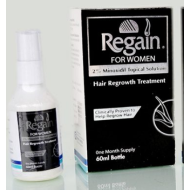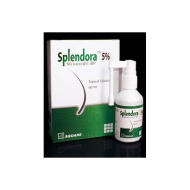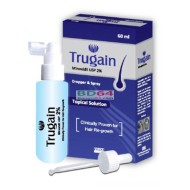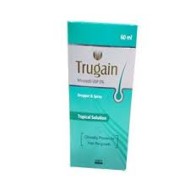
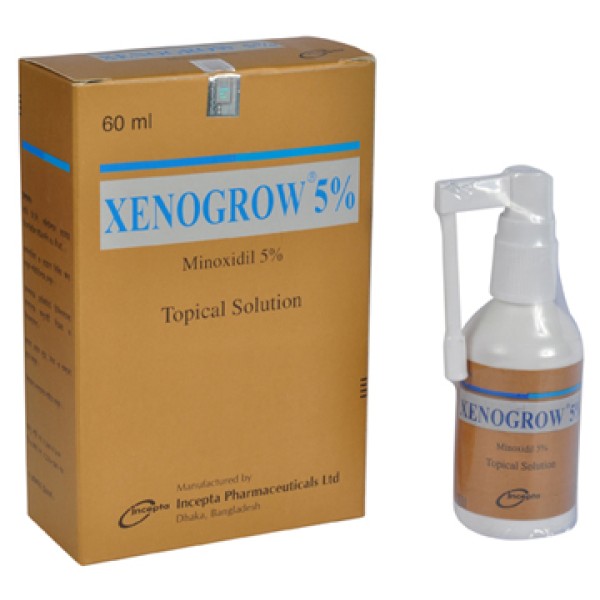
- Stock: In Stock
- Brand: Incepta Pharmaceuticals
- Product ID: Minoxidil
Available Options
🔒 100% Secure Payment | bKash | Nagad | SSLCommerz | COD
⭐ Become a FREE Member: 7% Extra Savings • Free Delivery • Refill Reminders • Priority Support
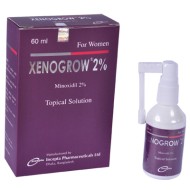
Xenogrow 5% Solution — Minoxidil 5% | Beximco Pharmaceuticals
| Generic Name | Minoxidil 5% w/v |
| Dosage Form | Topical Solution |
| Drug Class | Topical Vasodilator / Hair Growth Stimulant |
| Manufacturer | Beximco Pharmaceuticals Ltd. |
| Prescription Status | Available OTC; medical consultation recommended for best outcomes |
| Application Site | Scalp only — never oral, never on other body areas |
Overview
Xenogrow 5% Solution contains Minoxidil 5% — the gold-standard topical treatment for androgenetic alopecia (male-pattern and female-pattern hair loss) and one of only two treatments approved by major regulatory bodies worldwide for hair loss. Originally developed as an oral antihypertensive drug, minoxidil was found to have potent hair growth-stimulating properties. In topical form, minoxidil promotes hair regrowth by prolonging the anagen (growth) phase of the hair cycle and increasing follicle size. The 5% concentration is the standard strength for men; it is also used for women with significant hair loss under medical supervision. Clinical trials show that approximately 60% of men using 5% minoxidil twice daily achieve moderate to dense regrowth after 48 weeks.
Mechanism of Action
Minoxidil is a potassium channel opener — it opens KATP channels in vascular smooth muscle of scalp blood vessels, causing vasodilation and increased blood flow to hair follicles. This enhances delivery of oxygen, nutrients, and growth factors to miniaturised follicles. Additionally, minoxidil directly stimulates hair follicle epithelial cells via prostaglandin E2 upregulation and activation of beta-catenin signalling — promoting proliferation of dermal papilla cells and prolonging the anagen growth phase while shortening telogen (resting phase). Miniaturised (thinning) follicles gradually enlarge and produce thicker, pigmented terminal hairs.
Indications
- Androgenetic Alopecia (AGA) — male-pattern baldness (vertex and mid-scalp) in men; female-pattern hair loss in women
- Alopecia Areata — off-label use to promote regrowth in patchy hair loss (usually combined with other treatments)
- Chemotherapy-induced alopecia — off-label; may accelerate regrowth post-chemotherapy
- Eyebrow and beard enhancement — off-label use in clinical practice
Dosage and Application
| Parameter | Instructions |
|---|---|
| Dose | 1 mL (approximately 20 drops or half a capful) applied twice daily |
| Application site | Directly onto the scalp at the area of thinning/hair loss |
| Hair condition | Apply to dry or slightly damp scalp — not to wet hair |
| Post-application | Wash hands thoroughly immediately after application |
| Absorption time | Allow 4 hours minimum before washing hair or swimming |
| Minimum trial period | 4–6 months of consistent twice-daily use before assessing efficacy |
| Maintenance | Continue indefinitely — hair loss resumes within 3–4 months of stopping |
Important Note for Diabetic Patients
Hair loss in people with diabetes has multiple causes beyond simple androgenetic alopecia — poor glycaemic control, thyroid dysfunction (common in diabetes), nutritional deficiencies (zinc, biotin, iron, B12), medications (metformin can cause B12 depletion), and stress-related telogen effluvium. Before starting minoxidil, diabetic patients should:
- Assess HbA1c and glycaemic control — poorly controlled diabetes causes diffuse telogen effluvium and accelerates AGA; improving glycaemic control may itself help hair health
- Screen for thyroid dysfunction — hypothyroidism (common in type 2 diabetes) is a major reversible cause of hair loss; treat hypothyroidism first
- Check B12 levels — metformin users are at significant risk of B12 deficiency which causes diffuse hair thinning
- Check ferritin and iron — iron deficiency anaemia, more common in diabetic women, causes significant hair shedding
- Scalp integrity — diabetic patients with peripheral neuropathy may not detect skin irritation from minoxidil — inspect the scalp regularly for redness, scaling, or irritation
- Systemic absorption note — though topical, minoxidil can be absorbed systemically in small amounts — if you are on antihypertensive medication, monitor blood pressure when starting minoxidil
Side Effects
| Side Effect | Frequency | Notes |
|---|---|---|
| Initial shedding (telogen effluvium) | Very common (first 2–8 weeks) | Normal — follicles resetting; do NOT stop treatment |
| Scalp itching, dryness, flaking | Common | Often due to propylene glycol base; try foam formulation |
| Contact dermatitis | Uncommon | Discontinue if severe redness or rash develops |
| Unwanted facial hair growth | Uncommon (more common in women) | Due to transfer from hands/pillow; wash hands, change pillowcase |
| Systemic hypotension, tachycardia | Rare (significant systemic absorption) | Risk higher with large application areas or broken skin |
| Headache, dizziness | Rare | Reduce to once-daily if persistent |
Contraindications
- Hypersensitivity to minoxidil or any component (propylene glycol)
- Application to irritated, sunburned, or broken scalp skin
- Patients on oral minoxidil simultaneously
- Pregnancy and breastfeeding (safety not established)
- Children under 18 years (unless specifically directed by dermatologist)
Important Instructions
- Never take orally — topical minoxidil solution is not formulated for oral ingestion; oral minoxidil is a different formulation at much lower doses requiring medical supervision
- Avoid eyes and mucous membranes — rinse thoroughly with water if accidental contact occurs
- Results take time — expect no visible result for 3–4 months; full assessment at 6 months
- Stopping treatment — hair regained will be lost within 3–4 months of stopping; minoxidil maintains but does not permanently cure androgenetic alopecia
Storage
Store below 25°C. Keep away from heat and open flames — solution contains alcohol (flammable). Keep out of reach of children. Do not freeze.
FAQ
Q: Will the initial shedding mean the product is not working?
No — initial shedding (increased hair fall for the first 2–8 weeks) is a sign that minoxidil is working. Resting (telogen) hairs are shed to make way for new anagen (growing) hairs. This shedding phase is temporary and typically resolves by week 8–12. Many patients mistakenly discontinue at this stage — this is the most critical mistake in minoxidil therapy. Persist through the shedding phase and assess results at 4–6 months.
Q: I am diabetic and losing hair — is minoxidil the right first step?
Not necessarily. Hair loss in diabetic patients is often multifactorial. Before starting minoxidil, rule out reversible causes: poor glycaemic control, hypothyroidism, B12 deficiency (especially if on metformin), iron deficiency anaemia, and telogen effluvium from illness or stress. Consult a dermatologist or endocrinologist — treating the underlying cause may restore hair without the need for minoxidil. Minoxidil is most effective for true androgenetic pattern loss (vertex thinning, receding temples in men; diffuse crown thinning in women).
Q: Is it safe to use 5% minoxidil as a woman?
The 2% solution is the licensed strength for women in many countries; the 5% solution is used off-label in women under medical supervision and has been shown to be more effective in clinical trials. Use of 5% minoxidil in women carries a higher risk of unwanted facial hair growth due to transfer (from hands to face). Consult a dermatologist who can advise on the appropriate concentration and guide application technique to minimise side effects.
Medical Disclaimer: This information is for educational purposes only and does not constitute medical advice. Hair loss has multiple causes — consult a dermatologist before starting treatment to ensure the correct diagnosis. Diabetic patients should have reversible causes of hair loss (thyroid, B12, iron, glycaemic control) assessed prior to initiating minoxidil.