- Stock: Out Of Stock
- Brand: Acme Laboratories Limited
- Product ID: Cloxacillin Sodium
🔒 100% Secure Payment | bKash | Nagad | SSLCommerz | COD
⭐ Become a FREE Member: 7% Extra Savings • Free Delivery • Refill Reminders • Priority Support
This Item is for pre order
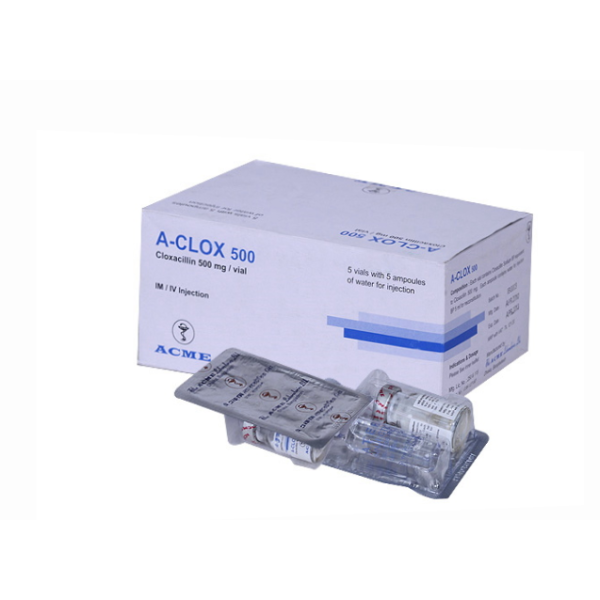
A-Clox 500mg/Vial Injection — Cloxacillin Sodium | Beximco Pharmaceuticals
| Generic Name | Cloxacillin Sodium 500mg |
| Drug Class | Penicillinase-Resistant Penicillin (Beta-Lactam Antibiotic) |
| Manufacturer | Beximco Pharmaceuticals Ltd. |
| Route | Injection (IM / IV) |
| Prescription Status | Prescription Required — Hospital/Clinical Use |
Overview
A-Clox 500mg Injection contains Cloxacillin Sodium — a narrow-spectrum, penicillinase-resistant (beta-lactamase-stable) penicillin antibiotic. It is specifically designed to treat infections caused by beta-lactamase-producing (penicillinase-producing) Staphylococcus aureus (MSSA — methicillin-sensitive S. aureus) that are resistant to ordinary penicillins (amoxicillin, ampicillin). Cloxacillin is a critical antibiotic for diabetic patients, who are at significantly elevated risk of staphylococcal skin, soft tissue, bone, and joint infections including diabetic foot osteomyelitis.
Mechanism of Action
Cloxacillin is a beta-lactam antibiotic that binds to Penicillin-Binding Proteins (PBPs) on bacterial cell walls, inhibiting transpeptidase-catalysed peptidoglycan cross-linking — ultimately causing cell wall lysis and bacterial death (bactericidal). Its key property is resistance to staphylococcal beta-lactamase (penicillinase): the isoxazolyl side chain sterically protects the beta-lactam ring from enzymatic hydrolysis. This makes cloxacillin effective against MSSA strains that would inactivate ordinary penicillins.
Spectrum of Activity
| Organism | Coverage |
|---|---|
| Staphylococcus aureus (MSSA) | Primary target — excellent activity |
| Staphylococcus epidermidis (MSSE) | Good activity |
| Streptococcus pyogenes (Group A Strep) | Good activity |
| Streptococcus pneumoniae | Moderate |
| MRSA (Methicillin-Resistant S. aureus) | NOT covered — requires vancomycin/linezolid |
| Gram-negative organisms | NOT covered (narrow spectrum) |
Indications
- Skin and soft tissue infections — cellulitis, impetigo, abscesses caused by MSSA
- Diabetic foot infections — mild-to-moderate MSSA-predominant (in combination regimens for severe/polymicrobial infections)
- Bone and joint infections — osteomyelitis, septic arthritis (MSSA)
- Post-surgical wound infections
- Endocarditis (MSSA) — usually with IV gentamicin
- Pneumonia (MSSA — rare, but severe)
Dosage
| Indication | Dose | Route | Frequency |
|---|---|---|---|
| Mild-moderate skin/soft tissue | 500mg | IM or IV | Every 6 hours |
| Severe infection / osteomyelitis | 1–2g | IV | Every 4–6 hours |
| Endocarditis (MSSA) | 2g IV | IV (slow infusion) | Every 4 hours |
| Children (body weight-based) | 25–50mg/kg/day | IM or IV | Divided every 6 hours |
Reconstitute powder with Water for Injection per label instructions. Administer IM injection deep into gluteal muscle. For IV use, dilute in compatible fluid (NS or D5W) and infuse slowly. Give on an empty stomach if switching to oral (oral cloxacillin is best absorbed fasting).
Critical Diabetic Patient Information
- Diabetic foot — leading indication: Diabetic foot ulcers are the most common reason for lower limb amputation. MSSA is a dominant pathogen in diabetic foot infections. Cloxacillin injection is a key antibiotic for moderate-to-severe MSSA-driven diabetic foot infection, often combined with metronidazole (anaerobic cover) ± gram-negative agents (gentamicin, ciprofloxacin)
- Glycaemic control during infection: Active bacterial infection causes stress hyperglycaemia — blood glucose often spikes 30–50% above baseline during systemic infection. Increase glucose monitoring frequency to every 4–6 hours in hospitalised diabetic patients on IV antibiotics
- MRSA risk — critical distinction: In Bangladesh, community-acquired MRSA rates are increasing. If a patient fails to respond to cloxacillin within 48–72 hours, or has risk factors for MRSA (prior hospitalisation, prior antibiotic use, nasal carrier, healthcare worker), MRSA must be suspected and vancomycin initiated pending cultures
- Renal dosing: Cloxacillin is primarily biliary-excreted; no dose adjustment needed for CKD alone. However, in diabetic patients with severe renal impairment (eGFR <10), use cautiously
Side Effects
| System | Side Effect | Severity |
|---|---|---|
| Hypersensitivity | Rash, urticaria, anaphylaxis (cross-reactive with all penicillins) | Common (rash) — Rare (anaphylaxis — Serious) |
| Hepatic | Elevated liver enzymes, cholestatic jaundice (especially prolonged IV) | Uncommon — monitor LFTs in long courses |
| GI | Nausea, diarrhoea (mainly oral form; injection less so) | Common — Mild |
| Haematological | Neutropenia, eosinophilia (prolonged courses) | Uncommon — monitor FBC |
| Local | Pain at IM injection site, thrombophlebitis (IV) | Common — Mild |
| Renal | Interstitial nephritis (rare) | Rare — monitor renal function |
Drug Interactions
| Drug | Interaction |
|---|---|
| Probenecid | Reduces cloxacillin renal tubular secretion — increases and prolongs plasma levels |
| Warfarin | Cloxacillin may decrease warfarin levels via CYP induction — monitor INR |
| Methotrexate | May increase methotrexate toxicity |
| Aminoglycosides (gentamicin) | Synergistic for Staphylococcal endocarditis — do not mix in same syringe (physically incompatible) |
| Bacteriostatic antibiotics (tetracycline, chloramphenicol) | May reduce bactericidal efficacy — avoid concurrent use if possible |
Contraindications
- Known hypersensitivity to cloxacillin, penicillins, or other beta-lactam antibiotics
- History of severe penicillin-induced anaphylaxis (relative contraindication — requires pre-treatment with antihistamines and availability of resuscitation equipment)
Storage
Store unreconstituted powder below 25°C. Protect from light and moisture. Once reconstituted, use immediately or within the time specified on the label (typically within 1 hour at room temperature, up to 24 hours if refrigerated). Do not freeze reconstituted solution.
Frequently Asked Questions
Q: Why is cloxacillin used instead of amoxicillin for skin infections?
A: Most Staphylococcus aureus strains in Bangladesh produce penicillinase (beta-lactamase), which destroys amoxicillin and ordinary penicillins. Cloxacillin's structure resists this enzyme — it remains effective against these resistant strains (MSSA).
Q: Is cloxacillin the same as flucloxacillin?
A: Cloxacillin and flucloxacillin are both isoxazolyl penicillins with the same mechanism and spectrum. Flucloxacillin has better oral bioavailability; cloxacillin injection is commonly used in Bangladesh where flucloxacillin may be less available.
Q: I am allergic to penicillin — can I take cloxacillin?
A: No. Cloxacillin is a penicillin — anyone with a confirmed penicillin allergy (especially anaphylaxis) should not take it. Inform your physician. Alternatives include cephalexin (low cross-reactivity) or clindamycin for MSSA skin infections.
Medical Disclaimer: A-Clox 500mg Injection (Cloxacillin Sodium) is a prescription-only antibiotic for hospital/clinical use. Contraindicated in penicillin allergy. Cross-allergy with all penicillins — anaphylaxis risk: resuscitation equipment must be available at point of administration. Diabetic patients with foot infections may require combination antibiotic regimens. Culture and sensitivity testing is essential to confirm MSSA and guide definitive therapy. This information is for educational purposes only. Always follow your physician's instructions.