- Stock: Out Of Stock
- Brand: Acme Laboratories Limited
- Product ID: Flucloxacillin Sodium
🔒 100% Secure Payment | bKash | Nagad | SSLCommerz | COD
⭐ Become a FREE Member: 7% Extra Savings • Free Delivery • Refill Reminders • Priority Support
This Item is for pre order
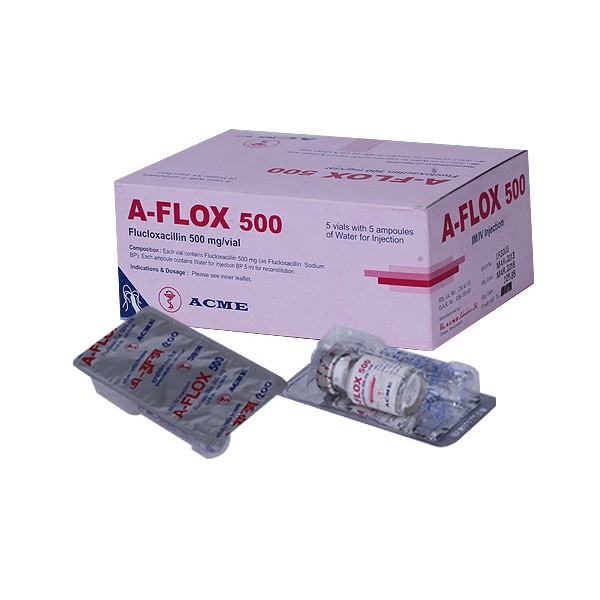
A-Flox 500 mg/vial IM/IV Injection (Flucloxacillin) — Product Overview
| Quick Reference | |
|---|---|
| Brand Name | A-Flox Injection 500 mg |
| Generic Name | Flucloxacillin Sodium 500 mg/vial |
| Drug Class | Beta-Lactamase Resistant Penicillin Antibiotic (Parenteral) |
| Manufacturer | ACI Limited, Bangladesh |
| Dosage Form | Powder for Injection (IM or IV) |
| Strength | 500 mg per vial (also: 250 mg/vial) |
| Route | Intramuscular (IM) or Intravenous (IV) — hospital/clinic use |
| Storage | Below 25°C, dry place, protected from light. Use immediately after reconstitution. |
| Prescription Status | Prescription Required — Hospital / Clinical Use |
What is A-Flox 500mg Injection (Flucloxacillin IV/IM)?
A-Flox 500mg/vial Injection contains Flucloxacillin Sodium as a sterile powder for reconstitution and parenteral (IV or IM) administration. The 500 mg vial is the standard adult dosing unit, providing twice the dose of the 250 mg vial in the same volume. It delivers rapid, high-level anti-staphylococcal activity essential for severe infections where oral therapy is either not possible or insufficient. The 500 mg dose is most commonly used for standard adult treatment (every 6 hours), while 2 g IV doses (four vials) are used for serious infections such as endocarditis and osteomyelitis.
Indications
- Staphylococcal septicaemia (bloodstream infection) — IV first-line for MSSA bacteraemia
- Infective endocarditis — IV flucloxacillin is first-line for native valve MSSA endocarditis (2 g IV every 4–6 hours)
- Osteomyelitis — IV initial therapy (2 g every 6 hours), then step down to oral
- Septic arthritis
- Severe cellulitis / necrotising fasciitis
- Severe diabetic foot infections with systemic features (fever, elevated WBC)
- Staphylococcal pneumonia
- Post-operative wound infections requiring parenteral therapy
- Surgical prophylaxis — single dose at induction (500 mg–1 g) for procedures at risk for staphylococcal contamination
Dosage — Parenteral (500 mg vial)
Adults — Standard infections:
- IM: 500 mg every 6 hours (deep IM injection)
- IV bolus: 500 mg every 6 hours (dissolved in 10 ml WFI; give over 3–4 minutes)
Adults — Severe infections (endocarditis, osteomyelitis):
- IV infusion: 1–2 g every 4–6 hours (= 2–4 vials per dose, 8–12 g/day)
Children: 25–50 mg/kg every 6 hours IV, adjusted by severity. Neonates: specialist guidance required.
Reconstitution for IM: Add 2 ml Water for Injection. Give deep IM only.
Reconstitution for IV bolus: Add 10 ml Water for Injection; give over 3–4 minutes slowly.
Reconstitution for IV infusion: Add to 50–100 ml Normal Saline or Dextrose 5%; infuse over 30–60 minutes. Stable for 1 hour at room temperature after reconstitution.
Renal impairment: No dose reduction required for mild/moderate renal impairment. Avoid accumulation in severe renal failure (CrCl <10 ml/min) — reduce dose frequency.
Mechanism of Action
Flucloxacillin is a beta-lactamase resistant, narrow-spectrum penicillin. It binds to penicillin-binding proteins (PBPs 1, 2, and 3) in bacterial cell walls, inhibiting transpeptidase crosslinking. The bulky isoxazolyl side chain confers steric protection against staphylococcal beta-lactamase (penicillinase), allowing activity against beta-lactamase-producing Staphylococcus aureus (MSSA) that would inactivate plain penicillins. It is bactericidal and time-dependent — plasma concentrations must stay above the MIC throughout the dosing interval.
Contraindications
- Penicillin hypersensitivity / anaphylaxis to any beta-lactam antibiotic
- History of flucloxacillin-associated hepatic dysfunction or cholestatic jaundice (even from a previous course)
Side Effects
Local: IM injection is painful — use large muscle, rotate sites. IV may cause phlebitis — use large bore vein, rotate IV sites if prolonged treatment.
Hepatic: Cholestatic hepatitis and jaundice — more common with prolonged courses (>2 weeks) and in older patients. Monitor LFTs on extended IV courses. Can occur up to 2 months after stopping treatment.
Haematological: Haemolytic anaemia (rare), neutropenia on prolonged courses — check FBC weekly if >2 weeks IV.
GI: Nausea, diarrhoea. Pseudomembranous colitis (C. difficile) — report new diarrhoea promptly.
Anaphylaxis: Rare but potentially fatal. Monitor for the first 30 minutes of each new IV administration. Adrenaline, antihistamines, corticosteroids must be immediately available.
Drug interaction — Warfarin: IV flucloxacillin significantly lowers INR — check INR daily in anticoagulated patients during IV therapy and after stopping.
Drug Interactions
- Warfarin / anticoagulants: Reduces anticoagulant effect — monitor INR closely
- Methotrexate: Flucloxacillin reduces renal clearance of methotrexate — increased toxicity risk
- Oral contraceptives: Theoretical reduction in efficacy — advise additional contraception
- Probenecid: Increases and prolongs plasma levels of flucloxacillin
Special Populations / Precautions
Hepatic disease: Use with caution in pre-existing liver disease. Monitor LFTs during treatment.
Pregnancy: Category B. Use only when clearly indicated; short courses are generally considered safe.
Breastfeeding: Excreted in breast milk in small amounts. Considered compatible but monitor infant for GI effects.
Elderly: Higher risk of hepatic adverse effects on prolonged courses. Monitor LFTs from week 2 onwards.
Diabetic patients: Glucose-containing diluents (5% Dextrose) can be used for reconstitution — factor into total glucose load in patients requiring tight glycaemic control.
Frequently Asked Questions (FAQ)
Q: What is the difference between A-Flox 250 mg and 500 mg injection?
A: Both contain Flucloxacillin Sodium and have identical indications. The 500 mg vial delivers twice the dose in the same volume and is the standard adult treatment dose. The 250 mg vial is used for paediatric dosing or when smaller increments are needed.
Q: Why is IV flucloxacillin preferred over IM for severe infections?
A: IV administration achieves immediate, higher, and more predictable blood levels than IM. For endocarditis, osteomyelitis, or septicaemia, reliable high blood levels are critical. IM is reserved for moderate infections or when IV access is difficult, but is painful and not suitable for prolonged therapy.
Q: Does flucloxacillin treat MRSA?
A: No. Flucloxacillin is effective only against MSSA (methicillin-sensitive S. aureus). MRSA is resistant to all penicillins and cephalosporins and requires vancomycin, linezolid, or daptomycin.
Q: How long does IV flucloxacillin treatment last?
A: Duration depends on the infection. Cellulitis: typically 5–7 days IV then oral switch. Osteomyelitis: 2 weeks IV then 4 weeks oral. Endocarditis: 4–6 weeks IV. Longer IV courses require weekly LFT and FBC monitoring.
Medical Disclaimer
For educational purposes only. Parenteral flucloxacillin must be prepared and administered by trained healthcare professionals. Monitor for anaphylaxis during the first 30 minutes of new IV treatment. Report any new jaundice during or up to 8 weeks after treatment. This page does not replace clinical judgment, hospital protocols, or specialist advice.