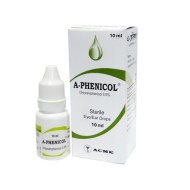
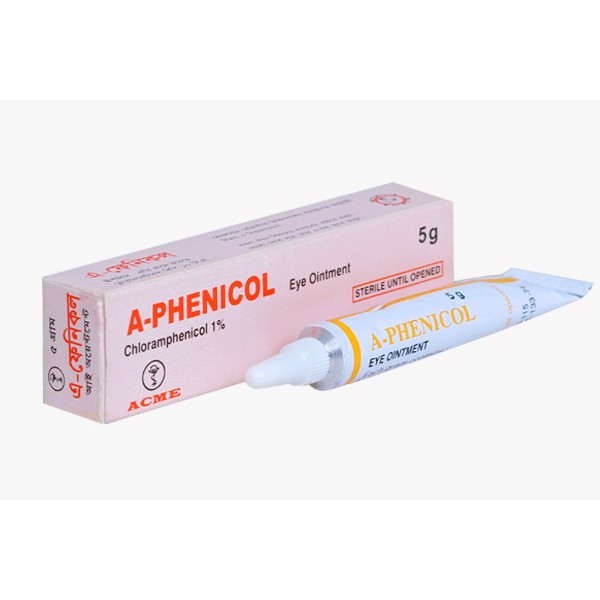
- Stock: Out Of Stock
- Brand: Acme Laboratories Limited
- Product ID: Chloramphenicol
🔒 100% Secure Payment | bKash | Nagad | SSLCommerz | COD
⭐ Become a FREE Member: 7% Extra Savings • Free Delivery • Refill Reminders • Priority Support
This Item is for pre order
A-Phenicol Eye Ointment 5g — Chloramphenicol 1% | Beximco Pharmaceuticals
| Generic Name | Chloramphenicol 1% w/w Ophthalmic Ointment |
| Drug Class | Broad-Spectrum Antibiotic — Topical Ophthalmic |
| Manufacturer | Beximco Pharmaceuticals Ltd. |
| Route | Topical — Ophthalmic (eye ointment) |
| Pack Size | 5g Tube |
Overview
A-Phenicol Eye Ointment contains Chloramphenicol 1% in an ophthalmic ointment base. The ointment formulation provides longer contact time with ocular tissues than drops — making it particularly suitable for overnight use (applied at bedtime when sustained antibiotic levels are beneficial) or for patients who find drops difficult to instil. Used alongside chloramphenicol drops during the day, the ointment at night is a classical regimen for bacterial conjunctivitis and blepharitis. The ointment base also provides lubrication, soothing the irritated ocular surface.
Mechanism of Action
Chloramphenicol 1% binds to the 50S bacterial ribosomal subunit, inhibiting peptidyl transferase activity and blocking protein elongation — bacteriostatic against most organisms. The ointment base (typically petroleum/white soft paraffin) provides prolonged retention in the conjunctival sac, extending the duration of antibiotic contact beyond what drops achieve. 1% concentration (double that of drops) compensates for potential dilution in the conjunctival secretions.
Indications
- Bacterial conjunctivitis — especially for nocturnal coverage (bedtime application)
- Blepharitis — bacterial infection of eyelid margins
- Blepharoconjunctivitis
- Used in combination with chloramphenicol drops (drops during day, ointment at night)
- Patients unable to instil eye drops accurately
- Superficial corneal abrasion prophylaxis against infection
How to Use (Eye Ointment)
| Step | Instructions |
|---|---|
| 1. Wash hands | Thoroughly wash and dry hands before use |
| 2. Pull lower lid | Tilt head back; gently pull down lower eyelid |
| 3. Apply ointment | Squeeze a small ribbon (~1cm) of ointment into the lower conjunctival sac |
| 4. Close eye | Close eye gently; blink a few times to distribute ointment |
| 5. Blurred vision | Vision will blur temporarily after ointment application — do not drive immediately after |
| 6. Timing | Apply at bedtime (or as directed — typically 3–4 times daily or night-time with daytime drops) |
| 7. Duration | Continue for 48 hours after eye appears normal — typically 5–7 days |
Do not touch tube tip to eye or any surface. Do not use for ear with the ophthalmic formulation. Remove contact lenses before application.
Critical Diabetic Patient Information
- Ocular infection susceptibility in diabetes: Diabetics are more prone to bacterial conjunctivitis and blepharitis due to immune dysfunction, reduced tear film antimicrobial activity, and altered ocular surface. Early treatment prevents progression to more serious ocular infection
- Distinguishing bacterial conjunctivitis from diabetic eye complications: Bacterial conjunctivitis causes redness and discharge with NORMAL vision. If vision is blurred or reduced, or there is significant eye pain — seek urgent ophthalmological assessment rather than self-treating with topical antibiotics
- Nocturnal dry eye in diabetics: Chloramphenicol ointment at night also provides lubrication for the not-uncommon nocturnal dry eye in diabetic patients with autonomic neuropathy affecting the lacrimal gland. This dual benefit (antibiotic + lubrication) makes the ointment useful in this population
- No systemic glucose effect: Topical chloramphenicol 1% ointment has negligible systemic absorption and does not affect blood glucose
Side Effects
| System | Side Effect | Severity |
|---|---|---|
| Local ocular | Transient blurring of vision after application (expected from ointment base) | Common — Mild, resolves in minutes |
| Local ocular | Mild stinging, mild irritation | Common — Mild |
| Hypersensitivity | Allergic conjunctivitis — itching, swelling (contact allergy to ointment base or chloramphenicol) | Uncommon — discontinue if develops |
| Systemic (theoretical) | Aplastic anaemia risk — extremely rare with topical ophthalmic use at standard duration | Theoretical — avoid prolonged unsupervised use |
Contraindications
- Known hypersensitivity to chloramphenicol
- Personal or family history of aplastic anaemia or blood dyscrasias
- Viral eye infections (herpes simplex keratitis) — antibiotic ointments are ineffective and delay antiviral treatment
- Fungal eye infections
- Contact lens use during treatment
Storage
Store below 25°C. Protect from light and heat. Discard 28 days after first opening. Keep out of reach of children. Do not freeze.
Frequently Asked Questions
Q: Should I use drops or ointment for eye infections?
A: Drops are preferred during the day as they don't blur vision. Ointment is ideal at night — it stays in contact with the eye longer while you sleep. A common regimen is drops every 2–4 hours during the day + ointment at bedtime.
Q: The ointment blurs my vision — is this normal?
A: Yes — this is expected from the ointment base (petroleum/paraffin) and is temporary (usually clears within 10–20 minutes). Applying at bedtime avoids this inconvenience during waking hours.
Q: Can I use A-Phenicol Ointment and A-Phenicol Drops together?
A: Yes — this is the standard regimen. Use drops every 2 hours during the day; apply ointment at bedtime for sustained overnight coverage.
Medical Disclaimer: A-Phenicol Eye Ointment (Chloramphenicol 1%) is for topical ophthalmic use only. Do not use in ears with this formulation. Discard 28 days after opening. If visual acuity is reduced or significant eye pain develops, seek urgent ophthalmological review. This information is for educational purposes only. Always follow your physician's instructions.