- Stock: In Stock
- Brand: Incepta Pharmaceuticals
- Product ID: Hydrochlorothiazide
Available Options
🔒 100% Secure Payment | bKash | Nagad | SSLCommerz | COD
⭐ Become a FREE Member: 7% Extra Savings • Free Delivery • Refill Reminders • Priority Support
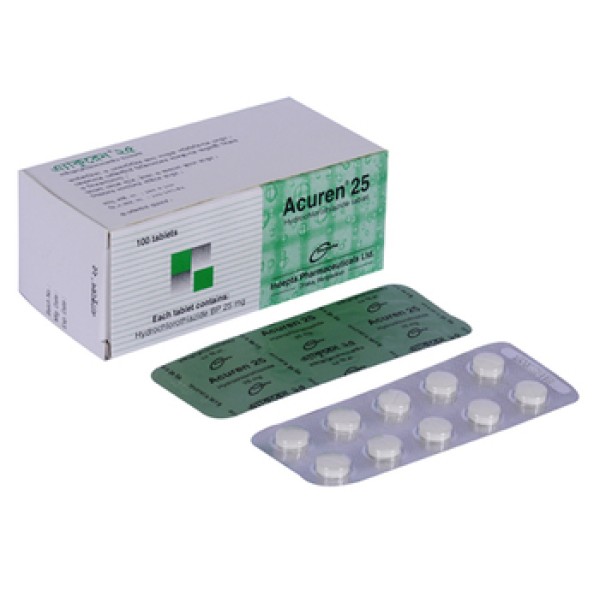
Acuren 25mg Tablet — Hydrochlorothiazide (HCTZ) | Beximco Pharmaceuticals
| Generic Name | Hydrochlorothiazide (HCTZ) 25mg |
| Drug Class | Thiazide Diuretic / Antihypertensive |
| Manufacturer | Beximco Pharmaceuticals Ltd. |
| Route | Oral (Tablet) |
| Prescription Status | Prescription Required |
Overview
Acuren 25mg contains Hydrochlorothiazide (HCTZ), a thiazide diuretic used for hypertension and oedema. HCTZ is among the most widely prescribed antihypertensives globally and is a first-line agent for blood pressure management in most international guidelines. It is frequently used as part of combination antihypertensive therapy. Diabetic patients on HCTZ require careful monitoring — thiazides can elevate blood glucose, triglycerides, and cause electrolyte disturbances that complicate diabetes management.
Mechanism of Action
HCTZ acts on the distal convoluted tubule of the kidney, inhibiting the Na⁺/Cl⁻ cotransporter. This reduces sodium and water reabsorption, increasing urine output (diuresis) and reducing blood volume, thereby lowering blood pressure. HCTZ also causes mild vasodilation with chronic use. The increased sodium delivery to collecting tubules promotes potassium excretion, leading to hypokalaemia with prolonged use.
Indications
- Hypertension (first-line, alone or in combination)
- Oedema due to heart failure, hepatic cirrhosis, or renal disease
- Nephrogenic diabetes insipidus
- Prevention of calcium-containing kidney stones (hypercalciuria)
- Combination antihypertensive therapy (with ACE inhibitors, ARBs, calcium channel blockers)
Dosage
| Indication | Dose | Frequency | Notes |
|---|---|---|---|
| Hypertension | 12.5–25mg | Once daily (morning) | Maximum 50mg/day |
| Oedema | 25–100mg | Once or twice daily | Intermittent dosing can reduce electrolyte disturbance |
Take in the morning to avoid night-time urination. Take with or without food.
Critical Diabetic Patient Warnings
- Hyperglycaemia: Thiazides reduce insulin secretion and increase insulin resistance — blood glucose can rise significantly. Monitor fasting glucose and HbA1c more frequently; antidiabetic drug doses may need adjustment
- Hypokalaemia worsens hyperglycaemia: Low potassium (caused by HCTZ) independently impairs insulin secretion. Monitor serum K⁺; supplement if K⁺ <3.5 mmol/L
- Dyslipidaemia: HCTZ elevates LDL cholesterol and triglycerides — worsens already elevated cardiovascular risk in diabetics. Monitor lipid panel every 6–12 months
- Hyponatraemia: Especially in elderly diabetics — confusion, falls, weakness; monitor serum Na⁺
- Renal impairment: HCTZ is less effective and potentially harmful in diabetic nephropathy with eGFR <30 ml/min — consider alternative diuretics (e.g. loop diuretics)
- Gout risk: HCTZ raises uric acid — avoid in diabetics with gout or hyperuricaemia
- Orthostatic hypotension: Combined with autonomic neuropathy in diabetics — fall risk increases; advise slow position changes
Side Effects
| System | Side Effect | Severity |
|---|---|---|
| Metabolic | Hypokalaemia, hyponatraemia, hypomagnesaemia, hypercalcaemia | Common — Moderate |
| Metabolic | Hyperglycaemia, elevated triglycerides, elevated LDL | Moderate |
| Metabolic | Hyperuricaemia, gout | Moderate |
| Renal | Increased creatinine (volume depletion) | Moderate |
| Cardiovascular | Orthostatic hypotension | Mild–Moderate |
| GI | Nausea, anorexia, gastric irritation | Mild |
| Skin | Photosensitivity rash, urticaria | Mild |
| Rare serious | Severe hyponatraemia, aplastic anaemia, pancreatitis | Rare |
Drug Interactions
| Drug | Interaction |
|---|---|
| ACE inhibitors / ARBs | Synergistic antihypertensive effect — monitor BP; may increase renal impairment risk |
| NSAIDs | Reduce diuretic and antihypertensive effect; worsen renal function |
| Digoxin | Hypokalaemia increases digoxin toxicity risk — monitor K⁺ and digoxin levels |
| Lithium | Reduced lithium excretion — toxicity risk; monitor lithium levels |
| Insulin / Oral antidiabetics | HCTZ raises blood glucose — may require dose adjustment of antidiabetic drugs |
| Corticosteroids | Additive potassium loss and hyperglycaemia |
Contraindications
- Anuria or severe renal impairment (eGFR <30 ml/min)
- Severe hepatic impairment
- Known hypersensitivity to HCTZ or sulphonamides
- Refractory hypokalaemia or hyponatraemia
- Symptomatic hyperuricaemia or active gout
Storage
Store below 30°C. Protect from light and moisture. Keep out of reach of children.
Frequently Asked Questions
Q: Why is HCTZ used less in diabetics compared to other antihypertensives?
A: Thiazides can worsen blood sugar control and dyslipidaemia in diabetics. ACE inhibitors, ARBs, or calcium channel blockers are generally preferred as first-line antihypertensives in diabetics. However, HCTZ remains useful in combination therapy at lower doses (12.5–25mg) with close monitoring.
Q: Can I take Acuren once daily?
A: Yes. HCTZ is typically taken once daily in the morning to avoid night-time urination. The full blood pressure-lowering effect may take 2–4 weeks to become apparent.
Q: What foods should I eat while on HCTZ?
A: Potassium-rich foods (bananas, oranges, potatoes, spinach) help replace potassium lost through urination. Avoid excessive salt intake. Stay well-hydrated especially in hot weather.
Medical Disclaimer: Acuren 25mg (Hydrochlorothiazide) is a prescription-only medicine. Diabetic patients must monitor blood glucose, electrolytes, and renal function regularly while on HCTZ. This drug may worsen glycaemic control and dyslipidaemia. This information is for educational purposes only and does not constitute medical advice. Always follow your physician's instructions.