- Stock: Out Of Stock
- Brand: ACI Pharmaceuticals
- Product ID: Naproxen Sodium
🔒 100% Secure Payment | bKash | Nagad | SSLCommerz | COD
⭐ Become a FREE Member: 7% Extra Savings • Free Delivery • Refill Reminders • Priority Support
This Item is for pre order
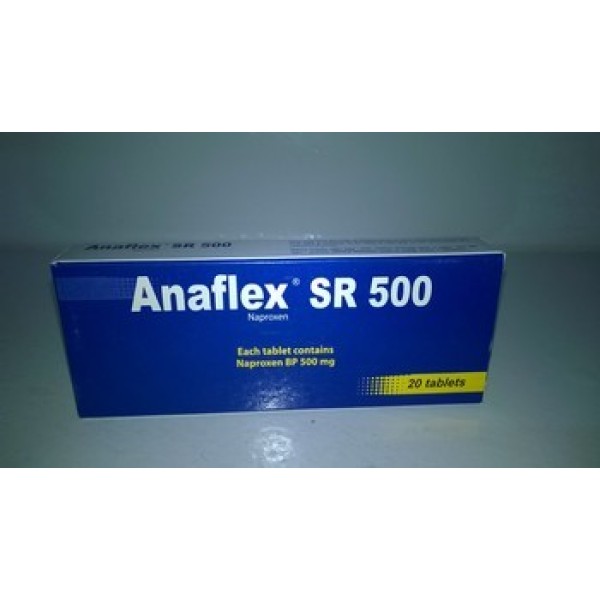
Anaflex SR 500 mg Tablet (Naproxen Sodium Sustained-Release) – ACI Limited
| Brand Name | Anaflex SR 500 mg Tablet |
|---|---|
| Generic Name | Naproxen Sodium 500 mg (Sustained-Release) |
| Strength | 500 mg |
| Dosage Form | Sustained-Release (SR) Tablet |
| Manufacturer | ACI Limited, Bangladesh |
| Drug Class | NSAID — Propionic Acid Derivative (Sustained-Release) |
| Pack Size | 10 Tablets per Strip |
| Prescription Required | Yes (Rx) |
| Storage | Store below 30°C, cool and dry, protected from sunlight |
1. About Anaflex SR 500 mg (Naproxen Sodium Sustained-Release)
Anaflex SR 500 mg is a sustained-release (SR) formulation of Naproxen Sodium 500 mg, manufactured by ACI Limited, Bangladesh. The SR matrix technology controls drug release over an extended period, providing a smoother plasma concentration profile compared to immediate-release naproxen — reducing peak concentration-related GI irritation while maintaining therapeutic tissue levels over the full dosing interval.
The SR formulation is particularly beneficial in chronic arthritis management where consistent round-the-clock anti-inflammatory coverage — including during sleep — is essential. A single evening dose of Anaflex SR can provide meaningful overnight and early-morning joint protection, addressing the characteristic early-morning stiffness of rheumatoid arthritis.
2. Mechanism of Action
Naproxen sodium is a non-selective COX-1 and COX-2 inhibitor that reduces arachidonic acid conversion to prostaglandins and thromboxanes. The SR formulation modifies the release kinetics: naproxen is released gradually from the matrix tablet, achieving a lower but more sustained peak plasma concentration (Cmax) compared to the immediate-release tablet. This:
- Reduces GI mucosal exposure to high drug concentrations — lower incidence of gastric irritation
- Provides more consistent anti-inflammatory coverage with reduced concentration troughs
- Once-daily or once-nightly dosing option for improved patient convenience and adherence
3. Indications
- Rheumatoid Arthritis (RA): Long-term management — especially once-nightly dosing to control early-morning stiffness
- Osteoarthritis (OA): Chronic joint pain with improved GI tolerability vs. immediate-release naproxen
- Ankylosing Spondylitis
- Chronic Musculoskeletal Pain requiring regular NSAID therapy
- Patients who experienced GI intolerance with immediate-release NSAIDs — SR formulation may be better tolerated
4. Dosage and Administration
Standard dose: 500–1000 mg once daily (one or two SR tablets), taken in the evening for overnight and early-morning RA coverage. Alternatively, 500 mg twice daily. Maximum 1,000 mg/day.
Do not crush, cut, or chew — swallow whole with water to preserve the SR matrix. Food reduces GI irritation; take with a meal or glass of milk.
Elderly: Start at 500 mg once daily. Use lowest effective dose. Monitor BP and renal function.
Renal impairment: Avoid if CrCl <30 ml/min.
5. Contraindications
- Active peptic ulcer or NSAID-related GI bleeding history
- Hypersensitivity to naproxen, aspirin, or any NSAID
- Aspirin-exacerbated respiratory disease (NSAID-sensitive asthma)
- Severe renal impairment (CrCl <30 ml/min); Severe hepatic impairment; Severe heart failure
- Third trimester of pregnancy
6. Warnings and Precautions
SR matrix integrity: Do not crush or split — this destroys the SR mechanism and releases the full 500 mg dose immediately, increasing GI toxicity risk and causing dose-dumping.
GI risk: SR formulation reduces but does not eliminate GI risk. Serious GI ulceration, perforation, and bleeding can still occur. Take with food. Consider co-prescribing a PPI (or use Anaflex Max) in high-GI-risk patients.
CV risk: NSAIDs increase serious CV thrombotic event risk (MI, stroke) with prolonged use or in high-CV-risk patients. Use lowest effective dose for shortest duration.
Renal risk: NSAIDs reduce renal prostaglandin-mediated blood flow — AKI risk in dehydrated, heart failure, or renally impaired patients. Maintain hydration.
Diabetic patients: Same cautions as all oral NSAIDs — can worsen diabetic nephropathy, oppose ACE inhibitor/ARB nephroprotection, elevate BP, and cause fluid retention. The SR formulation's lower peak concentration may slightly reduce GI irritation, but systemic NSAID effects on the kidney and heart are unchanged. Monitor eGFR and BP. For localised joint pain in diabetics with CKD, topical Anaflex Gel is safer.
7. Side Effects
Common: Nausea, dyspepsia, abdominal discomfort, headache, dizziness, oedema. SR formulation: lower incidence of GI symptoms vs. immediate-release at equivalent daily doses.
Uncommon: Peptic ulcer, GI bleeding, raised liver enzymes, elevated BP, renal impairment, rash.
Rare/Serious: GI perforation, anaphylaxis, severe skin reactions (SJS/TEN), MI or stroke with prolonged high-dose use.
8. Drug Interactions
- Other NSAIDs/Aspirin: Avoid — increased GI and renal toxicity
- Warfarin: Increased bleeding risk — monitor INR
- ACE inhibitors/ARBs/diuretics: Reduced efficacy; AKI risk
- Sulphonylureas: Enhanced hypoglycaemia — monitor blood glucose
- Methotrexate: Reduced clearance — increased toxicity
- Lithium: Increased lithium levels — monitor
- Corticosteroids: Markedly increased GI ulceration risk
9. Pharmacokinetics
SR formulation achieves lower Cmax (approx. 70% of IR) with delayed Tmax (~4–6 hours vs. 1–2 hours for IR). Total bioavailability equivalent to IR. Terminal half-life 12–17 hours — allows once-daily evening dosing. Hepatic CYP2C9 metabolism to inactive metabolites. Renal elimination ~95%.
10. SR vs. IR Naproxen: Clinical Comparison
The sustained-release formulation provides two key clinical advantages over immediate-release naproxen: (1) Lower GI peak exposure — reduced Cmax means the gastric mucosa is exposed to lower drug concentrations at any one time, reducing the direct irritant effect. Meta-analyses show a modest reduction in NSAID-related dyspepsia and GI complaints with SR vs. IR naproxen. (2) Flexibility for evening/nocturnal dosing — for RA patients with early-morning stiffness, taking Anaflex SR at bedtime provides therapeutic drug levels throughout the night and into the morning, controlling symptoms before waking. Once-daily dosing also simplifies treatment regimens.
11. Naproxen SR in Diabetic Arthritis Management
Chronic arthritis — particularly RA and OA — is more prevalent and more severe in patients with diabetes. When systemic NSAIDs are clinically required in diabetic patients, the SR formulation offers a modest GI tolerability advantage. However, the renal, cardiovascular, and fluid-retention risks of naproxen are not diminished by the SR release profile. For diabetic patients with CKD (eGFR <60), topical Anaflex Gel remains preferred for localised joint pain. Where systemic NSAID is unavoidable, Anaflex SR at lowest effective dose with PPI cover (or Anaflex Max) and close monitoring of BP and eGFR is the recommended approach.
12. ACI Limited Anaflex SR Range
Anaflex SR 500 mg is part of ACI Limited's comprehensive Anaflex range. The SR formulation sits alongside Anaflex 250 mg and 500 mg IR tablets (immediate-release for rapid onset), Anaflex Max 375/500 mg (with gastroprotective esomeprazole), and Anaflex Gel 15/30 g (topical). Clinicians can select the appropriate formulation based on chronicity, GI risk, renal function, and the need for nocturnal/early-morning symptom control.
13. Storage
- Store below 30°C in cool, dry conditions protected from light
- Do not crush or split tablets. Keep in original blister pack.
- Keep out of reach of children. Do not use after expiry date.
Frequently Asked Questions (FAQ)
Q1: What does SR mean in Anaflex SR and how is it different from regular Anaflex?
SR stands for Sustained-Release. Anaflex SR 500 mg uses a special matrix tablet that slowly releases naproxen over several hours, in contrast to regular (immediate-release) Anaflex tablets which release the drug quickly. Benefits of SR: lower peak drug concentration reduces stomach irritation, more consistent drug levels over the dosing period, and the option for once-daily dosing — particularly useful for an evening dose to control overnight and early-morning arthritis symptoms.
Q2: Can I split or crush Anaflex SR tablets?
No — never crush, cut, or chew Anaflex SR tablets. The tablet is specially formulated to release naproxen gradually. Crushing it destroys this SR mechanism, releasing the full 500 mg dose immediately — this causes dose-dumping (too much drug too quickly), greatly increasing GI side effect risk and potentially causing serious adverse effects. Always swallow whole with a full glass of water.
Q3: When is Anaflex SR preferred over regular Anaflex 500 mg?
Anaflex SR is preferred when: (1) patients experience GI discomfort with immediate-release naproxen and may benefit from lower peak concentrations; (2) simplified once-daily dosing is preferred for adherence; (3) early-morning joint stiffness is a major complaint — an evening dose of Anaflex SR controls symptoms through the night and into the morning without a midnight or early-morning tablet. For acute pain requiring rapid onset (dental pain, sports injury), immediate-release Anaflex 500 mg acts faster.
Q4: Is Anaflex SR safe for long-term use in arthritis?
Anaflex SR can be used long-term under physician supervision for chronic arthritis, at the lowest effective dose. Long-term NSAID use requires periodic monitoring: renal function (eGFR), blood pressure, haemoglobin (for occult GI bleeding), and liver function. In patients with GI risk factors, consider adding a PPI or switching to Anaflex Max (naproxen + esomeprazole). Annual review of NSAID need versus benefit-risk is recommended.