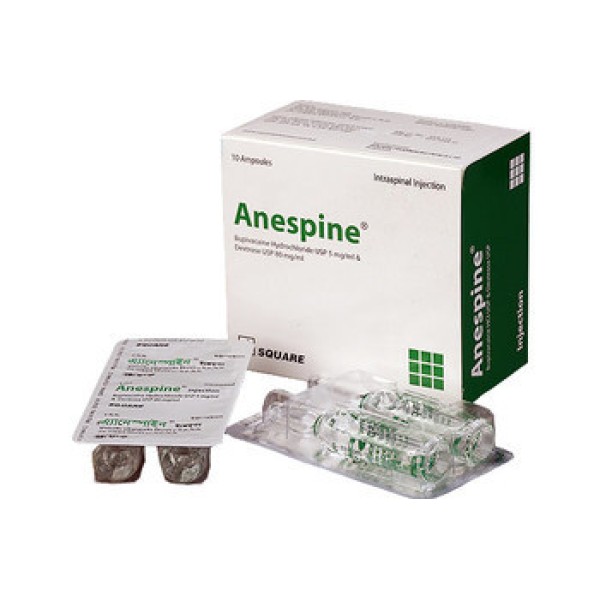
- Stock: Out Of Stock
- Brand: Square Pharmaceuticals
- Product ID: Bupivacaine Hydrochloride + Dextrose
🔒 100% Secure Payment | bKash | Nagad | SSLCommerz | COD
⭐ Become a FREE Member: 7% Extra Savings • Free Delivery • Refill Reminders • Priority Support
This Item is for pre order
Anespin (Inj) 4ml amp
| Generic Name | Bupivacaine Hydrochloride + Dextrose |
| Strength | 0.5% + 8% |
| Dosage Form | Intraspinal Injection |
| Manufacturer | Square Pharmaceuticals PLC |
| Therapeutic Class | Regional Anesthesia (Spinal/Intrathecal Anesthetic) |
| Pack Size | 4 ml Ampoule |
Overview
Anespin is a hyperbaric (heavy) local anesthetic injection containing Bupivacaine Hydrochloride USP 20 mg and Dextrose Anhydrous USP 320 mg per 4 ml ampoule. It is a long-acting amide-type local anesthetic used for intrathecal (spinal/subarachnoid) anesthesia in surgical and obstetric procedures.
Indications
This combination intraspinal injection is indicated for:
- Lower abdominal surgery (including Caesarean section), urological and lower limb procedures, including hip surgery, lasting 1.5 to 3 hours.
- Intrathecal (subarachnoid, spinal) anesthesia for surgical and obstetrical procedures.
It produces motor blockade of the abdominal muscles, making it suitable for abdominal surgery lasting 1.5-2 hours. The duration of motor blockade does not exceed the duration of analgesia.
Pharmacology
Bupivacaine is a long-acting local anesthetic of the amide type. The heavy (hyperbaric) solution has a rapid onset of action, with analgesia lasting 3-5 hours in the lower thoracic and lumbar segments, making it especially suitable for long-lasting procedures in the lower limbs. Muscular relaxation of the lower limbs is profound and lasts 3-4 hours, somewhat shorter than the sensory blockade. Circulatory effects are similar to or less than those of other spinal agents, and the solution is well tolerated by surrounding tissues.
Dosage and Administration
Spinal anesthesia for surgery (adults): 2-4 ml (10-20 mg Bupivacaine hydrochloride). The patient's physical status and concomitant medication should be considered when deciding the dose, and the lowest dose required for adequate anesthesia should be used. The dose should be reduced in the elderly and in patients in late stages of pregnancy.
Pediatrics:
- Below 5 kg: 0.40-0.50 mg/kg
- 5 to 15 kg: 0.30-0.40 mg/kg
- 15 to 40 kg: 0.25-0.30 mg/kg
Interaction
Should be used with care in patients receiving antiarrhythmic drugs with local anesthetic activity, as toxic effects may be additive. Phenothiazines and Butyrophenones may reduce or reverse the pressor effect of epinephrine.
Contraindications
Absolute:
- Allergy or hypersensitivity to amide-type local anesthetics.
- Acute active diseases of the cerebrospinal system such as meningitis, tumours, poliomyelitis, subacute combined degeneration of the spinal cord, cranial haemorrhage, demyelinating disease and raised intracranial pressure.
- Spinal stenosis and active disease or recent trauma in the vertebral column.
Relative: Arthritis and other diseases of the vertebral column, due to technical difficulties in performing a spinal injection.
Side Effects
The adverse reaction profile is similar to other long-acting local anesthetics administered intrathecally. Effects caused by the drug itself are difficult to distinguish from the physiological effects of the nerve block (e.g. decrease in blood pressure, bradycardia, temporary urinary retention), or from events caused by the needle puncture or cerebrospinal leakage.
Pregnancy and Lactation
A large number of pregnant women and women of child-bearing age have been given Bupivacaine without specific disturbances to the reproductive process reported. The dose should be reduced in late stages of pregnancy. At recommended doses, Bupivacaine enters breast milk in such small quantities that there is generally no risk to the breast-fed child.
Precautions and Warnings
Local anesthetics react with certain metals and cause release of ions which, if injected, may cause severe local irritation. Ampoules are for single use only; any unused portion should be discarded. The solution should be used immediately after opening, and discoloured solutions should not be used.
Overdose Effects
Since the dose required for spinal anesthesia is small (20% or less than that required for epidural anesthesia), acute systemic toxicity is extremely unlikely. With accidental intravascular injection, toxic effects appear within 1-3 minutes; with overdosage, peak plasma concentrations may not be reached for 20-30 minutes. Toxic reactions mainly involve the central nervous and cardiovascular systems.
Storage Conditions
Store at a temperature not exceeding 30°C in a dry place. Protect from light.
Frequently Asked Questions
What is Anespin used for?
Anespin is used for spinal (intrathecal) anesthesia in lower abdominal, urological, and lower limb surgeries, including Caesarean section and other obstetric procedures.
How is Anespin administered?
Anespin is administered only by a qualified anesthesiologist via intrathecal (spinal) injection in a hospital or surgical setting; it is not for self-administration.
This information is for educational purposes only and is not a substitute for professional medical advice. Anesthesia with this product must only be administered by a qualified anesthesiologist under appropriate medical supervision. Always consult a registered physician before use.