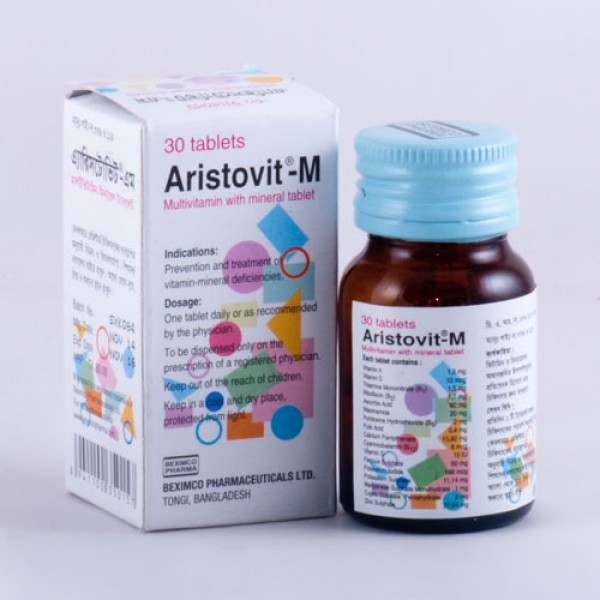
- Stock: In Stock
- Brand: Beximco Pharmaceutical
- Product ID: Multivitamin & Multimineral
🔒 100% Secure Payment | bKash | Nagad | SSLCommerz | COD
⭐ Become a FREE Member: 7% Extra Savings • Free Delivery • Refill Reminders • Priority Support
Aristovit M Tablet — Multivitamin & Multimineral | Beximco Pharmaceuticals
| Product Type | Multivitamin & Multimineral Supplement |
| Dosage Form | Tablet |
| Pack Size | 30 Tablets |
| Manufacturer | Beximco Pharmaceuticals Ltd. |
| Category | Nutritional Supplement / Micronutrient Support |
Overview
Aristovit M is a comprehensive Multivitamin and Multimineral tablet formulated to address the broad spectrum of daily micronutrient requirements. It provides a balanced combination of essential vitamins and minerals in a single convenient daily tablet — supporting energy metabolism, immune function, antioxidant defence, bone health, nerve function, and overall cellular health. Aristovit M is particularly relevant for individuals whose dietary intake may be insufficient to meet micronutrient needs — including people with diabetes, elderly adults, those on calorie-restricted diets, pregnant and lactating women, and individuals with increased metabolic demands due to illness or physical activity.
Why Micronutrient Supplementation Matters in Diabetes
People with diabetes are disproportionately affected by micronutrient deficiencies due to multiple factors: (1) increased urinary excretion of water-soluble vitamins and minerals (especially magnesium, zinc, and B vitamins) caused by osmotic diuresis from hyperglycaemia; (2) oxidative stress from chronic hyperglycaemia depletes antioxidant vitamins (C and E); (3) reduced dietary variety due to carbohydrate restriction; (4) metformin therapy causes vitamin B12 malabsorption (affecting up to 30% of long-term users); (5) impaired conversion of vitamin D from dietary precursors. Correcting micronutrient deficiencies can improve insulin sensitivity, reduce oxidative stress, support nerve and kidney health, and enhance immune function.
Key Nutrients and Their Roles
| Nutrient | Role | Particular Relevance in Diabetes |
|---|---|---|
| Vitamin B1 (Thiamine) | Carbohydrate metabolism; nerve function | Deficiency worsens diabetic neuropathy; high-dose thiamine (benfotiamine) may reduce neuropathic pain |
| Vitamin B6 (Pyridoxine) | Amino acid metabolism; neurotransmitter synthesis | Often low in diabetes; may help reduce diabetic peripheral neuropathy symptoms |
| Vitamin B12 (Cyanocobalamin) | Nerve myelin synthesis; red blood cell formation | Metformin depletes B12 in 10–30% of users; B12 deficiency causes peripheral neuropathy mimicking diabetic neuropathy |
| Folic Acid | DNA synthesis; homocysteine metabolism | Elevated homocysteine in diabetes increases cardiovascular risk; folate reduces homocysteine |
| Vitamin C | Collagen synthesis; antioxidant; immune support | Chronic hyperglycaemia competitively inhibits vitamin C uptake into cells; antioxidant supplementation reduces oxidative stress markers in diabetes |
| Vitamin D | Calcium absorption; bone health; immune modulation; insulin secretion | Vitamin D deficiency highly prevalent in Bangladeshi diabetic adults; deficiency impairs pancreatic beta-cell function and insulin sensitivity |
| Vitamin E | Lipid-soluble antioxidant; cell membrane protection | Antioxidant defence against lipid peroxidation — important in diabetes-related cardiovascular and retinal protection |
| Zinc | Insulin synthesis and storage; wound healing; immune function | Zinc is co-stored with insulin in pancreatic beta cells; urinary zinc loss increased in diabetes; deficiency impairs wound healing |
| Magnesium | Insulin receptor signalling; glucose metabolism; muscle and nerve function | Hypomagnesaemia very common in type 2 diabetes — worsens insulin resistance; associated with increased risk of diabetic retinopathy and cardiovascular disease |
| Chromium | Potentiates insulin action; glucose uptake | Chromium deficiency impairs insulin signalling; supplementation may modestly improve glycaemic control in type 2 diabetes |
| Selenium | Antioxidant enzyme cofactor (glutathione peroxidase) | Reduces oxidative stress in diabetic vasculopathy |
| Iron | Haemoglobin synthesis; oxygen transport | Iron deficiency anaemia is common in diabetic women; important caveat — excess iron supplementation can worsen oxidative stress in diabetes |
| Calcium | Bone health; muscle contraction; insulin secretion | Calcium intake often insufficient in diabetics due to dietary restriction |
Dosage and Administration
| Group | Dose | Timing |
|---|---|---|
| Adults (general) | 1 tablet daily | With or after a meal (food improves absorption of fat-soluble vitamins A, D, E, K and reduces GI upset) |
| Under physician recommendation | As directed | Some patients may be advised 2 tablets/day during periods of increased need |
Swallow whole with a glass of water. Do not crush or chew unless directed. Take consistently at the same time each day for best results. Avoid taking with tea, coffee, or dairy within 1 hour — tannins reduce iron and zinc absorption; calcium competes with iron absorption.
Important Notes for Diabetic Patients
- B12 monitoring on metformin: If you have been on metformin for more than 1 year, check serum B12 levels — supplementation via a multivitamin may not be sufficient if B12 is severely depleted; a separate high-dose B12 supplement or injection may be needed
- Vitamin D levels: Multivitamins typically contain 400–800 IU of vitamin D — this may be insufficient for patients with frank vitamin D deficiency; check serum 25-OH vitamin D and supplement separately if below 20 ng/mL
- Iron and HbA1c: Falsely low HbA1c may occur in iron-deficiency anaemia; after correcting iron deficiency with supplementation, HbA1c may appear to rise — this is an artefact of improved red blood cell turnover, not worsening glycaemic control
- Not a substitute for a balanced diet: Multivitamins supplement but cannot fully replace the micronutrients, phytonutrients, and dietary fibre provided by vegetables, fruits, whole grains, and pulses
- Caution with kidney disease: Diabetic patients with CKD stage 3+ should consult their nephrologist before taking multivitamin supplements — fat-soluble vitamins (A, D, E) and some minerals accumulate in renal impairment
Contraindications and Precautions
- Hypervitaminosis A or D (excessive vitamin A/D already prescribed separately)
- Haemochromatosis (iron overload condition) — avoid iron-containing supplements
- CKD Stage 3+ — review with nephrologist regarding fat-soluble vitamins and mineral load
- Wilson's disease — avoid copper-containing supplements
- Not recommended for children (adult formulation) — use paediatric-specific products
Storage
Store below 30°C in a cool, dry place. Protect from light and moisture. Keep out of reach of children. Do not use after expiry date.
FAQ
Q: Why do people with diabetes specifically need multivitamins?
Diabetes creates a perfect storm for micronutrient depletion: hyperglycaemia causes osmotic diuresis (flushing water-soluble vitamins and minerals out in urine), oxidative stress depletes antioxidant vitamins, metformin blocks B12 absorption, dietary restrictions reduce micronutrient variety, and diabetic kidney and gut complications impair absorption. Studies consistently find that diabetic adults have lower blood levels of magnesium, zinc, B12, vitamin C, vitamin D, and several B vitamins compared to non-diabetic adults. Correcting these deficiencies supports nerve health, immune function, wound healing, and may modestly improve insulin sensitivity.
Q: I am already on metformin. Do I specifically need B12 supplementation?
Yes — metformin reduces vitamin B12 absorption by interfering with calcium-dependent B12 absorption in the terminal ileum. Up to 30% of long-term metformin users develop B12 deficiency. The B12 in a standard multivitamin (typically 2.4–6 mcg) is often insufficient to reverse established deficiency. If you have been on metformin for more than 1 year, ask your physician to check your serum B12. If deficient, a higher-dose B12 supplement (500–1000 mcg/day oral) or intramuscular B12 injections may be recommended in addition to the multivitamin.
Q: Will taking a multivitamin affect my blood glucose levels?
A standard multivitamin containing chromium may have a very modest glucose-lowering effect, but this is unlikely to be clinically significant enough to cause hypoglycaemia. Some multivitamins contain small amounts of sugars as fillers — check the product label if you are very sensitive to carbohydrate intake. Overall, multivitamins do not meaningfully affect blood glucose monitoring and do not interfere with diabetes medications.
Medical Disclaimer: This information is for educational purposes only. Supplements should complement, not replace, a balanced diet and prescribed diabetes medications. Consult your physician before starting any new supplement, especially if you have kidney disease, are pregnant, or are taking medications that may interact with vitamins or minerals.