
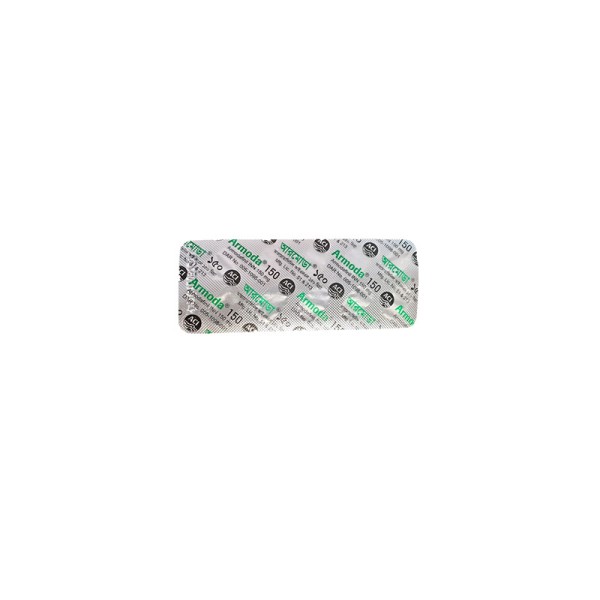
- Stock: Out Of Stock
- Brand: ACI Pharmaceuticals
- Product ID: Armodafinil
Available Options
🔒 100% Secure Payment | bKash | Nagad | SSLCommerz | COD
⭐ Become a FREE Member: 7% Extra Savings • Free Delivery • Refill Reminders • Priority Support
This Item is for pre order
Armoda 150 mg Tablet (Armodafinil) – ACI Limited
| Brand Name | Armoda 150 mg Tablet |
|---|---|
| Generic Name | Armodafinil 150 mg |
| Strength | 150 mg per tablet |
| Dosage Form | Tablet |
| Manufacturer | ACI Limited, Bangladesh |
| Drug Class | Wakefulness-Promoting Agent (Eugeroic) |
| Prescription Required | Yes (Rx) |
| Storage | Store below 30°C in a cool, dry place. Protect from light and moisture. |
1. About Armoda 150 mg (Armodafinil)
Armoda 150 mg Tablet contains Armodafinil 150 mg, the R-enantiomer of modafinil, manufactured by ACI Limited, Bangladesh. Armodafinil is a wakefulness-promoting agent (eugeroic) with a longer half-life and more consistent plasma concentration profile than racemic modafinil, making 150 mg armodafinil approximately equivalent to 200 mg modafinil in clinical efficacy.
Armoda 150 mg is indicated for the treatment of excessive sleepiness associated with narcolepsy, shift work sleep disorder (SWSD), and as an adjunct to CPAP therapy in obstructive sleep apnea (OSA). It promotes wakefulness without the euphoric effects and high abuse potential of traditional stimulants like amphetamines, while maintaining cognitive function, reaction time, and alertness.
2. Mechanism of Action
Armodafinil's precise mechanism is not fully elucidated, but it promotes wakefulness primarily by inhibiting dopamine reuptake (DAT blockade), leading to increased extracellular dopamine in the brain. This dopaminergic activity is essential for its wakefulness effect. Unlike amphetamines, armodafinil does not significantly release dopamine, reducing abuse potential.
Secondary mechanisms include increased norepinephrine activity (NE reuptake inhibition), increased histamine release in the hypothalamic wake-promoting pathways, and orexin/hypocretin system interaction. It does not significantly affect GABA, serotonin, or adenosine systems. As the R-enantiomer, armodafinil has a longer half-life (~15 hours) and higher peak plasma concentration vs racemic modafinil, providing more sustained alertness throughout the day.
3. Indications
- Narcolepsy: Reduce excessive daytime sleepiness (EDS) in patients with confirmed narcolepsy
- Shift work sleep disorder (SWSD): Improve wakefulness in patients with non-traditional work schedules
- Obstructive sleep apnea (OSA): Adjunct to CPAP for residual EDS despite adequate CPAP therapy
4. Dosage and Administration
Narcolepsy / OSA: 150–250 mg once daily in the morning. Armoda 150 mg once daily is the standard starting dose for narcolepsy and OSA.
Shift work sleep disorder: 150 mg approximately 1 hour before the start of the work shift.
Maximum dose: 250 mg/day. Take with or without food. Food may delay absorption but does not affect total bioavailability. Consistent daily timing is recommended for narcolepsy/OSA.
Hepatic impairment: Reduce dose by 50% in severe hepatic impairment. No adjustment in mild-moderate hepatic impairment. Elderly: Use with caution — start at lower doses due to reduced clearance.
5. Contraindications
- Hypersensitivity to armodafinil, modafinil, or any excipients
- History of severe skin reactions (SJS/TEN) with modafinil or armodafinil
6. Warnings and Precautions
Serious dermatological reactions: Stevens-Johnson syndrome and toxic epidermal necrolysis have been reported with modafinil/armodafinil. Discontinue immediately at first sign of rash and do not rechallenge.
Angioedema and anaphylaxis: Rare cases reported. Discontinue if angioedema (tongue, throat, face swelling) occurs.
Cardiovascular: Increased heart rate and blood pressure may occur. Avoid in patients with recent MI, unstable angina, or significant arrhythmias. Monitor BP and HR.
Psychiatric: May cause agitation, anxiety, mania, hallucinations, depression, and suicidal ideation. Use with caution in psychiatric patients. Discontinue if psychiatric symptoms emerge.
Not a substitute for sleep: Does not replace adequate sleep. Excessive sleepiness that persists despite treatment requires evaluation of underlying cause.
Pregnancy and lactation: Insufficient safety data. Use only if clearly needed. Hormonal contraceptives may become less effective — use alternative non-hormonal methods during treatment and for 1 month after.
7. Side Effects
Common (>5%): Headache (most frequent), nausea, dizziness, insomnia (especially with late dosing), dry mouth.
Uncommon: Palpitations, increased heart rate, anxiety, agitation, decreased appetite, dyspepsia, rash.
Rare but serious: Stevens-Johnson syndrome, angioedema, psychiatric symptoms (mania, psychosis), hypertension.
8. Drug Interactions
- Hormonal contraceptives: Armodafinil induces CYP3A4 — reduces efficacy of oral contraceptives. Use non-hormonal contraception.
- CYP3A4 substrates: May reduce levels of cyclosporine, steroidal hormones, and other CYP3A4-metabolised drugs
- Warfarin: Monitor INR more frequently when initiating armodafinil
- CYP2C19 inhibitors (e.g., omeprazole): Armodafinil is a CYP2C19 inhibitor — may increase levels of CYP2C19 substrates (e.g., phenytoin, diazepam, omeprazole)
- MAO inhibitors: Use with caution — limited data on combination
9. Armodafinil vs Modafinil
Armodafinil is the R-enantiomer of racemic modafinil. While 200 mg modafinil = ~150 mg armodafinil in efficacy, armodafinil provides a higher Cmax and more consistent plasma concentration throughout the day. Studies show armodafinil maintains alertness better in the late afternoon compared to modafinil, with a single morning dose — important for narcolepsy and CPAP-adjunct use. Both drugs have equivalent safety profiles; armodafinil's single-enantiomer formulation allows for lower mg dosing.
10. Narcolepsy, SWSD, and OSA: Clinical Context
Armodafinil is a first-line pharmacological therapy for excessive daytime sleepiness in narcolepsy (with or without cataplexy), OSA (as CPAP adjunct), and shift work sleep disorder. Multiple RCTs demonstrate significant improvement in Epworth Sleepiness Scale (ESS) scores, Maintenance of Wakefulness Test (MWT), and Clinical Global Impression of Change (CGI-C) vs placebo. Mean ESS improvement of 2–3 points vs placebo across indications in registration trials.
11. Storage and Dispensing
- Store below 30°C, cool and dry, protected from light and moisture
- Keep in original packaging. Do not use after expiry date.
- Prescription-only medication. Controlled substance in many countries.
Frequently Asked Questions (FAQ)
Q1: What is Armoda 150 mg (Armodafinil) used for?
Armoda 150 mg (Armodafinil) is a prescription wakefulness-promoting tablet manufactured by ACI Limited. It is indicated for excessive daytime sleepiness due to narcolepsy, obstructive sleep apnea (as an adjunct to CPAP therapy), and shift work sleep disorder. The 150 mg dose is the standard starting dose for narcolepsy and OSA — equivalent in efficacy to modafinil 200 mg but with a more consistent day-long plasma profile due to its single R-enantiomer formulation.
Q2: Can Armoda 150 mg be taken every day?
Yes — for narcolepsy and OSA, Armoda 150 mg is taken once daily every morning as a maintenance therapy. For shift work sleep disorder, it is taken approximately 1 hour before the work shift. It is not recommended for on-demand use as a cognitive enhancer. Long-term daily use is well-tolerated in clinical studies, though regular BP/HR monitoring and psychiatric evaluation are prudent for patients on chronic therapy.
Q3: Does Armoda 150 mg affect hormonal contraceptives?
Yes — armodafinil induces the CYP3A4 enzyme, which reduces plasma levels of estrogen-based oral contraceptives and progestogen-only pills. This can lead to contraceptive failure. Women of reproductive potential should use an alternative non-hormonal contraception method (e.g., condoms, IUD) during Armoda treatment and for at least 1 month after stopping. Discuss with your gynaecologist before starting Armoda.
Q4: What is the difference between Armoda 150 mg and Armoda 250 mg?
Both contain armodafinil — the same active ingredient. Armoda 150 mg is the standard dose for most patients with narcolepsy, OSA, and SWSD. Armoda 250 mg (higher dose) may be prescribed for narcolepsy patients who have an inadequate response to 150 mg, or where the physician determines the higher dose is clinically appropriate. The maximum recommended dose is 250 mg/day. The 250 mg dose is not approved for shift work sleep disorder (150 mg is used for SWSD).














