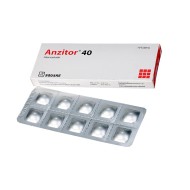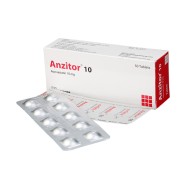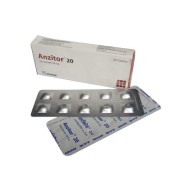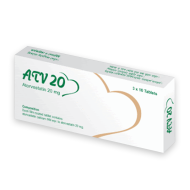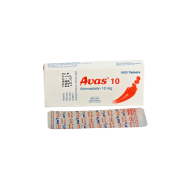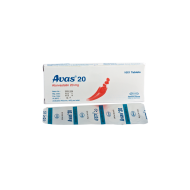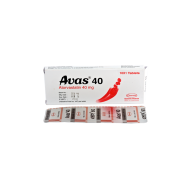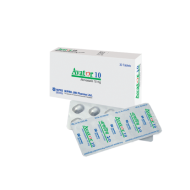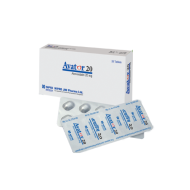
- Stock: Out Of Stock
- Brand: ACI Pharmaceuticals
- Product ID: Atorvastatin Calcium
🔒 100% Secure Payment | bKash | Nagad | SSLCommerz | COD
⭐ Become a FREE Member: 7% Extra Savings • Free Delivery • Refill Reminders • Priority Support
This Item is for pre order
Atasin 40 mg Tablet (Atorvastatin) – ACI Limited
| Brand Name | Atasin 40 mg Tablet |
|---|---|
| Generic Name | Atorvastatin Calcium 40 mg |
| Strength | 40 mg per tablet |
| Dosage Form | Tablet |
| Manufacturer | ACI Limited, Bangladesh |
| Drug Class | HMG-CoA Reductase Inhibitor (Statin) |
| Prescription Required | Yes (Rx) |
| Storage | Store below 30°C, cool and dry, protect from light. |
1. About Atasin 40 mg (Atorvastatin)
Atasin 40 mg Tablet contains Atorvastatin Calcium 40 mg, a high-intensity statin therapy option manufactured by ACI Limited, Bangladesh. At 40 mg, atorvastatin provides approximately 46–51% LDL-cholesterol reduction — placing it firmly within "high-intensity" statin therapy per ACC/AHA 2018 guidelines (defined as ≥50% LDL-C reduction at 40–80 mg). It is the standard dose for patients with established atherosclerotic cardiovascular disease (ASCVD), high-risk T2DM, and familial hypercholesterolaemia.
Atasin 40 mg is one of the most important doses in cardiovascular medicine in Bangladesh — the PROVE-IT TIMI-22 trial established 40 mg atorvastatin's superiority over 40 mg pravastatin in post-ACS patients, while the TNT trial showed 40 mg reduced events vs 10 mg in stable CAD. For many high-risk Bangladeshi patients with T2DM + CKD, established CAD, or post-stroke, the 40 mg dose is the minimum appropriate therapy.
2. Mechanism of Action
At 40 mg, atorvastatin provides near-maximal HMG-CoA reductase inhibition in clinical practice. The dose-response relationship for atorvastatin is logarithmic: 10 mg reduces LDL ~30–35%, 20 mg ~39–43%, 40 mg ~46–51%, 80 mg ~50–55%. The incremental benefit from 40 → 80 mg (approximately 4–5% additional LDL-C reduction) must be weighed against ~doubled myopathy risk at 80 mg. Most guidelines therefore use 40 mg as the standard high-intensity starting dose, reserving 80 mg for cases where LDL target is not met at 40 mg despite adherence.
Pleiotropic effects are maintained and potentially amplified at higher doses: greater CRP reduction, more pronounced endothelial function improvement, enhanced plaque stabilisation. These contribute to the incremental cardiovascular event reduction seen in the 40 vs 10/20 mg comparison trials.
3. Indications
- Established ASCVD (secondary prevention): Post-MI, post-ACS, stable angina, post-PCI, post-CABG, peripheral arterial disease, prior ischaemic stroke/TIA
- Familial hypercholesterolaemia (FH): Heterozygous FH — high-intensity statin required
- Very high-risk T2DM: T2DM + target organ damage (CKD, microalbuminuria, retinopathy, neuropathy) or T2DM + ≥3 CV risk factors
- High-risk primary prevention: 10-year CVD risk ≥20% where LDL target <1.8 mmol/L required
- Dose titration from 20 mg: When LDL target not achieved at 20 mg after 6–8 weeks
4. Dosage and Administration
40 mg once daily at any time of day, with or without food. The 14-hour half-life and active metabolites (t½ 20–30h) provide complete 24-hour inhibition regardless of timing. Recheck LDL-C at 6–8 weeks; if LDL target not met (e.g. <1.4 mmol/L for very-high-risk), increase to 80 mg or add ezetimibe 10 mg. No renal dose adjustment. Use cautiously in hepatic impairment — reduce dose, monitor closely.
5. Contraindications
- Active liver disease or persistently elevated transaminases
- Pregnancy (Category X) and lactation
- Hypersensitivity to atorvastatin or excipients
6. Warnings and Precautions
Myopathy/Rhabdomyolysis: Risk higher at 40 mg than 10–20 mg. Absolute risk remains low (<0.1% for rhabdomyolysis) but increases substantially with CYP3A4 inhibitors, cyclosporine, gemfibrozil, hypothyroidism, CKD, high-dose niacin, colchicine. Check CK if myalgia develops. Immune-mediated necrotising myopathy (IMNM) — rare, requires immunosuppressive treatment, does not resolve on statin withdrawal alone.
Hepatotoxicity: Higher doses carry slightly greater transaminase elevation risk. Monitor LFTs at baseline and if symptomatic. ALT >3× ULN on two consecutive measurements — consider dose reduction or switch.
Haemorrhagic stroke: Post-hoc data from SPARCL trial suggested possible increased haemorrhagic stroke with 80 mg in prior stroke patients. 40 mg appears safer; caution in prior haemorrhagic stroke.
7. Side Effects
Common: Myalgia (dose-dependent, higher at 40 mg), headache, arthralgia, nasopharyngitis, GI effects, insomnia, elevated CK.
Uncommon: Elevated transaminases, peripheral neuropathy, alopecia, erectile dysfunction, cognitive symptoms (memory, confusion).
Rare: Rhabdomyolysis, IMNM, severe hepatotoxicity, angioedema, lupus-like syndrome, pancreatitis.
8. Drug Interactions (Critical at 40 mg)
- Cyclosporine: Contraindicated or absolute maximum 10 mg — OATP1B1 + CYP3A4 inhibition markedly raises atorvastatin levels
- Strong CYP3A4 inhibitors (clarithromycin, itraconazole, HIV PIs): Significantly increase atorvastatin exposure — limit to 20 mg or switch
- Gemfibrozil: Avoid — increased myopathy risk; use fenofibrate if combination needed
- Colchicine + atorvastatin 40 mg: Myopathy risk — monitor closely, especially elderly
- Niacin ≥1g/day: Increased myopathy risk — caution
- Warfarin: Monitor INR — mild potentiation
9. High-Intensity Statin Therapy in Bangladeshi Practice
Bangladesh's high burden of T2DM, hypertension, and early-onset coronary artery disease (exacerbated by high saturated fat diet, smoking, central obesity, and sedentary lifestyles) means a large proportion of patients require high-intensity statin therapy. Atasin 40 mg represents ACI Limited's quality-assured high-intensity formulation for post-MI patients, T2DM with ASCVD, CKD + dyslipidaemia, and FH. The ESC/EAS 2019 guideline recommends maximally tolerated statin ± ezetimibe for very-high-risk patients, with LDL target <1.4 mmol/L and ≥50% reduction from baseline. Atasin 40 mg typically achieves this in patients with baseline LDL 2.8–3.5 mmol/L.
10. Storage
- Below 30°C, cool dry place, protected from light. Keep in original packaging. Keep out of reach of children.
Frequently Asked Questions (FAQ)
Q1: Who needs Atasin 40 mg (high-intensity atorvastatin)?
Atasin 40 mg is high-intensity statin therapy. It is indicated for: (1) All post-MI / post-ACS patients — regardless of baseline LDL (PROVE-IT trial: 40 mg atorvastatin reduced MACE 16% vs 40 mg pravastatin; intensive statin now standard post-ACS care); (2) Established ASCVD — stable angina, PAD, prior ischaemic stroke; (3) Very-high-risk T2DM — DM + CKD, DM + established CVD, DM + ≥3 risk factors; (4) Familial hypercholesterolaemia — high-intensity statin mandatory; (5) Primary prevention at very high 10-year CVD risk (>20%). Patients at moderate risk with LDL well-controlled at 10–20 mg do not need 40 mg.
Q2: What is the difference between Atasin 40 mg and Atasin 80 mg?
Atasin 40 mg and Atasin 80 mg both provide high-intensity statin therapy, but the additional LDL-C reduction from doubling to 80 mg is modest (~4–5% more: 46–51% at 40 mg vs 50–55% at 80 mg). However, the 80 mg dose doubles myopathy risk and is associated with slightly higher rates of hepatic transaminase elevations. For most high-risk patients, 40 mg achieves guideline LDL targets — 80 mg is reserved for the most extreme cases (FH with very high LDL, post-ACS with very high baseline LDL, or when 40 mg + ezetimibe does not achieve LDL <1.4 mmol/L). The ACC/AHA recommends 40–80 mg as high-intensity; ESC/EAS generally prefers 40 mg with add-on ezetimibe over 80 mg monotherapy for tolerability reasons.
Q3: Can I take Atasin 40 mg if I have a history of muscle aches on lower statin doses?
This requires careful assessment. If you experienced true statin-induced myopathy (confirmed elevated CK) at lower doses, 40 mg carries higher myopathy risk and should only be used with close monitoring or if lower doses have been retried successfully. However, most reports of "muscle aches on statins" are not pharmacological — the nocebo effect (expectation of side effects) accounts for a large proportion. The SAMSON trial (2020) found ~90% of statin-associated muscle symptoms were attributable to nocebo rather than pharmacological effect. Options include: retrial at lower dose; alternative statin (rosuvastatin, pravastatin — different CYP pathway or hydrophilicity); dose holidays with reintroduction; or add ezetimibe to allow lower statin dose achieving equivalent LDL reduction.
Q4: Should high-intensity statin (Atasin 40 mg) be combined with other lipid-lowering agents?
In patients who cannot achieve LDL targets with maximum tolerated statin alone, combination therapy is guideline-recommended: (1) Ezetimibe 10 mg — first add-on choice; inhibits intestinal cholesterol absorption; adds ~15–20% LDL-C reduction with excellent tolerability; evidence from IMPROVE-IT trial (simvastatin+ezetimibe reduced MACE post-ACS). Atasin 40 mg + ezetimibe 10 mg is a highly effective, well-tolerated combination. (2) PCSK9 inhibitors (evolocumab, alirocumab) — for FH and very-high-risk patients not meeting LDL targets on maximal statin + ezetimibe; adds 50–60% additional LDL reduction. Currently limited availability and high cost in Bangladesh. (3) Fenofibrate — for combined hyperlipidaemia with high triglycerides; can be safely combined with atorvastatin (unlike gemfibrozil).