- Stock: In Stock
- Brand: Aristopharma
- Product ID: Fexofenadine Hydrochloride
🔒 100% Secure Payment | bKash | Nagad | SSLCommerz | COD
⭐ Become a FREE Member: 7% Extra Savings • Free Delivery • Refill Reminders • Priority Support
This Item is for pre order
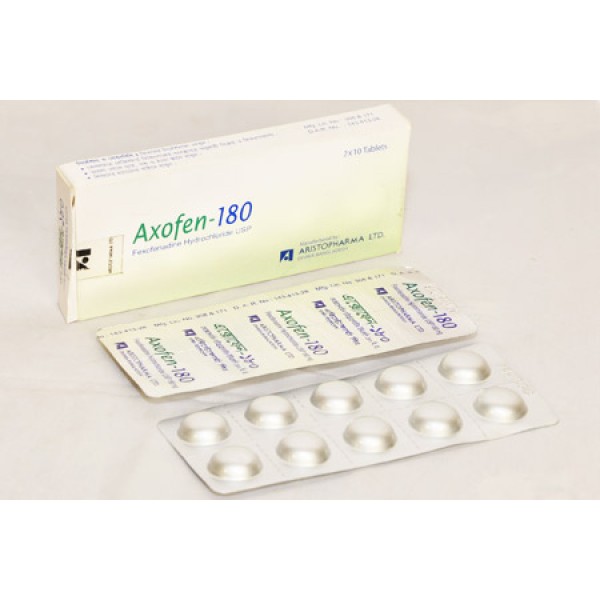
Axofen 180 mg Tablet (Fexofenadine HCl) — Clinical Information
| Brand Name | Axofen (Tab) 180mg/tab |
|---|---|
| Generic Name | Fexofenadine Hydrochloride |
| Manufacturer | ACI Limited, Bangladesh |
| Strength | 180 mg per tablet |
| Dosage Form | Film-coated Tablet |
| Drug Class | Non-Sedating H1 Antihistamine (2nd Generation) |
| Primary Indication | Chronic Idiopathic Urticaria; Moderate-to-Severe Allergic Rhinitis |
| Prescription Status | Prescription Only Medicine (POM) |
Axofen 180 mg — The Higher-Dose Antihistamine for Urticaria
Axofen (Tab) 180mg/tab represents the highest approved single-daily dose of fexofenadine within ACI's Axofen brand range. At 180 mg once daily, this formulation achieves greater peripheral H1 receptor occupancy than the 120 mg strength — making it the preferred choice when more complete histamine blockade is required, particularly for chronic idiopathic urticaria (CIU) and for adults with severe or difficult-to-control allergic rhinitis.
The Axofen brand by ACI Limited includes a paediatric suspension (30 mg/5 ml), an adult rhinitis tablet (120 mg), and this 180 mg tablet for urticaria and more demanding antihistamine applications. Across the range, all formulations share fexofenadine's defining pharmacological signature: potent peripheral H1 blockade, absence of CNS penetration, cardiac safety, and compatibility with complex medication regimens including antidiabetic polypharmacy.
Mechanism of Action at 180 mg
Fexofenadine is a selective, inverse agonist at peripheral histamine H1 receptors. At the 180 mg dose, the higher plasma concentration (Cmax approximately 494 ng/ml) results in prolonged and more complete receptor occupancy versus 120 mg (Cmax ~427 ng/ml). This pharmacokinetic difference translates into clinically relevant differences in:
- Urticaria suppression: More complete blockade of histamine-mediated wheal formation and flare — directly relevant to the pathophysiology of chronic hives
- Duration at therapeutic concentrations: Plasma levels remain above the effective threshold for a longer interval within the 24-hour dosing window
- Pruritus control: Skin pruritus (itching) driven by peripheral H1 activation is more effectively suppressed at 180 mg
Key safety advantages preserved at the 180 mg dose: no QTc prolongation, no CNS sedation, no CYP450 enzyme interactions, no anticholinergic activity.
Approved Clinical Indications
- Chronic idiopathic urticaria (CIU): Adults — 180 mg once daily is the first-choice antihistamine dose per international dermatology guidelines (EAACI/GA²LEN/EDF/WAO)
- Seasonal allergic rhinitis (SAR): For patients with moderate-to-severe symptoms or inadequate response to fexofenadine 120 mg
- Perennial allergic rhinitis (PAR): In patients requiring higher-level histamine receptor blockade for year-round symptom control
Dosage and Administration
- Adults and adolescents ≥12 years: 180 mg orally once daily, with or without food, at approximately the same time each day
- Renal impairment: Reduce to 60 mg once daily — renal excretion is the primary elimination pathway (~80% unchanged)
- Hepatic impairment: No dose adjustment required
- Elderly: No specific dose reduction unless renal function is impaired
- Duration for CIU: Typically 3–6 months minimum; may need to continue until spontaneous remission, reassessed periodically
Administration note: Take with water only. Fruit juices (orange, apple, grapefruit) reduce bioavailability by up to 36% via OATP transporter inhibition. Antacids with aluminium/magnesium should be taken ≥2 hours apart.
Interactions Relevant to Diabetic Patients
Axofen 180 mg is one of the safest antihistamines to use alongside the complex medication regimens common in Bangladeshi diabetes management:
- Metformin: No interaction — both are renally excreted, no shared metabolic pathways
- Sulphonylureas (glibenclamide, glipizide, glimepiride): No CYP2C9 inhibition or induction by fexofenadine — no altered sulphonylurea exposure
- Insulin (all types): No pharmacodynamic interaction — no effect on glucose, insulin sensitivity, or counterregulatory response
- DPP-4 inhibitors (sitagliptin, vildagliptin, saxagliptin): No CYP3A4 or P-gp interaction of clinical significance at standard doses
- SGLT-2 inhibitors (dapagliflozin, empagliflozin): No known interaction
- Caution with erythromycin or ketoconazole: These inhibit P-glycoprotein and OATP transporters, increasing fexofenadine plasma levels by 109% and 164% respectively — monitor for increased side effects if co-prescribed
Side Effects and Safety Profile
- Very common: Headache (frequency similar to placebo in clinical trials)
- Common: Dizziness, nausea, fatigue — at rates indistinguishable from placebo
- Uncommon: Dry mouth, insomnia
- Rare: Hypersensitivity reactions (rash, urticaria paradoxically worsening, dyspnoea)
- Not reported at any dose: Sedation above placebo rates, QTc prolongation, significant anticholinergic effects
Frequently Asked Questions (FAQ)
What makes Axofen 180 mg different from Axofen 120 mg?
The primary difference is the intended clinical use and degree of H1 receptor blockade. Axofen 120 mg is the standard dose for allergic rhinitis (hay fever). Axofen 180 mg is the recommended dose for chronic idiopathic urticaria (CIU) and for more severe rhinitis symptoms, because urticaria requires higher receptor occupancy to adequately suppress histamine-driven wheal and flare reactions. Both are taken once daily and are equally non-sedating.
Is Axofen 180 mg safe for diabetic patients with kidney disease?
Diabetic patients with significant chronic kidney disease (diabetic nephropathy) may need a lower dose because approximately 80% of each fexofenadine dose is eliminated by the kidneys unchanged. If your eGFR is significantly below 80 ml/min, your doctor will likely recommend reducing to 60 mg once daily. Patients with normal or mildly reduced renal function can take Axofen 180 mg safely. Renal function should be monitored routinely in diabetic patients, and antihistamine dosing adjusted as kidney function changes.
How long does Axofen 180 mg take to work for hives?
Fexofenadine 180 mg reaches peak plasma concentration within 1–3 hours of administration, with antihistamine effects becoming clinically noticeable within 1–2 hours for acute itch relief. For chronic idiopathic urticaria, full therapeutic benefit typically takes several days of consistent daily dosing to manifest, as the condition requires sustained H1 blockade rather than single-dose rescue. Do not stop taking Axofen 180 mg abruptly when hives appear to improve — complete the prescribed course to prevent rebound.
Can Axofen 180 mg be taken every day for months?
Yes — fexofenadine is suitable for extended daily use. Unlike some sedating antihistamines, it does not cause tolerance or loss of efficacy with long-term use. International dermatology guidelines recommend taking antihistamines daily (not on-demand) for chronic urticaria to maintain consistent H1 receptor blockade. Axofen 180 mg has been used in clinical trials for periods of up to 12 weeks without evidence of tachyphylaxis, cumulative toxicity, or significant adverse events.