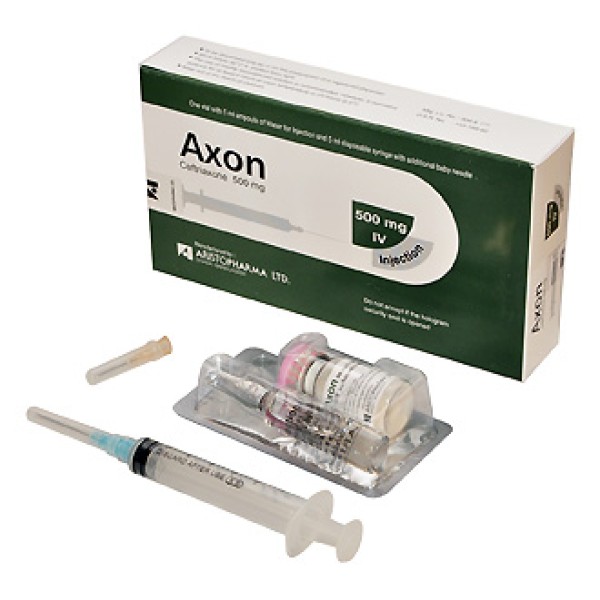
- Stock: Pre-Order
- Brand: Aristopharma
- Product ID: Ceftriaxone
🔒 100% Secure Payment | bKash | Nagad | SSLCommerz | COD
⭐ Become a FREE Member: 7% Extra Savings • Free Delivery • Refill Reminders • Priority Support
This Item is for pre order
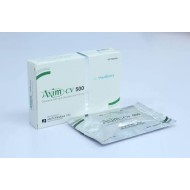
Axon 500 mg Injection (Ceftriaxone) — Clinical Overview
| Brand Name | Axon (Inj) 500 mg |
|---|---|
| Generic Name | Ceftriaxone Sodium |
| Manufacturer | ACI Limited, Bangladesh |
| Strength | 500 mg per vial |
| Dosage Form | Powder for Injection (Reconstituted IV/IM) |
| Drug Class | Third-Generation Cephalosporin Antibiotic |
| Route of Administration | Intravenous (IV) or Intramuscular (IM) |
| Prescription Status | Prescription Only Medicine (POM) |
About Axon 500 mg Injection
Axon 500 mg Injection is a ceftriaxone sodium 500 mg vial for parenteral use, manufactured by ACI Limited, Bangladesh. The 500 mg strength sits between the 250 mg (used for gonorrhoea and paediatric cases) and the 1 g vial (the standard adult dose for most serious infections). Axon 500 mg is used as a standalone dose in moderate infections requiring parenteral cover, as a prophylactic agent in select surgical settings, and as part of paediatric dosing regimens where weight-based calculations fall in the 500 mg range.
Ceftriaxone's once-daily IV/IM administration, driven by its unusually long half-life (~8 hours), makes it operationally convenient in both inpatient and outpatient parenteral therapy settings. This property is particularly valuable in Bangladesh, where many patients with diabetes requiring infection treatment may need outpatient parenteral therapy rather than hospital admission.
Mechanism of Action
Ceftriaxone is bactericidal — it kills bacteria by irreversibly binding to penicillin-binding proteins (PBPs) on the bacterial cell wall, halting peptidoglycan cross-linking and causing osmotic lysis. The β-lactam ring of ceftriaxone mimics the D-Ala-D-Ala terminus of the peptidoglycan precursor chain, occupying PBP active sites and blocking the transpeptidase and carboxypeptidase reactions essential to structural cell wall integrity. Ceftriaxone's stability against most β-lactamases (except ESBLs and AmpC) broadens its gram-negative coverage compared to earlier cephalosporins.
Clinical Indications for 500 mg Dosing
- Community-acquired pneumonia (CAP, mild-moderate): 500 mg IV/IM once daily may be used for uncomplicated CAP in patients requiring brief parenteral therapy before oral step-down
- Surgical prophylaxis: 500 mg–1 g given 30–60 minutes pre-operatively for clean-contaminated and contaminated procedures
- Paediatric serious infections (weight 8–15 kg): 50–100 mg/kg/day once daily — 500 mg falls within range for children in this weight band
- Moderate UTI requiring parenteral therapy: 500 mg once daily pending urine culture and sensitivity results
- Step-down from 1 g in improving patients: Clinical judgment may support dose reduction to 500 mg once daily as infection responds
Dosage and Administration
- Reconstitution (IM): Dissolve 500 mg in 1.8 ml of 1% lidocaine injection (without adrenaline) for IM use — reduces injection pain significantly
- Reconstitution (IV push): Dissolve in 10 ml sterile water; administer slowly over 2–4 minutes
- IV infusion: Dilute reconstituted solution in 50–100 ml of 0.9% normal saline or 5% dextrose; infuse over 30 minutes
- Frequency: Once daily in most indications (half-life ~8 hours supports 24-hour dosing)
- Duration: Varies by indication — typically 5–14 days; longer courses for osteomyelitis or deep tissue infections
- Calcium incompatibility: Never co-administer or mix with calcium-containing fluids (Ringer's lactate, Hartmann's) — risk of ceftriaxone-calcium precipitate formation
Use in Diabetic Patients — Key Scenarios
- Outpatient parenteral therapy for DFI: Patients with moderate diabetic foot infections who do not require ICU-level care but cannot tolerate oral antibiotics may receive daily IV/IM ceftriaxone on an outpatient basis, reducing hospitalisation costs and risk of nosocomial infection.
- Pre-operative prophylaxis in diabetic surgery: Diabetic patients undergoing elective surgery face higher surgical site infection (SSI) risk due to impaired neutrophil function and microvascular disease. Pre-operative ceftriaxone provides effective gram-negative and gram-positive (non-MRSA) prophylaxis.
- Typhoid fever management: Enteric fever (Salmonella typhi) remains common in Bangladesh. Ceftriaxone 500 mg–1 g once daily is the first-line parenteral treatment, with 10–14 day courses required. Diabetic patients with typhoid face greater risk of serious complications and may need IV therapy even for less severe presentations.
- Blood glucose monitoring during therapy: Concurrent infections elevate blood glucose via cortisol and adrenaline release. Monitoring blood glucose at least 4 times daily during acute parenteral antibiotic therapy allows timely insulin dose adjustment.
Frequently Asked Questions (FAQ)
When is Axon 500 mg used instead of 250 mg or 1 g?
Axon 500 mg occupies a clinically useful mid-range dose. It is preferred over 250 mg when the severity or site of infection requires more than the minimum effective dose, and over 1 g when infection is moderate rather than severe, in paediatric patients in the 8–15 kg weight range, as surgical prophylaxis in some protocols, or during dose step-down in a responding patient. The prescribing clinician determines the appropriate strength based on infection type, severity, patient weight, and renal function.
How is Axon 500 mg injection prepared and administered?
For IM use: dissolve the 500 mg powder in 1.8 ml of 1% lidocaine injection (without adrenaline) to reduce pain, then inject deep into a large muscle. For IV push: dissolve in 10 ml sterile water and administer slowly over 2–4 minutes. For IV infusion: dissolve and further dilute in 50–100 ml 0.9% normal saline or 5% dextrose and infuse over 30 minutes. Never mix with calcium-containing IV fluids. Reconstituted solution should be used promptly; if refrigerated, within 24 hours.
Can ceftriaxone cause allergic reactions?
Yes — as a beta-lactam antibiotic, ceftriaxone can cause allergic reactions ranging from mild skin rash to life-threatening anaphylaxis. Before administration, always ask about previous penicillin or cephalosporin allergy. Cross-reactivity between penicillins and cephalosporins is approximately 1–2%. A history of severe anaphylaxis to penicillin is a relative contraindication; milder penicillin reactions do not preclude ceftriaxone use with caution. Have adrenaline available wherever ceftriaxone is administered parenterally.
Does ceftriaxone affect blood sugar in diabetic patients?
Ceftriaxone itself does not directly alter blood glucose. However, the underlying infection being treated causes stress hyperglycaemia — elevated cortisol and adrenaline from the immune response increases hepatic glucose output and reduces insulin sensitivity. As the infection resolves with antibiotic therapy, blood glucose typically falls and insulin requirements decrease. Monitoring glucose frequently (4 times daily minimum) during active infection and antibiotic treatment allows appropriate insulin dose adjustments to prevent both hyperglycaemia and rebound hypoglycaemia as the patient recovers.