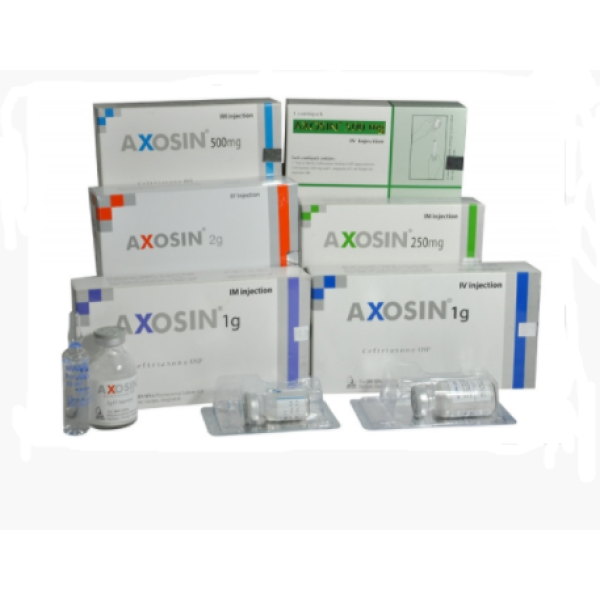
- Stock: In Stock
- Brand: Ibn-Sina Pharmaceuticals Ltd.
- Product ID: Ceftriaxone
🔒 100% Secure Payment | bKash | Nagad | SSLCommerz | COD
⭐ Become a FREE Member: 7% Extra Savings • Free Delivery • Refill Reminders • Priority Support
This Item is for pre order
Axosin IM 250 mg Injection (Ceftriaxone Sodium) — Clinical Overview
| Brand Name | Axosin i.m Inj. 250 mg |
|---|---|
| Generic Name | Ceftriaxone Sodium |
| Manufacturer | ACI Limited, Bangladesh |
| Strength | 250 mg per vial |
| Dosage Form | Powder for Injection (IM/IV) |
| Drug Class | Third-Generation Cephalosporin Antibiotic |
| Primary Route | Intramuscular (IM) |
| Prescription Status | Prescription Only Medicine (POM) |
About Axosin IM 250 mg Injection
Axosin IM 250 mg is ceftriaxone sodium 250 mg in ACI Limited's Axosin brand, designed for intramuscular administration. ACI markets ceftriaxone injection under two complementary brands — Axon and Axosin — providing healthcare professionals in Bangladesh with flexible procurement options across different formulation presentations and pack specifications while maintaining the same active molecule, spectrum of activity, and clinical efficacy.
At the 250 mg dose, Axosin IM is particularly valuable for single-dose gonorrhoea treatment — the WHO-recommended first-line intramuscular therapy for uncomplicated Neisseria gonorrhoeae infection — as well as for paediatric infections where weight-based dosing yields doses in this range, and for situations requiring a minimal effective parenteral antibiotic dose. The small injection volume (approximately 1 ml after lidocaine reconstitution) makes this the most patient-friendly of all ceftriaxone IM strengths in terms of injection comfort and site tolerance.
Bactericidal Mechanism
Ceftriaxone kills susceptible bacteria by irreversible binding to penicillin-binding proteins (PBPs) on the bacterial cell membrane, preventing the final cross-linking step of peptidoglycan synthesis. This results in structural cell wall weakness and osmotic lysis. The beta-lactam ring of ceftriaxone is stable against most plasmid-mediated beta-lactamases but susceptible to hydrolysis by ESBLs and AmpC-type enzymes — an important consideration in Bangladesh where ESBL-producing Enterobacteriaceae (particularly E. coli and Klebsiella) are increasingly prevalent.
Clinical Applications of Axosin IM 250 mg
- Uncomplicated gonorrhoea: 250 mg IM single dose + azithromycin 1 g oral for dual-therapy coverage of N. gonorrhoeae and concurrent chlamydial infection — WHO and Bangladesh STI management guideline endorsed
- Paediatric bacterial infections: Weight-based ceftriaxone at 50–100 mg/kg/day for infants/children weighing 2.5–5 kg; the 250 mg dose is appropriate in this paediatric weight range for once-daily IM administration
- Mild-moderate community infections requiring initial IM dose: Single parenteral loading dose before transitioning to oral therapy; bridging approach in settings with no IV access
- Outpatient injection therapy: For patients presenting at pharmacy injection services or outpatient clinics with bacterial infections not severe enough for hospitalisation but beyond oral antibiotic capability
Reconstitution and Injection Technique
- Reconstitution medium: 0.9 ml of 1% lidocaine HCl injection (WITHOUT adrenaline/epinephrine)
- Resulting volume: Approximately 1.0 ml — minimal, easily accommodated in a single IM site
- Injection site: Upper outer gluteus maximus or vastus lateralis (anterolateral thigh) using a 21–23G needle
- Technique: Swift insertion, aspirate, inject slowly over 5 seconds, apply gentle pressure post-withdrawal
- Single-dose use: For gonorrhoea, reconstitute and administer immediately; do not store reconstituted solution
- Temperature: Lyophilised powder stable at room temperature; reconstituted solution must be used promptly
Relevance for Patients with Diabetes
- STI and diabetes: Any concurrent infection including sexually transmitted infections can destabilise glycaemic control through stress-mediated hormonal responses. Single-dose IM ceftriaxone for gonorrhoea provides rapid, reliable bacterial eradication — helping restore baseline glycaemic stability faster than multi-day oral regimens.
- Diabetic children: Paediatric patients with type 1 diabetes requiring IM antibiotics for serious infections may receive weight-appropriate ceftriaxone dosing within the 250 mg range. Close glucose monitoring is essential during any bacterial infection in children with type 1 diabetes, as inflammatory mediators cause significant insulin resistance.
- Allergy screening: Before administering any beta-lactam antibiotic in a diabetic patient, check for prior penicillin or cephalosporin allergy. Cross-reactivity between penicillins and 3rd-gen cephalosporins is low (~1–2%), but anaphylaxis readiness (adrenaline, antihistamine) is essential at any injection site.
Frequently Asked Questions (FAQ)
What is the difference between Axosin and Axon ceftriaxone injection?
Both Axosin and Axon are ACI Limited's brand names for ceftriaxone sodium injection. They contain the same active ingredient (ceftriaxone sodium) at the same strengths and deliver identical clinical efficacy and safety profiles. The two brands provide prescribers and procurement teams with flexibility in sourcing parenteral ceftriaxone from ACI's antibiotic portfolio. Clinically, there is no meaningful difference between Axosin and Axon ceftriaxone for patient outcomes.
How many injections of Axosin 250 mg are needed for gonorrhoea?
Only one. A single 250 mg intramuscular injection of ceftriaxone is the complete treatment for uncomplicated gonorrhoea. It should ideally be combined with a single oral dose of azithromycin 1 g (taken at the same visit) to cover concurrent chlamydial infection, which occurs in 20–40% of gonorrhoea cases. No further ceftriaxone injections are required unless symptoms persist or test-of-cure at 7 days reveals treatment failure or reinfection.
Is Axosin 250 mg suitable for children with diabetes who have bacterial infections?
Yes — ceftriaxone is used in paediatric bacterial infections at 50–100 mg/kg/day, and the 250 mg dose is appropriate for infants and young children in the 2.5–5 kg weight range. Children with type 1 diabetes receiving IM ceftriaxone for bacterial infections require careful blood glucose monitoring — bacterial infections cause significant insulin resistance via pro-inflammatory cytokines and stress hormones, making glucose control more challenging. A paediatrician should oversee antibiotic and insulin management in these patients.
Can Axosin IM 250 mg be stored after reconstitution?
For single-dose applications (such as gonorrhoea treatment), reconstituted Axosin should be administered immediately after preparation. If storage is necessary, reconstituted ceftriaxone solutions are stable for up to 6 hours at room temperature (25°C) or 24 hours when refrigerated (2–8°C). However, for maximum sterility and stability assurance — particularly important in Bangladesh's climate — use immediately after reconstitution. Never use reconstituted solution that appears cloudy or contains particles.