- Stock: In Stock
- Brand: Ibn-Sina Pharmaceuticals Ltd.
- Product ID: Ceftriaxone
Available Options
🔒 100% Secure Payment | bKash | Nagad | SSLCommerz | COD
⭐ Become a FREE Member: 7% Extra Savings • Free Delivery • Refill Reminders • Priority Support
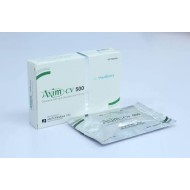
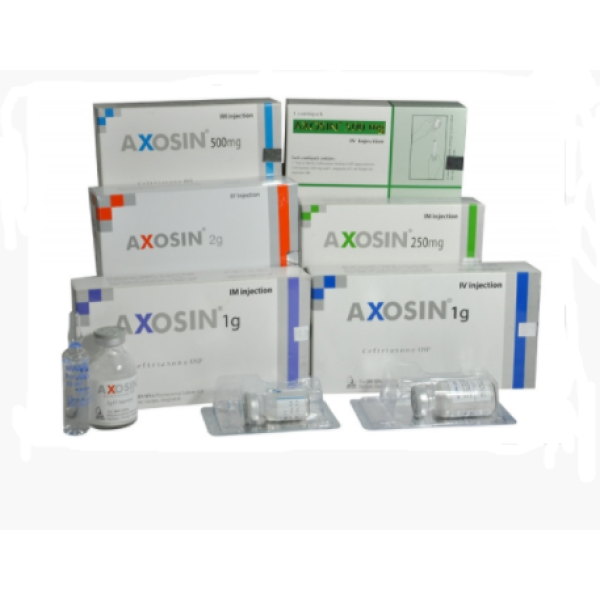
Axosin IM 500 mg Injection (Ceftriaxone Sodium) — Clinical Overview
| Brand Name | Axosin i.m Inj. 500 mg |
|---|---|
| Generic Name | Ceftriaxone Sodium |
| Manufacturer | ACI Limited, Bangladesh |
| Strength | 500 mg per vial |
| Dosage Form | Powder for Injection (IM/IV) |
| Drug Class | Third-Generation Cephalosporin Antibiotic |
| Route | Intramuscular (IM) / Intravenous (IV) |
| Prescription Status | Prescription Only Medicine (POM) |
About Axosin IM 500 mg Injection
Axosin IM 500 mg is a ceftriaxone sodium 500 mg parenteral injection by ACI Limited under the Axosin brand, formulated for intramuscular delivery. Within ACI's range of ceftriaxone products, the 500 mg strength bridges the minimal 250 mg (primarily gonorrhoea/paediatric) and the standard adult 1 g (most serious systemic infections) — making it clinically useful for moderate infections, surgical prophylaxis, and paediatric patients requiring higher weight-based doses without reaching the full 1 g threshold.
In Bangladesh's community healthcare infrastructure, the 500 mg IM dose is commonly used at outpatient injection clinics, primary care centres, and pharmacy injection services for patients with moderate bacterial infections who are not systemically unwell enough to require IV antibiotics or hospital admission. ACI's dual-brand availability (Axosin IM 500 mg alongside Axon IM 500 mg) ensures consistent supply and procurement flexibility across the country's healthcare network.
Spectrum of Activity and Resistance Considerations
At 500 mg IM once daily, ceftriaxone achieves plasma concentrations that exceed the MIC90 for most susceptible gram-positive (excluding MRSA and Enterococcus) and gram-negative pathogens throughout the 24-hour dosing interval. Key susceptibility points relevant to Bangladesh:
- Susceptible: Streptococcus pneumoniae (pen-sensitive and intermediate), Streptococcus pyogenes, MSSA Staphylococcus aureus, E. coli (non-ESBL), Klebsiella pneumoniae (non-ESBL), Haemophilus influenzae, Neisseria species, Salmonella typhi/paratyphi, Proteus mirabilis
- Reduced susceptibility or resistant: ESBL-producing E. coli and Klebsiella (increasingly common in Bangladesh — treat with carbapenems), MRSA, Pseudomonas aeruginosa, Acinetobacter baumannii, Enterococcus spp., Listeria monocytogenes
- Clinical implication: In Bangladesh's high ESBL-prevalence environment, obtain urine culture before empirical ceftriaxone for UTI — if ESBL-positive, escalate to ertapenem or meropenem
Dosage, Reconstitution, and Administration
- Standard adult dose: 500 mg IM once daily (some clinicians prefer 1 g for most adult infections — verify with prescriber)
- Surgical prophylaxis: 500 mg to 1 g IM single dose 30–60 minutes pre-operatively
- Paediatric (8–15 kg): Weight-based dosing at 50–100 mg/kg/day may yield a 500 mg once-daily dose
- Reconstitution (IM): Dissolve in 1.8 ml of 1% lidocaine HCl without adrenaline; resulting volume ~2.0 ml — comfortable at single IM site
- Reconstitution (IV): Dissolve in 10 ml sterile water for injection; administer over 2–4 minutes IV push, or further dilute in 50–100 ml NS/D5W and infuse over 30 minutes
- Calcium incompatibility: Never mix or co-administer with calcium-containing IV solutions
- Frequency: Once daily — long half-life (~8 hours) maintains therapeutic levels throughout 24-hour interval
Outpatient Parenteral Therapy (OPAT) with Axosin IM 500 mg
Axosin IM 500 mg is well-suited for OPAT programmes in Bangladesh — where patients attend a clinic or pharmacy daily for their injection and return home otherwise:
- Eligibility criteria for IM OPAT: Clinically stable patient; no systemic inflammatory response syndrome (SIRS); infection accessible to antibiotic penetration at 500 mg; daily attendance feasible; no allergy to beta-lactams
- Monitoring during OPAT: Clinical assessment at each injection visit; temperature, pulse, and wound assessment for DFI patients; urine dipstick for UTI patients; blood glucose for diabetic patients
- Escalation criteria: Fever persisting after 48–72 hours, worsening local signs, new systemic symptoms — requires same-day medical review and likely hospital admission for IV therapy
- Step-down to oral: Once culture and sensitivity confirm a sensitive organism amenable to oral therapy, transition to appropriate oral antibiotic to complete the total antibiotic course
Frequently Asked Questions (FAQ)
Is Axosin 500 mg IM the same as Axon 500 mg IM?
Yes — both Axosin IM 500 mg and Axon IM 500 mg are ACI Limited products containing ceftriaxone sodium 500 mg per vial. They are equivalent in terms of active ingredient, dosing, clinical indication, spectrum of activity, and safety profile. The two brand names within ACI's portfolio provide procurement and supply flexibility. Either brand may be prescribed or dispensed depending on availability, and substitution between them does not affect treatment outcomes.
Should 500 mg or 1 g ceftriaxone be used for an adult with pneumonia?
For adults with community-acquired pneumonia, international guidelines and most Bangladeshi clinical practice favour 1 g once daily as the standard adult dose for pneumonia requiring parenteral therapy. The 500 mg dose may be sufficient for mild pneumonia presentations, paediatric patients, or as a step-down approach in improving patients. Your treating physician will select the appropriate dose based on severity scoring (e.g., CURB-65), the patient's weight and renal function, and local antibiotic protocols.
Can Axosin IM 500 mg cover ESBL-producing bacteria?
No — ceftriaxone is hydrolysed and inactivated by ESBL (extended-spectrum beta-lactamase) enzymes produced by certain E. coli, Klebsiella, and other Enterobacteriaceae strains. ESBL-producing organisms are increasingly common causes of UTI, biliary tract infections, and bacteraemia in Bangladesh. If urine or blood culture confirms ESBL positivity, ceftriaxone must be discontinued and replaced with a carbapenem antibiotic (ertapenem, meropenem, or imipenem). This is particularly important for diabetic patients, who are at higher risk of ESBL-producing UTI due to frequent antibiotic exposure and recurrent infections.
How long does a course of Axosin 500 mg IM typically last?
Duration depends on the infection being treated: uncomplicated UTI/pyelonephritis typically 5–7 days; community-acquired pneumonia 5–10 days; skin and soft tissue infections 7–14 days; diabetic foot infections 14–21 days or longer based on wound healing; surgical prophylaxis is a single dose only. Once clinical improvement is established and culture/sensitivity results available, consider stepping down to an appropriate oral antibiotic to complete the course, reducing injection burden and cost.