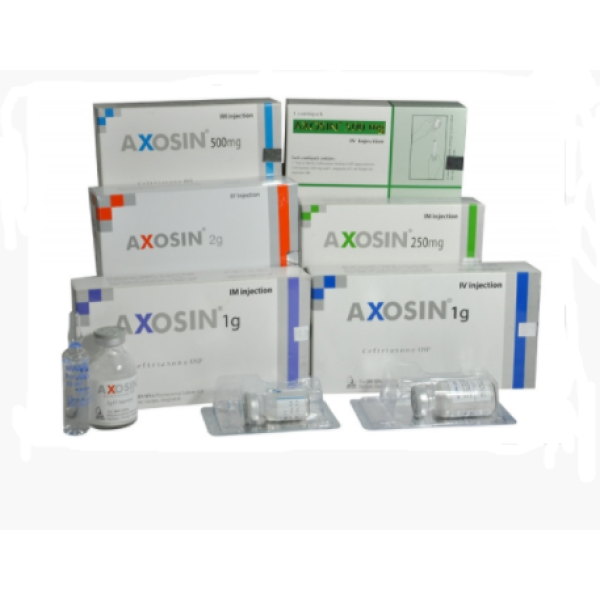
- Stock: In Stock
- Brand: Ibn-Sina Pharmaceuticals Ltd.
- Product ID: Ceftriaxone
Available Options
🔒 100% Secure Payment | bKash | Nagad | SSLCommerz | COD
⭐ Become a FREE Member: 7% Extra Savings • Free Delivery • Refill Reminders • Priority Support
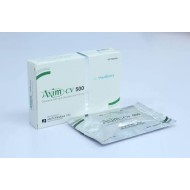
Axosin IV 1gm Injection (Ceftriaxone Sodium) — Clinical Overview
| Attribute | Details |
|---|---|
| Brand Name | Axosin |
| Generic Name | Ceftriaxone Sodium |
| Strength | 1 gram (1000 mg) |
| Dosage Form | Powder for Intravenous (IV) Injection/Infusion |
| Drug Class | Third-generation Cephalosporin Antibiotic |
| Manufacturer | ACI Limited, Bangladesh |
| Route of Administration | Intravenous (IV bolus or infusion) |
| Pack Size | Single vial |
What Is Axosin IV 1gm and How Does It Work?
Axosin IV 1gm contains ceftriaxone sodium, a third-generation cephalosporin antibiotic manufactured by ACI Limited, Bangladesh. The intravenous formulation achieves significantly higher and more rapid peak serum concentrations compared to the intramuscular route, making it the preferred choice for severe systemic infections where immediate bactericidal action is required.
Ceftriaxone exerts its antibacterial effect by binding to penicillin-binding proteins (PBPs), thereby inhibiting transpeptidation — the final cross-linking step in bacterial cell wall synthesis. This leads to osmotic lysis and rapid bacterial death. The broad-spectrum activity covers gram-positive cocci (including Streptococcus pneumoniae), gram-negative rods (including Enterobacteriaceae), and many anaerobes, with the notable exception of Pseudomonas aeruginosa and MRSA.
A pharmacokinetic advantage of IV ceftriaxone is its ability to penetrate the blood-brain barrier (BBB) at therapeutic concentrations, particularly when inflammation is present, making the 1g–2g IV dose the standard for bacterial meningitis treatment in adults.
Approved Indications for Axosin IV 1gm
The IV route is preferred over IM for infections where rapid tissue distribution and sustained high serum levels are critical. Approved indications include: bacterial meningitis (adults and children — note: 2g dose preferred for meningitis in adults); community-acquired and hospital-acquired pneumonia requiring IV therapy; complicated intra-abdominal infections (typically combined with metronidazole); septicaemia and bacteraemia; acute pyelonephritis and complicated urinary tract infections; pelvic inflammatory disease (PID) requiring hospitalisation; severe skin and soft tissue infections including necrotising fasciitis (combined with other agents); spontaneous bacterial peritonitis (SBP) in cirrhotic patients; and surgical prophylaxis for high-risk procedures (single 1–2g dose 30–60 minutes pre-incision).
IV Reconstitution and Administration Protocol
Correct reconstitution of Axosin IV 1gm is essential for patient safety and drug stability. Step 1 — Reconstitution: dissolve the 1g powder in 10 mL of sterile water for injection (SWFI). Shake gently until fully dissolved; the solution should be pale yellow to amber. Do NOT use lidocaine for IV reconstitution (lidocaine is reserved for IM route only). Step 2 — Dilution: for IV infusion, further dilute the reconstituted solution in 50–100 mL of 0.9% sodium chloride (normal saline) or 5% dextrose. Step 3 — Infusion rate: administer over at least 30 minutes. Rapid IV bolus injection over less than 4 minutes is not recommended due to the risk of cardiac arrhythmias, particularly in neonates. Step 4 — Compatibility: ceftriaxone must NOT be mixed with calcium-containing IV fluids (including Ringer's lactate) in the same line due to precipitation risk. Flush IV lines with saline before and after ceftriaxone if calcium-containing fluids are running.
Stability: once reconstituted, use within 6 hours at room temperature or within 24 hours refrigerated (2–8°C). Discard any unused portion.
Dosage in Adult Infections
Standard adult dose: 1–2g IV once daily (every 24 hours). The long plasma half-life of ceftriaxone (6–9 hours) permits once-daily dosing, improving compliance and reducing nursing workload in hospital settings. For most community-acquired pneumonia, uncomplicated sepsis, and pyelonephritis, 1g once daily is sufficient. For meningitis, severe hospital-acquired infections, and life-threatening sepsis: 2g once daily (or 1g every 12 hours). Surgical prophylaxis: 1g single IV dose 30–60 minutes before incision. Endocarditis: 2g IV once daily for 4–6 weeks (for streptococcal endocarditis in combination with aminoglycoside). Duration of therapy is typically 5–14 days depending on site and severity of infection.
Paediatric IV Dosing
Ceftriaxone IV is widely used in hospitalised children. Standard paediatric dose: 50–100 mg/kg/day IV once daily (maximum 2g/day for most indications). For bacterial meningitis in children: 100 mg/kg/day IV (maximum 4g/day) in two divided doses for the first 24 hours, then once daily thereafter. Neonates (0–28 days): special caution required — ceftriaxone must NOT be administered simultaneously with calcium-containing IV fluids due to risk of fatal ceftriaxone-calcium precipitate in neonatal lungs and kidneys. This interaction is unique to neonates and is a WHO black-box warning. In neonates with hyperbilirubinaemia, ceftriaxone should be avoided as it may displace bilirubin from albumin binding sites.
Spontaneous Bacterial Peritonitis (SBP) — A Key Bangladesh Hospital Use
Liver cirrhosis with ascites is prevalent in Bangladesh due to high rates of hepatitis B and C virus infection. Spontaneous bacterial peritonitis (SBP) is a life-threatening complication in cirrhotic patients, caused most commonly by gram-negative enteric organisms. Ceftriaxone 1g IV once daily for 5–7 days is the first-line empirical treatment for SBP per international guidelines (EASL, AASLD). Axosin IV 1gm provides cost-effective SBP coverage compared to imported alternatives. Co-administration with albumin 1.5g/kg IV on day 1 and 1g/kg IV on day 3 significantly reduces the risk of hepatorenal syndrome.
Biliary Excretion and Ceftriaxone-Associated Biliary Pseudolithiasis
Unlike most antibiotics, ceftriaxone is excreted both renally (33–67%) and biliary (17–50%). Biliary ceftriaxone can form insoluble calcium-ceftriaxone salts in bile, resulting in biliary sludge or pseudolithiasis — a reversible, drug-induced condition resembling gallstones on ultrasound. This occurs in approximately 2–40% of patients on prolonged ceftriaxone therapy (usually more than 10 days). The condition is generally asymptomatic but can occasionally cause biliary colic or obstructive jaundice. It is fully reversible upon discontinuation of the drug. Clinicians using Axosin IV for extended treatment courses (e.g., endocarditis, osteomyelitis) should be aware of this phenomenon and avoid unnecessary alarm at incidental biliary findings during treatment.
Drug Interactions
Key interactions to note: calcium-containing solutions (including Ringer's lactate, Hartmann's solution, parenteral nutrition containing calcium) — contraindicated in the same IV line and in neonates generally. Warfarin — ceftriaxone may prolong prothrombin time; monitor INR closely. Aminoglycosides (gentamicin, amikacin) — synergistic activity for gram-negative sepsis, but administer via separate IV lines and time apart (aminoglycoside nephrotoxicity is enhanced by co-administration). Probenecid — does not significantly affect ceftriaxone clearance unlike other cephalosporins. Oral contraceptives — theoretical reduction in efficacy due to gut flora disruption (clinical significance is debated).
Storage and Handling
Store Axosin IV 1gm vials at room temperature below 30°C, away from direct sunlight and moisture. Protect from freezing. The dry powder is stable until the printed expiry date. Once reconstituted, use promptly. Discard unused portions according to hospital waste disposal protocols — do not save partially used vials for future doses. Follow hospital infection control procedures for IV preparation in a clean environment or laminar flow hood where available.
Frequently Asked Questions (FAQ)
Q1: What is the difference between Axosin IV and Axosin IM injection?
Both contain ceftriaxone sodium manufactured by ACI Limited; the difference is the route of administration. Axosin IV is reconstituted with sterile water only and administered into a vein over ≥30 minutes, achieving rapid peak serum levels suited for severe infections. Axosin IM is reconstituted with 1% lidocaine to reduce injection site pain and given into muscle (gluteal or thigh). The IV route is preferred for hospitalised patients with severe infections, meningitis, sepsis, or when rapid drug levels are needed.
Q2: Can Axosin IV 1gm be used for bacterial meningitis?
Yes, ceftriaxone IV is the drug of choice for community-acquired bacterial meningitis in both adults and children in Bangladesh. For adults, the recommended dose is 2g IV every 12 hours (4g/day) for at least 7–10 days. For the 1g vial, two vials are required for the adult meningitis dose. Dexamethasone IV (0.15 mg/kg every 6 hours for 4 days) should be co-administered starting before or with the first dose of antibiotic to reduce neurological complications, particularly hearing loss.
Q3: Is once-daily IV dosing of ceftriaxone clinically adequate for serious infections?
Yes. Ceftriaxone has a long half-life of 6–9 hours and high protein binding (~95%), resulting in a sustained free drug concentration above the MIC for most susceptible organisms throughout the 24-hour dosing interval. Time-above-MIC is the key pharmacodynamic driver for beta-lactam efficacy, and ceftriaxone's PK profile supports once-daily dosing for the majority of indications. This reduces IV access use, nursing interventions, and risk of line-associated complications.
Q4: Why must ceftriaxone IV not be mixed with calcium-containing fluids?
Ceftriaxone forms an insoluble salt when it comes into contact with calcium ions. If mixed in the same IV bag or administered through the same IV line as calcium-containing fluids (e.g., Ringer's lactate, parenteral nutrition), visible precipitation can occur. This precipitate can cause pulmonary and renal embolism, which has been fatal in neonates. In adults, the risk is lower but the incompatibility is absolute — always flush the IV line with normal saline before and after ceftriaxone if calcium-containing fluids are in use.
Medical Disclaimer: This information is provided for healthcare professional reference and patient education purposes only. Axosin IV 1gm is a prescription-only medication. Dosage, indication selection, and treatment duration must be determined by a qualified physician based on clinical assessment, local microbiological sensitivity patterns, and individual patient factors. Self-medication with injectable antibiotics is dangerous. Always consult a licensed healthcare provider.