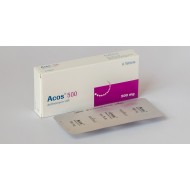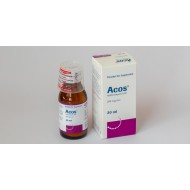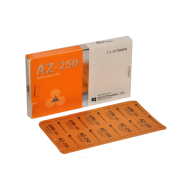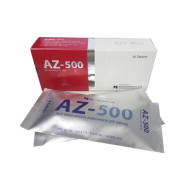
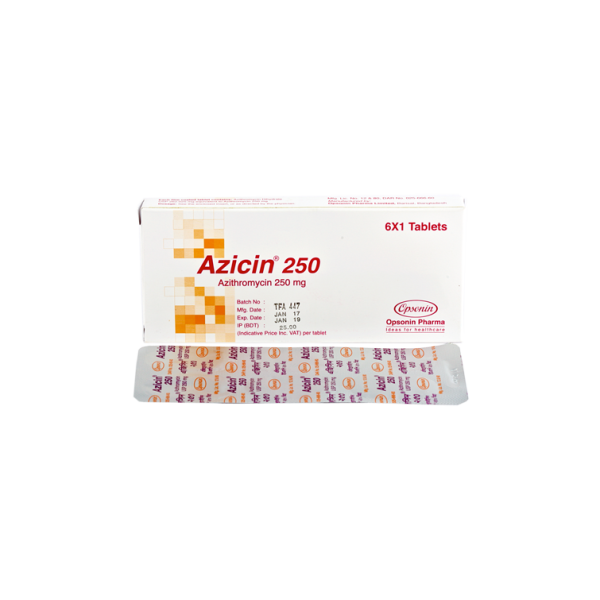
- Stock: In Stock
- Brand: Opsonin Pharma Limited
- Product ID: Azithromycin
Available Options
🔒 100% Secure Payment | bKash | Nagad | SSLCommerz | COD
⭐ Become a FREE Member: 7% Extra Savings • Free Delivery • Refill Reminders • Priority Support
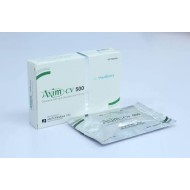
Azicin 250mg Tablet — Azithromycin for Skin, Respiratory & Systemic Infections
| Attribute | Details |
|---|---|
| Brand Name | Azicin |
| Generic Name | Azithromycin |
| Strength | 250 mg |
| Dosage Form | Film-Coated Tablet |
| Drug Class | Macrolide Antibiotic (Azalide) |
| Manufacturer | Opsonin Pharma Limited, Bangladesh |
| Route of Administration | Oral |
About Azicin 250mg Tablet
Azicin 250mg Tablet is a film-coated oral tablet containing azithromycin 250 mg per tablet, manufactured by Opsonin Pharma Limited, Bangladesh. The film-coated tablet formulation provides specific advantages over the capsule form: film coating masks the bitter taste of azithromycin, reducing the dysgeusia (taste disturbance) sometimes reported with capsule formulations; the coating stabilises the tablet against moisture during storage in Bangladesh's humid climate; and film-coated tablets can be taken with or without food, unlike capsule formulations where food significantly reduces absorption rate. The 250mg tablet strength is designed for the classic 5-day treatment course but the tablet formulation is also favoured for patients who split or crush medications — though azithromycin tablets should ideally not be split as this may affect the film-coat's protective function. Azicin 250mg Tablet covers all major indications for azithromycin at standard dosing.
Azithromycin Tablet vs Capsule — Key Differences
Both Azicin 250mg tablets and capsules contain the same active ingredient at the same dose and are bioequivalent in terms of total drug absorption (AUC). However, there are pharmacokinetically meaningful differences in the effect of food. Tablet formulation: food has minimal effect on the bioavailability of film-coated azithromycin tablets — patients can take Azicin 250mg tablets with meals without significant reduction in absorption; this is particularly convenient for patients who prefer taking medications with food or who experience nausea on an empty stomach. Capsule formulation: food significantly reduces the peak concentration (Cmax) achieved with capsules — empty stomach administration is recommended. For clinical purposes, in most outpatient scenarios, these differences are unlikely to affect outcomes, but for severe infections where rapid attainment of high tissue concentrations is important, the capsule taken fasting achieves the highest early tissue loading.
Skin and Soft Tissue Infection Applications
Azithromycin 250mg tablet is well-suited for outpatient skin and soft tissue infections (SSTIs) caused by gram-positive organisms. Indications include: uncomplicated cellulitis and erysipelas (typically caused by Streptococcus pyogenes — azithromycin provides excellent Streptococcal coverage); impetigo (Staphylococcal and/or Streptococcal); infected wound or surgical site infection managed in the outpatient setting; and erythrasma (caused by Corynebacterium minutissimum — responds well to macrolides). In Bangladesh, SSTIs are particularly common given the hot, humid climate and frequent minor skin trauma; secondary bacterial infection of insect bites, cuts, and abrasions is endemic. For SSTI, the regimen is typically 500mg on Day 1 (two 250mg tablets), then 250mg once daily on Days 2–5. Note: azithromycin does not cover MRSA — if methicillin-resistant Staphylococcus aureus is suspected (hospital-acquired, recurrent, or treatment-resistant SSTI), specialist assessment and cotrimoxazole or clindamycin are preferred.
Azithromycin 250mg for MAC Prophylaxis in Immunocompromised Patients
A less commonly known but important use of azithromycin 250mg tablets is prophylaxis against Mycobacterium avium complex (MAC) infection in HIV-positive patients with CD4 counts below 50 cells/µL. The WHO recommends azithromycin 1200mg weekly (equivalent to 4–5 tablets of 250mg once weekly) for MAC prophylaxis in severely immunocompromised HIV patients in settings where MAC is prevalent. While MAC prophylaxis is now less commonly needed with effective ART (antiretroviral therapy), it remains relevant for patients who present late with advanced HIV before ART initiation. This use reflects azithromycin's unique intracellular penetration — it accumulates in macrophages, the primary intracellular host of MAC organisms — and its long tissue half-life supporting once-weekly dosing.
Diabetic Skin and Wound Infections
Skin and soft tissue infections are among the most common complications in patients with diabetes mellitus. Diabetic foot infections (DFIs) account for a disproportionate share of hospitalisation and amputation risk in diabetic patients. Hyperglycaemia-associated peripheral neuropathy reduces pain sensation, delaying recognition of minor skin injuries; peripheral vascular disease reduces delivery of antibiotics and immune cells to infected tissue; and impaired neutrophil function reduces local bacterial killing. While severe DFI requires broad-spectrum intravenous antibiotics and specialist care, mild-moderate DFI involving superficial skin (without bone, tendon, or deep tissue involvement) may be managed in the outpatient setting with oral antibiotics including azithromycin 250mg for gram-positive coverage, typically combined with a fluoroquinolone for gram-negative coverage. Glycaemic control is critical during any infection — blood glucose typically rises with infection-related stress response and requires active management.
Frequently Asked Questions (FAQ)
Q1: Can Azicin 250mg Tablet be taken with food?
Yes — unlike azithromycin capsule formulations, Azicin 250mg film-coated tablets can be taken with or without food. The film coating protects against the food-related reduction in absorption rate that affects capsule formulations. This makes the tablet formulation particularly convenient for patients who prefer taking medications with meals or who experience gastric discomfort when taking medications on an empty stomach. However, if nausea is not a concern, taking on a light stomach is still preferable to ensure maximum peak concentration — particularly for the Day 1 loading dose.
Q2: How many Azicin 250mg tablets make one dose for most infections?
For adults, the standard Day 1 loading dose is 500mg — meaning two Azicin 250mg tablets taken together. From Day 2 onwards, one tablet (250mg) is taken once daily until the course is complete (Days 2–5 for a 5-day course). For a complete 5-day course: 2 tablets on Day 1 + 1 tablet each on Days 2, 3, 4, and 5 = 6 tablets total per course of treatment. Patients should be counselled clearly on this dosing pattern to avoid under-dosing on Day 1 (taking only one tablet instead of two).
Q3: Is Azicin 250mg Tablet safe for elderly patients?
Yes — azithromycin 250mg is generally well tolerated in elderly patients and no dose adjustment is required based on age alone. The tablet formulation is advantageous for elderly patients because: it can be taken with food, reducing GI side effects common in the elderly; it does not require splitting or crushing; once-daily dosing simplifies the regimen. The main elderly-specific concern is QT interval prolongation — elderly patients, particularly those with pre-existing cardiac disease or on multiple medications that prolong QT (some antihistamines, antiarrhythmics), should have azithromycin prescribed with awareness of this risk. ECG monitoring may be warranted in high-risk elderly patients. Azithromycin is hepatically metabolised — dose reduction is recommended in severe hepatic impairment, which is more common in elderly patients.
Q4: How is azithromycin different from erythromycin and clarithromycin?
All three are macrolide antibiotics but with important differences. Azithromycin (Azicin): once daily, short 3–5 day course, minimal GI side effects, very high tissue penetration, active against H. influenzae (unlike erythromycin), no significant drug interactions via CYP3A4 at standard doses. Erythromycin: 4 times daily, 7–14 days, significant GI side effects (nausea/vomiting in up to 30%), strong CYP3A4 inhibitor with multiple drug interactions, poor H. influenzae activity. Clarithromycin: twice daily, 7–14 days, moderate GI side effects, strong CYP3A4 inhibitor (interacts with statins, warfarin), better H. pylori activity. For most outpatient bacterial infections in Bangladesh, azithromycin's adherence advantages (once daily, short course, food flexibility) make Azicin 250mg tablets the preferred macrolide choice.
Medical Disclaimer: Azicin 250mg Tablet is a prescription antibiotic. Macrolide resistance in respiratory pathogens is increasing — azithromycin should be used only for confirmed or strongly suspected bacterial infections where clinical benefit outweighs resistance selection risks. Use strictly as prescribed by your physician.