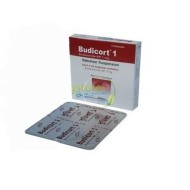
- Stock: In Stock
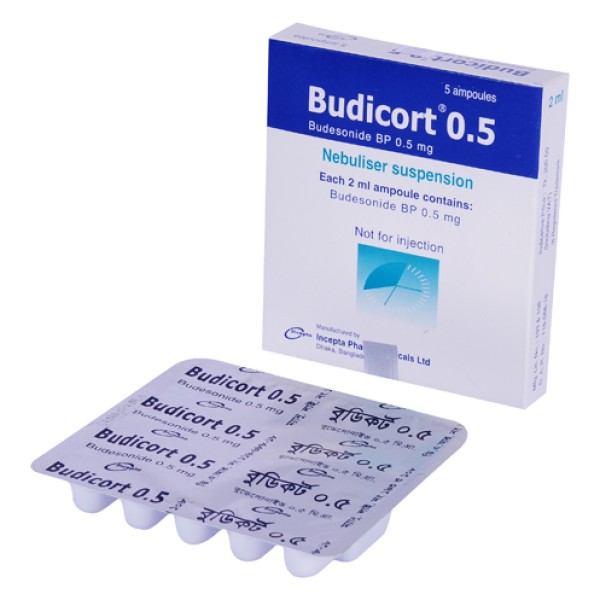
- Brand: Incepta Pharmaceuticals
- Product ID: Budesonide
🔒 100% Secure Payment | bKash | Nagad | SSLCommerz | COD
⭐ Become a FREE Member: 7% Extra Savings • Free Delivery • Refill Reminders • Priority Support
| Generic Name | Budesonide (Nebuliser Suspension) |
| Brand Name | Budicort |
| Manufacturer | Incepta Pharmaceuticals Ltd. |
| Dosage Form | Nebuliser Suspension |
| Strength | 0.5 mg/2 ml |
| Pack Size | 2 x 6 ampoules |
| Drug Class | Respiratory Corticosteroid |
| Prescription Required | Yes |
What is Budicort Nebuliser Suspension?
Budicort is a brand of Budesonide, a synthetic inhaled corticosteroid with potent glucocorticoid activity and weak mineralocorticoid activity. It is used via nebuliser for treatment of persistent bronchial asthma and severe pseudocroup (laryngitis subglottica).
Indications
Budicort nebuliser suspension is indicated for: treatment of persistent bronchial asthma in patients where a pressurised inhaler or dry powder formulation is unsatisfactory or inappropriate; and very serious pseudocroup (laryngitis subglottica) in which hospitalisation is indicated.
Pharmacology
Budesonide has approximately 200-fold higher affinity for the glucocorticoid receptor and 1000-fold higher topical anti-inflammatory potency than cortisol. It inhibits multiple cell types (mast cells, eosinophils, neutrophils, macrophages, lymphocytes) and inflammatory mediators (histamine, eicosanoids, leukotrienes, cytokines) involved in allergic airway inflammation.
Dosage & Administration
Asthma — Children 6 months and above: Initial dose: 0.25–1.0 mg/day; maintenance: 0.25–1.0 mg/day. Give twice daily; once-daily administration may be considered for mild to moderate stable asthma (0.25–1 mg/day).
Asthma — Adults and adolescents 12 years and older: Initial dose: 0.5–2 mg/day; maintenance: 0.5–2.0 mg/day. In severe cases dose may be further increased.
Pseudocroup: 2 mg as a single administration or as two 1 mg doses separated by 30 minutes. Repeat every 12 hours for maximum 36 hours or until clinical improvement.
Mix with 0.9% saline to a volume of 2 ml. Use with a jet nebuliser connected to an air compressor (5–8 l/min air flow). Rinse mouth with water after inhalation to minimise risk of oropharyngeal candidiasis.
Interaction
CYP3A4 inhibitors (e.g. ketoconazole, itraconazole, ritonavir, saquinavir, erythromycin, clarithromycin, cobicistat) may markedly increase systemic Budesonide exposure — avoid concurrent use where possible. Additive adrenal suppression with systemic or intranasal corticosteroids.
Contraindications
Not indicated for treatment of acute dyspnoea or status asthmaticus, which should be treated with short-acting beta-sympathomimetics and bronchodilators.
Side Effects
Facial irritation (with face mask use), oropharyngeal candidiasis, hoarseness, cough. Systemic effects at high doses: adrenal suppression, growth retardation in children, decreased bone mineral density, cataract, glaucoma. Rare: pneumonia risk in COPD patients.
Pregnancy & Lactation
FDA Pregnancy Category B. Benefits should be weighed against foetal risks. Budesonide is excreted in breast milk; at therapeutic doses no effects on the suckling infant are anticipated.
Precautions & Warnings
Patients transferring from oral corticosteroids require special care; adrenal function may be impaired. Monitor HPA axis function regularly. Paradoxical bronchospasm requires immediate discontinuation. Monitor height in children on prolonged treatment. Caution in patients with tuberculosis, fungal or viral airway infections, or severe hepatic dysfunction. Do not use with ultrasonic nebulisers.
Overdose Effects
Acute overdose is unlikely to cause clinical problems. Chronic excess may cause adrenal suppression and systemic glucocorticoid effects. Reduce to lowest effective maintenance dose; adrenocortical function normalises within 1–2 days.
Therapeutic Class
Respiratory corticosteroids
Storage Conditions
Keep below 30°C, away from light and moisture. Keep out of reach of children.
Disclaimer: This product information is for reference purposes only and does not substitute professional medical advice, diagnosis, or treatment. Always consult a registered physician or qualified healthcare professional before taking any medication.