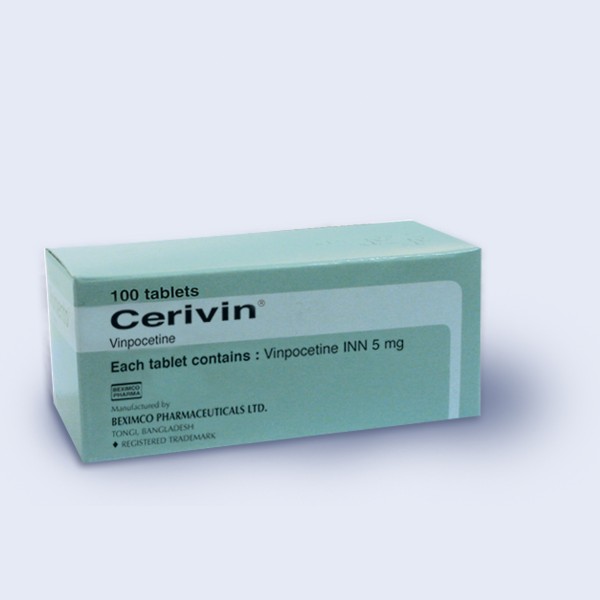
- Stock: Out Of Stock
- Brand: Beximco Pharmaceutical
- Product ID: Vinpocetine
Available Options
🔒 100% Secure Payment | bKash | Nagad | SSLCommerz | COD
⭐ Become a FREE Member: 7% Extra Savings • Free Delivery • Refill Reminders • Priority Support
This Item is for pre order
Cerivin 5mg Tablet — Cetirizine Hydrochloride 5mg | Beximco Pharmaceuticals
| Generic Name | Cetirizine Hydrochloride 5 mg |
| Dosage Form | Tablet |
| Drug Class | Second-Generation Antihistamine (H₁ Receptor Antagonist) |
| Manufacturer | Beximco Pharmaceuticals Ltd. |
| Sedation Profile | Minimally sedating — second-generation antihistamine |
| Prescription Status | OTC (Over-the-Counter) — no prescription required |
| Available Strengths | 5 mg (this — half-dose for elderly/children), 10 mg (standard adult) |
Overview
Cerivin 5mg contains Cetirizine Hydrochloride — one of the most widely used second-generation antihistamines globally. Cetirizine selectively blocks peripheral H₁ histamine receptors without significantly crossing the blood-brain barrier, providing effective allergy relief with minimal sedation compared to first-generation antihistamines (chlorpheniramine, diphenhydramine). The 5mg tablet is the half-standard dose, specifically designed for elderly patients, children aged 6–12 years, or adults sensitive to the full 10mg dose. It provides sustained 12–24 hour allergy control from a single daily or twice-daily dose.
First vs Second Generation Antihistamines
| Feature | 1st Gen (Chlorpheniramine, Diphenhydramine) | Cerivin (Cetirizine 5mg) — 2nd Gen |
|---|---|---|
| Sedation | Strong sedation — impairs driving | Minimal — safe for daytime use (most patients) |
| Duration | 4–6 hours | 12–24 hours (once or twice daily) |
| Anticholinergic effects | Dry mouth, urinary retention, constipation | Minimal anticholinergic side effects |
| Suitability | Nighttime/acute use; not for elderly | Daytime use; elderly; driving; work |
Indications
- Allergic Rhinitis — seasonal (hay fever: pollens, grass) and perennial (dust mites, animal dander); nasal congestion, runny nose, sneezing, itchy eyes
- Chronic Urticaria — itchy hives, wheals on skin
- Acute Urticaria — allergic skin reaction
- Atopic Dermatitis / Eczema — adjunct therapy for itch relief
- Allergic Conjunctivitis — itchy, watery, red eyes
- Insect Bite Reactions — local allergic skin reactions
- Angioedema (mild, non-laryngeal) — adjunct; adrenaline for severe cases
Dosage & Administration
| Patient Group | Dose | Frequency | Notes |
|---|---|---|---|
| Adults (standard) | 10 mg (2 tablets) | Once daily (OD) | Or 5mg BD if 10mg causes drowsiness |
| Adults sensitive to sedation | 5 mg (1 tablet) | Twice daily (BD) | Same total daily dose with split dosing |
| Children 6–12 years | 5 mg (1 tablet) | Once or twice daily | Max 10mg/day |
| Elderly patients | 5 mg (1 tablet) | Once daily | Reduced dose for impaired renal clearance |
| Renal impairment (CrCl 30–49) | 5 mg | Once daily | Cetirizine is renally excreted |
| Renal impairment (CrCl <30) | 5 mg | Every other day | Significant dose reduction needed |
Can be taken with or without food. Take at the same time each day. For seasonal allergies, take regularly throughout the allergy season rather than only when symptoms arise (pre-emptive dosing is more effective).
Special Note for Diabetic Patients
Cetirizine is one of the preferred antihistamines for diabetic patients: (1) No glucose effect — cetirizine does not raise or lower blood glucose; (2) No significant drug interactions with any common diabetes medication (metformin, insulin, sulfonylureas, DPP-4 inhibitors, SGLT-2 inhibitors); (3) Renal dosing adjustment — diabetics with CKD require dose reduction (5mg OD or alternate days) as cetirizine is renally cleared; (4) Preferred over first-generation antihistamines — chlorpheniramine and diphenhydramine can impair the recognition of hypoglycaemia symptoms and cause urinary retention; cetirizine has minimal anticholinergic effects. Diabetics with allergic skin conditions (urticaria, atopic eczema) will find Cerivin 5mg safe and effective for long-term symptom management.
Side Effects
- Drowsiness (5–15%) — less than first-generation antihistamines; may impair driving in sensitive individuals
- Dry mouth — mild and infrequent
- Headache — mild, usually transient
- Fatigue — particularly at higher doses
- Urinary retention — rare; caution in men with prostatic enlargement
Drug Interactions
- Alcohol / CNS depressants: Additive sedation — avoid alcohol during treatment
- Theophylline: Slightly reduces cetirizine clearance at high theophylline doses — monitor
- No significant interaction with most common drugs including all diabetes medications
Contraindications
- Hypersensitivity to cetirizine, hydroxyzine, or piperazine derivatives
- Severe renal impairment with no dose adjustment (use 5mg every 48h in end-stage renal disease)
- Children under 2 years (safety not established)
Storage
Store below 30°C in a dry place, away from direct sunlight. Keep out of reach of children.
FAQ
Q1: Why is Cerivin 5mg available instead of the standard 10mg?
The 5mg tablet serves specific patient groups where 10mg is too much: elderly patients (reduced renal clearance means slower drug elimination and higher drug levels), children aged 6–12 years (10mg may cause excessive drowsiness), adults who experience drowsiness with 10mg (can take 5mg twice daily for the same total daily dose), and patients with renal impairment. Having a 5mg option allows safe, effective dosing across all age groups.
Q2: Can I take Cerivin daily for months for chronic urticaria?
Yes — cetirizine is safe for long-term continuous use. Chronic spontaneous urticaria often requires daily antihistamine therapy for months to years. The standard approach is daily cetirizine (10mg OD or 5mg BD) until urticaria resolves, then gradual dose reduction. There is no tolerance development, dependence, or organ toxicity with long-term cetirizine use.
Q3: Can I drive after taking Cerivin 5mg?
Most people can drive safely on cetirizine 5mg, but individual responses to sedation vary. Do not drive or operate machinery until you know how cetirizine affects you. Avoid alcohol during treatment, as it significantly increases sedation. The 5mg dose causes less sedation than 10mg and is preferred for daytime use in patients who need to drive.
Q4: What is the difference between cetirizine and levocetirizine?
Levocetirizine (e.g., Beximco's Levorid or similar) is the active R-enantiomer of cetirizine — it is approximately twice as potent, so a 5mg levocetirizine dose is roughly equivalent to 10mg cetirizine. Levocetirizine is slightly less sedating than cetirizine at equivalent doses. Both are effective; levocetirizine may be preferred when sedation with standard cetirizine is problematic.
Medical Disclaimer: Educational information only. While cetirizine is available OTC, patients with renal impairment, pregnant or breastfeeding women, and young children should consult a physician before use.