- Stock: In Stock
- Brand: Renata
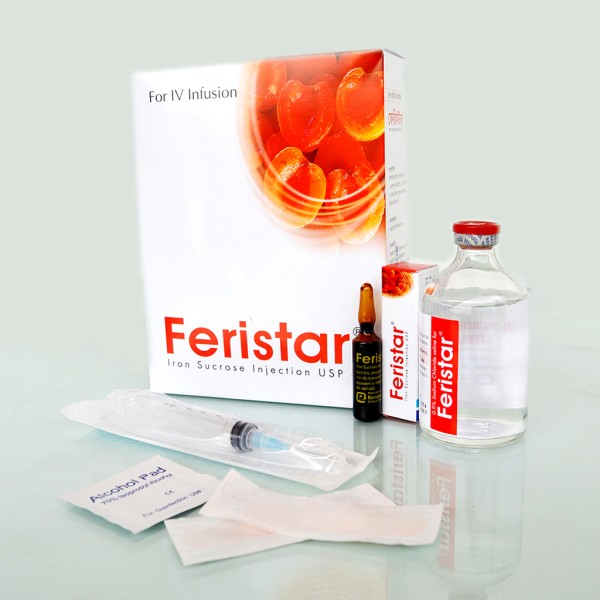
- Product ID: Iron Sucrose Injection [Elemental Iron]
🔒 100% Secure Payment | bKash | Nagad | SSLCommerz | COD
⭐ Become a FREE Member: 7% Extra Savings • Free Delivery • Refill Reminders • Priority Support
This Item is for pre order
Feristar IV Injection or Infusion — Iron Sucrose
| Generic Name | Iron Sucrose |
|---|---|
| Strength | 100 mg/5 ml |
| Dosage Form | Injection |
| Manufacturer | Renata Limited |
| Therapeutic Class | Parenteral Iron Preparations |
Indications
This is indicated for the treatment of Feristar deficiency in the following indications:
Where there is a clinical need for a rapid Feristar supply
In patients who can not tolerate oral Feristar therapy or who are non-compliant
In active inflammatory bowel disease where oral Feristar preparations are ineffective ... Read moreThis is indicated for the treatment of Feristar deficiency in the following indications:
Where there is a clinical need for a rapid Feristar supply
In patients who can not tolerate oral Feristar therapy or who are non-compliant
In active inflammatory bowel disease where oral Feristar preparations are ineffective
Non-dialysis dependent-chronic kidney disease (NDD-CKD) patients receiving an erythropoietin
Non-dialysis dependent-chronic kidney disease (NDD-CKD) patients not receiving an erythropoietin
Hemodialysis dependent-chronic kidney disease (HDD-CKD) patients receiving an erythropoietin
Peritoneal dialysis dependent-chronic kidney disease (PDD-CKD) patients receiving an erythropoietin
It is also indicated in the treatment of Feristar deficiency anaemia in patients undergoing surgical procedures, patients donating blood, postpartum patients.
Mechanism of Action
The therapeutic class of Iron Sucrose is haematinic. Iron Sucrose Injection USP is a brown, sterile, aqueous, complex of Polynuclear Iron (III) Hydroxide in Sucrose for Intravenous use. The drug product contains approximately 30% Sucrose w/v (300 mg/ml) and has a pH of 10.5-11.1. Following intravenous administration, Iron Sucrose Injection is dissociated into Iron and Sucrose by the reticuloendothelial system, and Iron is transferred from the blood to a pool of Iron in the liver and bone marrow. Ferritin, an Iron storage protein, binds and sequesters Iron in a nontoxic form, from which Iron is easily available. Iron binds to plasma transferrin, which carries Iron within the plasma and the extracellular fluid to supply the tissues. The transferrin receptor, located in the cell, and the transferrin-receptor complex is returned to the cell membrane. Transferrin without Iron (apotransferrin) is then released to the plasma. The intracellular Iron becomes (mostly) haemoglobin in circulating red blood cells (RBCs). Transferrin synthesis is increased and ferritin production reduced in Iron deficiency. The converse is true when Iron is plentiful. Its elimination halflife is 6 h, total clearance is 1.2 L/h, non-steady state apparent volume of distribution is 10.0 L and steady state apparent volume of distribution is 7.9 L. In Iron Sucrose, its Iron component appears to distribute mainly in blood and to some extent in extravascular fluid. A significant amount of the administered Iron distributes in the liver, spleen and bone marrow and that the bone marrow is an Iron trapping compartment and not a reversible volume distribution. The sucrose component is eliminated mainly through urinary excretion.
Contraindications
The use of Iron Sucrose is contraindicated in patients with evidence of Iron overload, in patients with known hypersensitivity to Iron Sucrose or any of its inactive components, and in patients with anaemia not caused by Iron deficiency. It is also contraindicated in patients with history of allergic disorders including asthma, eczema and anaphylaxis, liver disease and infections.
Side Effects
Adverse reactions, whether or not related to Feristar injection are as follows: hypotension, cramps/leg cramps, nausea, headache, vomiting, and diarrhea. Some of these symptoms may be seen in patients with chronic renal failure or on hemodialysis not receiving intravenous iron.
Body as a Whole: headache, fever, pain, asthenia, unwell, malaise, accidental injury. Cardiovascular Disorders
General: hypotension, chest pain, hypertension, hypervolemia.
Gastrointestinal Disorders: nausea, vomiting, abdominal pain, elevated liver enzymes.
Central and Peripheral Nervous System: dizziness.
Musculoskeletal System: cramps/leg cramps, musculoskeletal pain.
Respiratory System: dyspnea pneumonia, cough.
Skin and appendages: pruritus, application site reaction.
Hypersensitivity reactions: In safety studies, several patients experienced mild or moderate hypersensitivity reactions presenting with wheezing, dyspnea, hypotension, rashes, or pruritus. Anaphylactoid reactions including patients who experienced serious or life-threatening reactions (anaphylactic shock, loss of consciousness or collapse, bronchospasm with dyspnea, or convulsion) associated with Feristar administration can occur. So, patients should be given a small test dose initially.
Drug Interactions
Drug-drug interactions involving Feristar have not been studied. Feristar Injection should not be administered concomitantly with oral iron preparations since the absorption of oral Feristar is reduced. Even oral Feristar therapy should not be given until 5 days after last injection.
Pregnancy and Lactation
Pregnancy Category-B. No adequate and well controlled studies in pregnant women. This drug should be used during pregnancy only if clearly needed. It is not known whether this drug is excreted in human milk. Because many drugs are excreted in human milk, caution should be exercised when Iron Sucrose is administered to a nursing woman.
Precautions and Warnings
General: Because body Feristar excretion is limited and excess tissue Feristar can be hazardous, caution should be exercised to withhold Feristar administration in the presence of evidence of tissue Feristar overload. Patients receiving Feristar require periodic monitoring of hematologic and haematinic parameters (hemoglobin, hematocrit, serum ferritin and transferrin saturation). Feristar therapy should be withheld in patients with evidence of Feristar overload. Transferrin saturation values increase rapidly after IV administration of Feristar; thus, serum Feristar values may be reliably obtained 48 hours after IV dosing. Hypersensitivity Reactions: Serious hypersensitivity reactions have been rarely reported in patients receiving Feristar. Several cases of mild or moderate hypersensitivity reactions were observed in these studies. Hypotension: Hypotension has been reported frequently in hemodialysis patients receiving intravenous Feristar. Hypotension following administration of Feristar may be related to rate of administration and total dose administered. Caution should be taken to administer Feristar according to recommended guidelines.
Use in Special Populations
Pediatric Use: Safety and effectiveness of Feristar in pediatric patients have not been established. Geriatric Use: No overall differences in safety were observed between the elder subjects and younger subjects, and other reported clinical experience has not identified differences in responses between the elderly and younger patients, but greater sensitivity of some older individuals cannot be ruled out.Injection into dialyser: Feristar Injection may be administered directly into the venous limb of the dialyser under the same conditions as for intravenous injection.Hemodialysis Dependent-Chronic Kidney Disease Patients (HDD-CKD): Feristar Injection may be administered undiluted as a 100 mg slow intravenous injection over 2 to 5 minutes or as an infusion of 100 mg, diluted in a maximum of 100 ml of 0.9% NaCI over a period of at least 15 minutes per consecutive hemodialysis session for a total cumulative dose of 1,000 mg.Non-Dialysis Dependent-Chronic Kidney Disease Patient (NDD-CKD): Feristar Injection is administered as a total cumulative dose 1000 mg over a 14 day period as a 200 mg slow IV injection undiluted over 2 to 5 minutes on 5 different occasions within the 14 day period.
Overdose
Dosages of Feristar Injection in excess of Feristar needs may lead to accumulation of Feristar in storage sites leading to hemosiderosis. Periodic monitoring of Feristar parameters such as serum ferritin and transferrin saturation may assist in recognizing Feristar accumulation. Feristar should not be administered to patients with Feristar overload and should be discontinued when serum ferritin levels equal or exceed established guidelines. Particular caution should be exercised to avoid Feristar overload where anaemia unresponsive to treatment has been incorrectly diagnosed as Feristar deficiency anaemia. Symptoms associated with overdosage or infusing Feristar too rapidly included hypotension, headache, vomiting, nausea, dizziness, joint aches, paresthesia, abdominal and muscle pain, edema. and cardiovascular collapse. Most symptoms have been successfully treated with IV fluids, hydrocortisone, and/or antihistamines. Infusing the solution as recommended or at a slower rate may also alleviate symptoms.
Storage
Store in a cool (15°C- 30°C) & dry place, protected from light. Keep out of the reach of children. Do not freeze.
Medical Disclaimer: This information is provided for educational purposes only and is not intended as medical advice. Always consult a qualified healthcare professional before starting, changing, or stopping any medication.