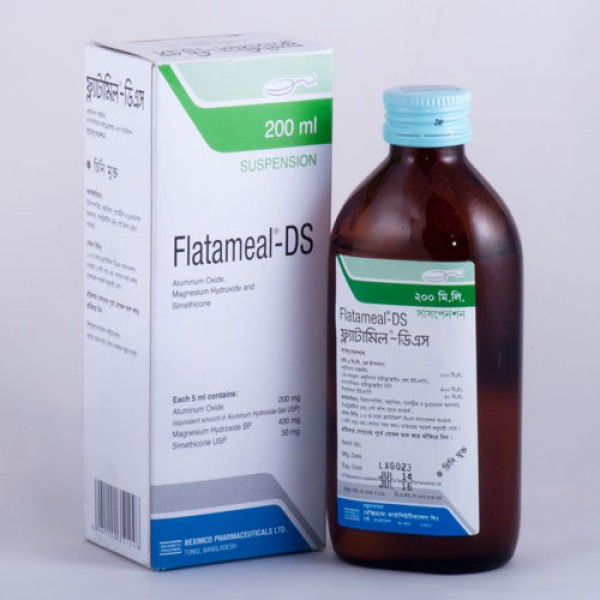
- Stock: In Stock
- Brand: Beximco Pharmaceutical
- Product ID: Aluminium Hydroxide + Magnesium Hydroxide + Simethicone
Available Options
🔒 100% Secure Payment | bKash | Nagad | SSLCommerz | COD
⭐ Become a FREE Member: 7% Extra Savings • Free Delivery • Refill Reminders • Priority Support
Flatameal DS Suspension — Aluminium Hydroxide + Magnesium Hydroxide + Simethicone | Beximco Pharmaceuticals
| Active Ingredients | Aluminium Hydroxide Gel + Magnesium Hydroxide + Simethicone (per 5ml dose) |
| Dosage Form | Oral Suspension |
| Drug Class | Antacid (Aluminium + Magnesium) + Antiflatulent (Simethicone) |
| Manufacturer | Beximco Pharmaceuticals Ltd. |
| Brand Equivalents | Maalox Plus, Mylanta (same three-component formula) |
| Prescription Status | Over-the-Counter (OTC) — no prescription required |
Overview
Flatameal DS is a triple-action antacid suspension combining three complementary agents: Aluminium Hydroxide (slow-acting, prolonged acid neutralisation; also acts as a mucosal protectant), Magnesium Hydroxide (fast-acting, potent acid neutraliser), and Simethicone (antifoaming agent that relieves gas and bloating). The aluminium-magnesium combination is carefully balanced — aluminium hydroxide alone causes constipation while magnesium hydroxide alone causes diarrhoea; together they provide effective acid neutralisation with a neutral bowel effect. Simethicone reduces the surface tension of gas bubbles in the GI tract, causing them to coalesce and be expelled more easily. This triple formulation addresses both excess acid and trapped gas — two commonly coexisting upper GI complaints.
How Each Component Works
| Component | Mechanism | Primary Effect |
|---|---|---|
| Aluminium Hydroxide | Reacts with HCl → AlCl₃ + H₂O; slow-acting buffer; coats mucosa | Sustained acid neutralisation; mucosal protection; binds phosphate |
| Magnesium Hydroxide | Reacts with HCl → MgCl₂ + H₂O; rapid acid neutralisation | Fast-onset acid neutralisation; mild laxative effect (counterbalances Al(OH)₃) |
| Simethicone | Reduces gas bubble surface tension → gas coalescence → easier expulsion | Relieves bloating, flatulence, gas pain — no systemic absorption |
Indications
- Hyperacidity / Acid Dyspepsia — burning sensation, sour taste, post-meal discomfort
- Gastritis — acute and chronic gastric irritation
- Flatulence & Bloating — trapped intestinal gas causing distension and discomfort
- Peptic Ulcer Disease — adjunct symptomatic relief (use with PPI/H2-blocker for definitive treatment)
- GERD — symptomatic relief of heartburn (for raft-forming barrier action, consider Algicid)
- Post-meal gas and indigestion — common after heavy or gas-producing meals (legumes, carbonated drinks)
- Infant colic — simethicone component (paediatric doses; consult physician)
Dosage & Administration
| Indication | Adult Dose | Timing |
|---|---|---|
| Acidity / Heartburn / Gastritis | 10–20 ml (2–4 teaspoons) | 1–3 hours after meals and at bedtime |
| Gas / Bloating / Flatulence | 10–20 ml | After meals and as needed |
| Acute acidity episode | 10–20 ml | As needed (PRN) |
| Children 6–12 years | 5–10 ml | After meals |
| Maximum daily dose | 60–80 ml/day | Do not exceed; not for prolonged daily use >2 weeks without medical review |
Shake well before use. Take 1–3 hours after meals for best antacid effect — this is when food buffer has left the stomach and acid rebounds. Do not take within 2 hours of other medications (antacids reduce absorption of many drugs).
Special Note for Diabetic Patients
Flatameal DS is generally safe for diabetic patients for short-term use with the following considerations: (1) Drug absorption interaction: Antacids can significantly reduce absorption of several common diabetes medications — take diabetes drugs at least 2 hours before or after Flatameal DS. This applies to metformin (reduced absorption if taken with antacid), and fluoroquinolone antibiotics (ciprofloxacin, levofloxacin) which are chelated by aluminium/magnesium ions; (2) Phosphate binding: Aluminium hydroxide binds dietary phosphate — diabetics with CKD requiring phosphate restriction (who may already use Al(OH)₃ as a phosphate binder) should not add Flatameal DS on top without physician advice; (3) Magnesium content: Diabetics with severe renal impairment should use magnesium-free antacids — accumulated magnesium can cause toxicity; (4) No glucose effect: Neither aluminium hydroxide, magnesium hydroxide, nor simethicone affects blood glucose levels. However, some antacid suspensions contain sugar — check label; sugar-free formulations preferred in diabetics.
Drug Interactions — Important
| Drug | Interaction | Action |
|---|---|---|
| Fluoroquinolones (ciprofloxacin, levofloxacin) | Al³⁺/Mg²⁺ chelate fluoroquinolones → dramatically reduced antibiotic absorption | Take antibiotic 2h BEFORE or 6h AFTER antacid |
| Tetracyclines | Same chelation — antibiotic made ineffective | Do not co-administer; separate by 2–3 hours |
| Iron supplements | Aluminium reduces iron absorption | Separate by at least 2 hours |
| Thyroid hormones (levothyroxine) | Aluminium reduces T4 absorption | Take levothyroxine 4h before antacid |
| Ketoconazole / Itraconazole | Need acid environment for absorption; antacid reduces absorption | Take antifungal 2h before antacid |
| Digoxin | Reduced absorption with antacids | Separate by at least 2 hours |
Side Effects
- Constipation — from aluminium component; counterbalanced by magnesium component; usually neutral bowel effect with the combined formulation
- Diarrhoea — if magnesium component predominates at high doses
- Phosphate depletion — with long-term high-dose use; avoid in malnutrition
- Aluminium accumulation — in severe renal impairment (avoid or use cautiously)
- Magnesium toxicity — in severe renal failure (hypermagnesaemia); avoid magnesium-containing antacids in eGFR <30
Storage
Store below 25°C. Do not freeze. Shake well before each use. Keep bottle tightly closed. Keep out of reach of children.
FAQ
Q1: Why is Flatameal DS better than taking plain antacid for gas and bloating?
Plain aluminium or magnesium antacids address acid but do not treat gas. Simethicone specifically targets intestinal gas by breaking up gas bubbles — this is the key component for bloating, distension, and flatulence. For patients who have both acid symptoms AND gas/bloating (very common together), Flatameal DS addresses both simultaneously, whereas plain antacids or simethicone alone would only address one component.
Q2: Can I take Flatameal DS every day long-term?
Flatameal DS is suitable for short-term and occasional use. Daily use for more than 2 weeks without medical review is not recommended — persistent acidity may indicate peptic ulcer disease, H. pylori infection, or GERD requiring definitive treatment with a PPI. Long-term aluminium antacid use can also cause phosphate depletion and, in renal patients, aluminium accumulation. Consult a doctor if symptoms persist.
Q3: Should I take Flatameal DS before or after meals?
For acid-related symptoms, take 1–3 hours after meals — this is when gastric acid rebounds as the food buffering effect wears off, and symptoms are most prominent. For pre-emptive relief before a meal you know will cause symptoms, a dose 30 minutes before eating can also help. At bedtime is useful for nocturnal acid symptoms. For gas and bloating, take immediately after the meal that causes symptoms.
Q4: Can I take Flatameal DS with my antibiotic?
No — do not take Flatameal DS within 2–4 hours of any antibiotic, especially fluoroquinolones (ciprofloxacin, levofloxacin, moxifloxacin) or tetracyclines. The aluminium and magnesium ions in Flatameal DS form insoluble complexes (chelates) with these antibiotics, rendering them virtually unabsorbable. This can cause treatment failure of serious infections. Take the antibiotic first and wait 2–3 hours before taking the antacid, or take the antacid and wait 4–6 hours before the antibiotic.
Medical Disclaimer: Educational information only. Do not use antacids within 2 hours of other medications. Persistent GI symptoms require medical evaluation. Not for prolonged daily use without physician guidance. Avoid in severe renal impairment.