- Stock: In Stock
- Product ID: Meropenem Trihydrate
Available Options
🔒 100% Secure Payment | bKash | Nagad | SSLCommerz | COD
⭐ Become a FREE Member: 7% Extra Savings • Free Delivery • Refill Reminders • Priority Support
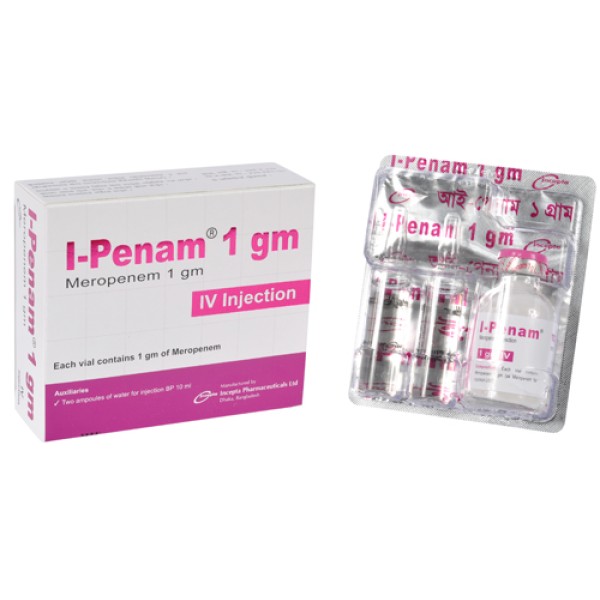
I-Penam 1gm IV Injection — Meropenem 1g | Beximco Pharmaceuticals
| Generic Name | Meropenem Trihydrate 1 g (equivalent to Meropenem 1000 mg) |
| Dosage Form | Powder for Intravenous (IV) Infusion |
| Drug Class | Carbapenem (Beta-lactam Antibiotic) — Broadest Spectrum Class |
| Manufacturer | Beximco Pharmaceuticals Ltd. |
| Prescription Status | Prescription Only — ICU / Hospital Specialist Use |
| Route | Intravenous (IV) only |
Overview
I-Penam 1gm contains Meropenem 1g — the standard adult dose of this ultra-broad-spectrum carbapenem antibiotic and the most commonly prescribed strength for serious hospital infections. Meropenem 1g every 8 hours (3g/day) is the backbone of empirical and definitive therapy for the most severe bacterial infections in ICUs and hospital wards across Bangladesh — including ESBL-producing organism infections, hospital-acquired pneumonia, complicated intra-abdominal infections, febrile neutropenia, and severe diabetic foot infections with systemic involvement. The 1g vial is the most practical unit for standard adult dosing, reducing the need for multiple smaller vials. For bacterial meningitis and Pseudomonas aeruginosa infections, the dose is escalated to 2g every 8 hours.
Mechanism of Action
Meropenem binds all penicillin-binding proteins (PBPs) with high affinity and is stable to virtually all clinically relevant beta-lactamase enzymes including AmpC, ESBLs, OXA-type carbapenemases (partially), and serine carbapenemases (KPC) — explaining its superiority over cephalosporins and penicillins against resistant organisms. The 6-alpha methyl substituent eliminates susceptibility to renal dehydropeptidase-I, allowing monotherapy without cilastatin, and confers lower seizurogenic potential compared to imipenem. Not active against MRSA, VRE, Stenotrophomonas maltophilia, or NDM/VIM metallo-carbapenemase producers.
Indications
- Hospital-acquired pneumonia (HAP) and VAP — MDR Gram-negative organisms including Pseudomonas
- ESBL infections — bacteraemia, UTI, pneumonia caused by ESBL E. coli and Klebsiella
- Septicaemia and septic shock — empirical broadest-spectrum IV monotherapy
- Febrile neutropenia — oncology/haematology patients with fever and low neutrophil count
- Complicated intra-abdominal infections — peritonitis, bowel perforation, hepatic abscess
- Complicated UTI and pyelonephritis — ESBL or MDR Gram-negative uropathogens
- Severe diabetic foot infections — deep space, necrotising, or polymicrobial with systemic sepsis
- Bacterial meningitis — resistant Gram-negative meningitis (2g dose)
- Pseudomonas aeruginosa infections — respiratory, urinary, bloodstream (2g dose)
Dosage and Administration
| Indication | Dose | Frequency | Notes |
|---|---|---|---|
| Moderate infections | 500 mg | Every 8 hours IV | Half vial; use 500mg product for convenience |
| Severe infections / sepsis / HAP / ESBL | 1 g | Every 8 hours IV | Standard adult dose; 3 g/day |
| Meningitis / Pseudomonas | 2 g | Every 8 hours IV | Two 1g vials; 6 g/day maximum |
| CrCl 26–50 mL/min | 1 g | Every 12 hours | Standard dose, reduced frequency |
| CrCl 10–25 mL/min | 500 mg | Every 12 hours | Half dose and frequency |
| CrCl <10 mL/min / ESRD | 500 mg | Every 24 hours | Supplement post-haemodialysis |
| Paediatric (3 months–12 years) | 10–40 mg/kg | Every 8 hours IV | Max 2 g/dose for meningitis |
Reconstitute each 1g vial with 20 mL sterile water for injection; dilute in 100–250 mL NS or D5W. Administer by IV infusion over 15–30 minutes (standard) or 3–4 hours (extended infusion — preferred for resistant organisms and to optimise time above MIC). Once reconstituted and diluted in NS, stable for 1 hour at room temperature or 8 hours at 2–8°C — prepare each dose immediately before administration. Compatible with most IV lines — do not mix with other medications in the same line.
Critical Considerations for Diabetic Patients
- When meropenem is specifically indicated in diabetics: (1) UTI or bacteraemia where urine/blood culture confirms ESBL-producing E. coli or Klebsiella; (2) Diabetic foot infection with gas in tissues (gas gangrene), rapidly spreading necrotising fasciitis, or osteomyelitis with systemic sepsis; (3) Diabetic patient in ICU with septic shock of unknown source requiring broadest empirical coverage; (4) Hospital-acquired pneumonia in a ventilated diabetic patient with risk factors for MDR pathogens
- Renal dosing in diabetic nephropathy: Always check eGFR/creatinine before and during meropenem therapy in diabetic patients — diabetic nephropathy is extremely prevalent and failure to dose-reduce risks meropenem accumulation, causing encephalopathy and seizures
- Glycaemic management in ICU: Sepsis causes profound hyperglycaemia through stress hormone release and cytokine-mediated insulin resistance. ICU-level glycaemic control (IV insulin infusion, glucose monitoring every 1–2 hours, target BG 7–10 mmol/L) is standard for critically ill diabetic patients on meropenem
- Culture-guided therapy: Always obtain blood cultures and wound/respiratory/urine cultures before starting meropenem. Review culture results at 48–72 hours — de-escalate to narrower agents if organism and sensitivity allow. Preserving carbapenem activity through stewardship is a public health priority
- Carbapenem-resistant organism (CRE) risk: Prior carbapenem use is the strongest risk factor for carbapenem-resistant bacteria. Diabetic patients who receive repeated courses of meropenem are at high risk of developing CRE infections for which treatment options are very limited (colistin, tigecycline, ceftazidime-avibactam). Use meropenem only when genuinely indicated
Side Effects
| Side Effect | Frequency | Notes |
|---|---|---|
| Nausea, vomiting, diarrhoea | Common | Usually mild; GI rest if severe |
| Elevated LFTs (AST/ALT/ALP) | Common (transient) | Monitor LFTs in prolonged courses |
| IV site phlebitis | Common | Rotate insertion sites; use large veins |
| Skin rash, urticaria | Uncommon | Stop and assess; allergy review |
| Anaphylaxis | Rare (~1% with penicillin allergy) | Have resuscitation equipment available |
| C. difficile-associated diarrhoea | Uncommon | Severe/bloody diarrhoea — stop and treat |
| Seizures / encephalopathy | Very rare (less than imipenem) | Dose reduce in CKD; avoid in CNS disease if alternative exists |
| Thrombocytopenia / neutropenia | Rare (prolonged courses) | Monitor FBC in extended therapy |
Contraindications
- Known hypersensitivity to meropenem or any carbapenem
- Severe immediate penicillin allergy — use with caution (low but real ~1% cross-reactivity); weigh benefit vs risk in life-threatening infections
Storage
Store unreconstituted vials below 25°C, protected from light. Once reconstituted and diluted in NS: use within 1 hour at room temperature or 8 hours at 2–8°C. Do not freeze reconstituted solution. Keep out of reach of children.
Medical Disclaimer: This information is for educational purposes only. Meropenem is a last-resort carbapenem antibiotic restricted to ICU and specialist hospital use. It must be prescribed by a physician, prepared by pharmacy, and administered by nursing staff under clinical supervision. Prescription required. Never self-administer injectable antibiotics.