- Stock: In Stock
- Product ID: Meropenem Trihydrate
Available Options
🔒 100% Secure Payment | bKash | Nagad | SSLCommerz | COD
⭐ Become a FREE Member: 7% Extra Savings • Free Delivery • Refill Reminders • Priority Support
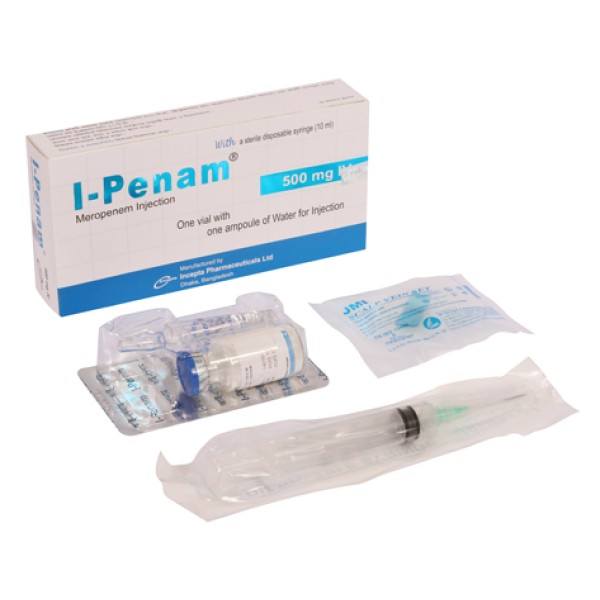
I-Penam 500mg IV Injection — Meropenem 500mg | Beximco Pharmaceuticals
| Generic Name | Meropenem Trihydrate 500 mg (equivalent to Meropenem 500 mg) |
| Dosage Form | Powder for IV Infusion / Injection |
| Drug Class | Carbapenem (Beta-lactam Antibiotic) — Broadest Spectrum Antibiotic Class |
| Manufacturer | Beximco Pharmaceuticals Ltd. |
| Prescription Status | Prescription Only — ICU / Hospital Specialist Use |
| Route | Intravenous (IV) bolus or infusion |
Overview
I-Penam 500mg contains Meropenem 500mg — the standard dose unit of this ultra-broad-spectrum carbapenem antibiotic. Meropenem 500mg every 8 hours is used for moderate infections requiring carbapenem coverage; 1g (two 500mg vials) every 8 hours is the standard adult dose for most serious infections; and 2g every 8 hours is used for bacterial meningitis and Pseudomonas infections requiring maximum concentrations. Carbapenems are the most powerful beta-lactam antibiotics available and are specifically reserved for: infections caused by ESBL-producing bacteria resistant to all cephalosporins, hospital-acquired polymicrobial infections requiring simultaneous Gram-positive, Gram-negative and anaerobic coverage, severely ill patients in ICU where empirical broadest-spectrum coverage is required while awaiting cultures, and infections caused by Pseudomonas aeruginosa. Meropenem is the preferred carbapenem over imipenem/cilastatin for CNS infections due to its lower seizure risk.
Mechanism of Action
Meropenem achieves the broadest beta-lactam activity by binding all penicillin-binding proteins (PBPs) with high affinity and showing stability to virtually all beta-lactamase enzymes (AmpC, ESBLs, most serine carbapenemases). The 6-alpha methyl group confers enhanced stability versus imipenem, eliminating the need for renal dehydropeptidase inhibitor (cilastatin) co-administration. Active against most clinically relevant Gram-negative, Gram-positive, and anaerobic bacteria. Not active against MRSA, VRE, Stenotrophomonas, or metallo-carbapenemase-producing CRE.
Indications
- Hospital-acquired pneumonia (HAP) and ventilator-associated pneumonia (VAP) — especially MDR Gram-negatives
- ESBL-producing E. coli and Klebsiella infections — UTI, pneumonia, bacteraemia
- Pseudomonas aeruginosa infections — septicaemia, pneumonia, UTI
- Febrile neutropenia — empirical monotherapy
- Complicated intra-abdominal infections — peritonitis, perforation, liver abscess
- Necrotising fasciitis and severe polymicrobial soft tissue infections
- Severe diabetic foot infections — deep tissue, bone, or systemic involvement
- Bacterial meningitis — resistant Gram-negative (preferred over imipenem for CNS use)
- Septic shock — empirical broad-spectrum coverage
Dosage and Administration
| Indication | Adult Dose | Frequency |
|---|---|---|
| Moderate infections (UTI, skin) | 500 mg | Every 8 hours IV |
| Severe infections / HAP / sepsis / IAI | 1 g | Every 8 hours IV |
| Meningitis / Pseudomonas | 2 g | Every 8 hours IV |
| Renal impairment CrCl 26–50 | Standard dose | Every 12 hours |
| Renal impairment CrCl 10–25 | Half dose | Every 12 hours |
| CrCl <10 / dialysis | Half dose | Every 24 hours |
Reconstitute with 10 mL sterile water per 500mg vial; dilute in 50–250 mL NS. IV bolus over 5 minutes or infusion over 15–30 minutes. Extended 3–4 hour infusions improve pharmacodynamic target attainment for resistant organisms — ask the clinical pharmacist. Stable for 1 hour at room temperature after reconstitution — prepare doses fresh.
Critical Notes for Diabetic Patients
- ESBL UTIs in diabetics: Diabetic women and men with recurrent UTIs, prior fluoroquinolone or cephalosporin therapy, or prior hospitalisation are at high risk for ESBL-producing uropathogens — meropenem is the treatment of choice for ESBL bacteraemia and severe ESBL UTI
- Severe diabetic foot infections: Deep tissue infections, osteomyelitis with polymicrobial flora, necrotising fasciitis in diabetic feet — meropenem covers the full spectrum including Gram-positives, ESBL Gram-negatives, anaerobes, and Pseudomonas
- Mandatory eGFR check: Diabetic nephropathy makes renal dose adjustment essential — use the dosing table above; failure to dose-reduce in CKD risks accumulation and neurotoxicity
- Hyperglycaemia management during sepsis: Severe infection and sepsis cause profound insulin resistance — intensive IV insulin infusion targeting BG 7–10 mmol/L is standard in ICU; monitor glucose hourly
- Carbapenem stewardship: Use only when culture sensitivity confirms carbapenem requirement or clinical severity demands empirical broadest-spectrum coverage — de-escalate to narrower agents based on culture results to preserve carbapenem effectiveness
Side Effects
GI disturbance (nausea, diarrhoea, vomiting) common. Elevated LFTs (transient) common. Injection site phlebitis common. Skin rash and hypersensitivity uncommon. Anaphylaxis rare (~1% cross-reactivity with penicillin). C. difficile colitis uncommon. Seizures very rare (much less than imipenem) — reduce dose in renal impairment. Haematological effects (thrombocytopenia, neutropenia) rare with prolonged courses.
Contraindications
- Known hypersensitivity to meropenem or carbapenems
- Caution with penicillin allergy (~1% cross-reactivity)
Storage
Store below 25°C, protected from light. Once reconstituted: use within 1 hour at room temperature or 8 hours refrigerated. Keep out of reach of children.
Medical Disclaimer: For educational purposes only. Meropenem is a last-resort carbapenem antibiotic for ICU and specialist hospital use only. Must be prescribed and administered by qualified physicians and nursing staff. Prescription required. Never self-administer injectable antibiotics.