- Stock: In Stock
- Brand: Beximco Pharmaceutical
- Product ID: Amoxicillin + Clavulanic Acid
🔒 100% Secure Payment | bKash | Nagad | SSLCommerz | COD
⭐ Become a FREE Member: 7% Extra Savings • Free Delivery • Refill Reminders • Priority Support
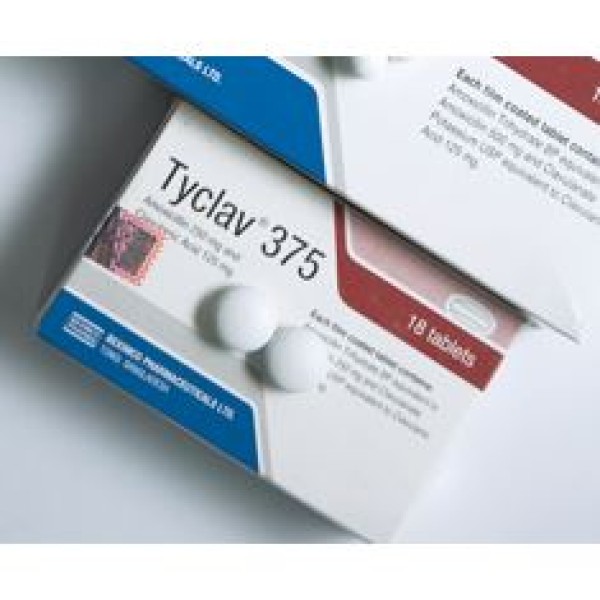
Tyclav 375mg Tablet — Amoxicillin 250mg + Clavulanic Acid 125mg | Beximco Pharmaceuticals
| Generic Names | Amoxicillin Trihydrate 250 mg + Potassium Clavulanate 125 mg |
| Total Content | 375 mg per tablet (250mg amoxicillin + 125mg clavulanate) |
| Dosage Form | Film-coated Tablet |
| Manufacturer | Beximco Pharmaceuticals Ltd. |
| Therapeutic Class | Beta-Lactamase Protected Aminopenicillin (Co-amoxiclav) |
| Brand Equivalent | Augmentin 375mg (GSK) — same formulation |
| Availability | In Stock — Available Online |
Overview
Tyclav 375mg is Beximco's co-amoxiclav tablet — a combination of Amoxicillin 250mg and Clavulanic Acid (Potassium Clavulanate) 125mg. The clavulanate component is a beta-lactamase inhibitor that protects amoxicillin from enzymatic inactivation by beta-lactamase-producing bacteria. This combination extends amoxicillin's spectrum to include many bacteria that are resistant to amoxicillin alone — particularly beta-lactamase-producing strains of H. influenzae, M. catarrhalis, Staphylococci, Klebsiella, and E. coli. Co-amoxiclav (Augmentin) is one of the most widely prescribed antibiotics globally, serving as step-up therapy when plain amoxicillin fails.
Why Add Clavulanate to Amoxicillin?
| Feature | Amoxicillin Alone (Tycil) | Amoxicillin + Clavulanate (Tyclav) |
|---|---|---|
| Beta-lactamase-producing bacteria | Inactivated — treatment fails | Clavulanate inhibits beta-lactamase — amoxicillin active |
| H. influenzae (beta-lactamase +) | May fail (~30–40% strains) | Covered |
| M. catarrhalis | May fail (~90–95% strains) | Covered |
| MSSA (S. aureus) | Fails (>90% produce beta-lactamase) | Covered |
| Anaerobes (dental/abdominal) | Poor coverage | Good coverage (B. fragilis) |
| MRSA, Pseudomonas | Not covered | Not covered |
Tyclav Range
| Product | Amoxicillin | Clavulanate | Dosing |
|---|---|---|---|
| Tyclav 375mg (this) | 250 mg | 125 mg | TDS (q8h) — standard |
| Tyclav 625mg | 500 mg | 125 mg | TDS — higher dose infections |
| Tyclav 1gm Tab | 875 mg | 125 mg | BD — convenient twice-daily |
Indications
- Acute Exacerbation of Chronic Bronchitis (AECB) — beta-lactamase-producing H. influenzae, M. catarrhalis
- Community-Acquired Pneumonia — when plain amoxicillin fails or resistant organisms suspected
- Otitis Media — treatment failure after first-line amoxicillin
- Sinusitis — persistent bacterial sinusitis, treatment failure
- Skin & Soft Tissue Infections — including infections with MSSA and mixed organisms
- Dental Infections — abscess, pericoronitis, post-extraction infections with anaerobic coverage
- Urinary Tract Infections — amoxicillin-resistant E. coli
- Animal Bite Wounds — Pasteurella, mixed anaerobic/aerobic prophylaxis/treatment
- Diabetic Foot Infections (mild-moderate) — polymicrobial cover
Dosage & Administration
| Indication | Dose | Frequency | Duration |
|---|---|---|---|
| Respiratory Tract Infections | 375 mg (1 tablet) | Three times daily (q8h) | 5–10 days |
| Skin & Soft Tissue Infections | 375 mg | Three times daily | 5–14 days |
| Dental Infections | 375 mg | Three times daily | 5–7 days |
| UTI (amoxicillin-resistant) | 375 mg | Three times daily | 5–7 days |
| Animal Bites | 375 mg | Three times daily | 5–7 days |
Take with or at the start of a meal to improve tolerability and reduce GI side effects (particularly diarrhoea from clavulanate). Take at evenly spaced 8-hour intervals. Complete the full course.
Special Note for Diabetic Patients
Co-amoxiclav is very commonly used in diabetic patients for: (1) Diabetic foot infections — excellent polymicrobial coverage (Streptococci, MSSA, enteric Gram-negatives, anaerobes); (2) UTIs resistant to plain amoxicillin; (3) Skin infections in immunocompromised diabetics. No blood glucose effects. Does not interact with diabetes medications. Note: diarrhoea is more common with co-amoxiclav than amoxicillin — take with food and consider probiotic co-administration.
Side Effects
- GI (most common with co-amoxiclav): Diarrhoea (9–14%), nausea, vomiting — significantly higher than plain amoxicillin due to clavulanate; take with food
- Skin: Rash, urticaria; rare — cholestatic jaundice (delayed, usually resolves)
- Hepatic: Elevated LFTs; cholestatic hepatitis (rare but more common than with plain amoxicillin)
- Hypersensitivity: Anaphylaxis (rare; cross-reactivity with all penicillins)
Storage
- Store below 25°C in a dry place, protected from moisture. Keep out of reach of children.
FAQ
Q1: Why is Tyclav prescribed when plain Tycil (amoxicillin) would not work?
When bacteria produce beta-lactamase enzymes, they break down amoxicillin before it can kill them. Clavulanate acts as a "shield" — it irreversibly binds and inactivates beta-lactamase, protecting amoxicillin so it can reach and kill the bacteria. Co-amoxiclav is used when plain amoxicillin has failed, or when the infection is caused by beta-lactamase-producing organisms that are known or suspected.
Q2: Why does Tyclav cause more diarrhoea than regular amoxicillin?
Clavulanate stimulates gut motility and disrupts the intestinal microbiome more than amoxicillin alone. Taking Tyclav at the start of meals significantly reduces GI side effects. Probiotic co-administration (e.g., Lactobacillus) may help reduce antibiotic-associated diarrhoea.
Q3: Can Tyclav 375mg treat a dog or cat bite?
Yes — co-amoxiclav is the first-choice antibiotic for animal bite wound infections. Animal bites introduce Pasteurella multocida (cats/dogs), Capnocytophaga (dogs), and anaerobic oral flora, all of which are well-covered by the amoxicillin+clavulanate combination. Standard treatment is Tyclav 375mg TDS for 5–7 days starting as soon as possible after the bite.
Medical Disclaimer: Educational information only. Always take antibiotics only as prescribed by a licensed physician.