- Stock: In Stock
- Brand: Beximco Pharmaceutical
- Product ID: Amoxicillin + Clavulanic Acid
🔒 100% Secure Payment | bKash | Nagad | SSLCommerz | COD
⭐ Become a FREE Member: 7% Extra Savings • Free Delivery • Refill Reminders • Priority Support
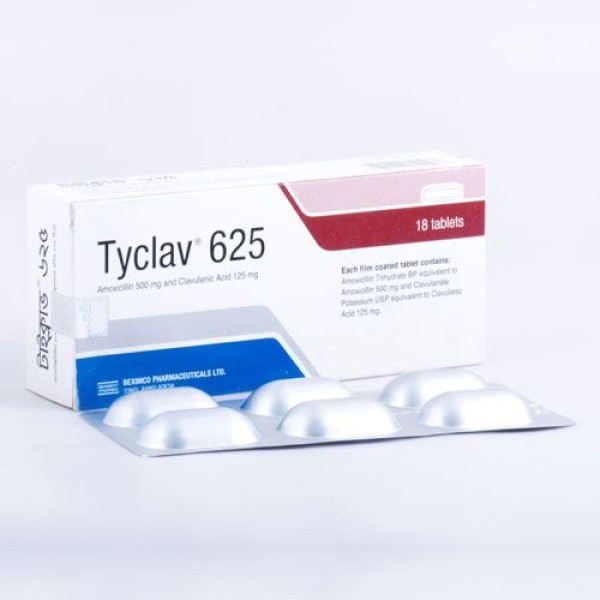
Tyclav 625mg Tablet — Amoxicillin 500mg + Clavulanic Acid 125mg | Beximco Pharmaceuticals
| Generic Names | Amoxicillin Trihydrate 500 mg + Potassium Clavulanate 125 mg |
| Total Content | 625 mg per tablet (500mg amoxicillin + 125mg clavulanate) |
| Dosage Form | Film-coated Tablet |
| Manufacturer | Beximco Pharmaceuticals Ltd. |
| Therapeutic Class | Beta-Lactamase Protected Aminopenicillin (Co-amoxiclav) |
| Brand Equivalent | Augmentin 625mg (GSK) — same formulation |
| Availability | In Stock — Available Online |
Overview
Tyclav 625mg is a higher-strength co-amoxiclav tablet combining Amoxicillin 500mg and Clavulanic Acid (Potassium Clavulanate) 125mg. The doubled amoxicillin dose (compared to Tyclav 375mg) provides greater bactericidal activity against susceptible organisms, making it appropriate for moderate-to-severe infections and situations where the 375mg dose is insufficient. The clavulanate dose remains at 125mg — sufficient to protect amoxicillin from beta-lactamase — while keeping GI side effects manageable. Tyclav 625mg (equivalent to Augmentin 625mg) is the most widely prescribed co-amoxiclav strength globally and the standard choice for most adult respiratory, skin, urinary, and dental infections.
How Co-Amoxiclav Works
Amoxicillin is a beta-lactam antibiotic that kills bacteria by inhibiting cell wall synthesis. Many bacteria have evolved resistance by producing beta-lactamase enzymes that destroy amoxicillin before it can act. Clavulanate is a suicide inhibitor — it irreversibly binds and inactivates beta-lactamase enzymes, restoring amoxicillin's effectiveness. Together, the combination covers: Streptococci, Staphylococci (MSSA), H. influenzae, M. catarrhalis, E. coli, Klebsiella, Proteus, Pasteurella, and many anaerobes (Bacteroides, Prevotella) — a broad polymicrobial spectrum essential for complex infections.
Tyclav Strength Comparison
| Product | Amoxicillin | Clavulanate | Best Use |
|---|---|---|---|
| Tyclav 375mg | 250 mg | 125 mg | Mild infections, step-up from amoxicillin |
| Tyclav 625mg (this) | 500 mg | 125 mg | Standard adult dose for most indications |
| Tyclav 1gm Tab | 875 mg | 125 mg | Higher dose, BD dosing convenience |
Indications
- Lower Respiratory Tract Infections — pneumonia, AECB, bronchitis with beta-lactamase-producing organisms
- Upper Respiratory Tract Infections — acute sinusitis, otitis media (treatment failure), tonsillitis/pharyngitis with resistant organisms
- Skin & Soft Tissue Infections — cellulitis, wound infections, abscess (MSSA), impetigo
- Urinary Tract Infections — complicated UTI, cystitis, pyelonephritis with resistant E. coli
- Dental & Oral Infections — periapical abscess, pericoronitis, severe periodontitis, post-extraction infections
- Diabetic Foot Infections (mild-moderate) — polymicrobial coverage for soft tissue and superficial bone infections
- Animal Bite Wounds — prophylaxis and treatment (Pasteurella, Capnocytophaga, anaerobes)
- Intra-abdominal Infections (mild) — mixed aerobic/anaerobic coverage
Dosage & Administration
| Indication | Dose | Frequency | Duration |
|---|---|---|---|
| Respiratory Infections (moderate) | 625 mg (1 tablet) | Three times daily (q8h) | 5–10 days |
| Sinusitis / Otitis Media | 625 mg | Three times daily | 5–10 days |
| Skin & Soft Tissue | 625 mg | Three times daily | 7–14 days |
| UTI (complicated) | 625 mg | Three times daily | 7–14 days |
| Dental Infections | 625 mg | Three times daily | 5–7 days |
| Animal Bites | 625 mg | Three times daily | 5–7 days |
Take with or at the start of a meal to reduce GI side effects, particularly diarrhoea from clavulanate. Take at evenly spaced 8-hour intervals. Complete the full prescribed course even if feeling better.
Special Note for Diabetic Patients
Tyclav 625mg is a frontline antibiotic for diabetic patients for several key indications: Diabetic foot infections — the polymicrobial nature of diabetic foot (Streptococci, MSSA, Gram-negative bacilli, anaerobes) makes co-amoxiclav an excellent oral choice for mild-moderate severity infections; UTIs — diabetics have higher rates of resistant E. coli UTIs where Tyclav provides coverage; Skin infections — impaired healing and immune response in diabetes make beta-lactamase-protected coverage important. No glucose-raising effect. No interaction with metformin, insulin, sulfonylureas, or DPP-4 inhibitors. Take with food to limit diarrhoea, which can be more pronounced in diabetics with gastropathy.
Side Effects
- GI (very common): Diarrhoea (14–20%), nausea, vomiting — due to clavulanate; significantly reduced by taking with food
- Hepatic: Elevated liver enzymes; cholestatic hepatitis (rare but more common with co-amoxiclav than amoxicillin alone; usually reversible)
- Skin: Rash, urticaria; maculopapular rash if given in EBV mononucleosis
- Hypersensitivity: Anaphylaxis (rare; do not use in penicillin-allergic patients)
- Candidiasis: Oral or vaginal thrush — more likely with longer courses
Contraindications
- Penicillin allergy or history of hypersensitivity to any beta-lactam antibiotic
- History of amoxicillin/clavulanate-associated jaundice or hepatic dysfunction
- Infectious mononucleosis (EBV) — high risk of maculopapular rash
Drug Interactions
| Drug | Interaction | Management |
|---|---|---|
| Warfarin / Acenocoumarol | Enhanced anticoagulant effect — increased bleeding risk | Monitor INR closely during and after treatment |
| Methotrexate | Amoxicillin reduces methotrexate renal excretion — toxicity risk | Avoid combination; monitor if unavoidable |
| Probenecid | Reduces renal excretion of amoxicillin — increased levels | Use with caution |
| Allopurinol | Increased risk of skin rash | Monitor; use alternative if possible |
| Oral Contraceptives | Possible reduced efficacy (theoretical) | Advise additional contraceptive precautions |
Storage
Store below 25°C in a dry place, protected from moisture. Keep out of reach of children.
FAQ
Q1: What is the difference between Tyclav 375mg and Tyclav 625mg?
The only difference is the amoxicillin dose: 250mg in 375mg tablets vs 500mg in 625mg tablets. The clavulanate dose is the same (125mg) in both. Tyclav 625mg delivers twice the bactericidal amoxicillin, making it more suitable for moderate-to-severe infections or when higher tissue concentrations are needed. Both are taken three times daily (TDS).
Q2: Is Tyclav 625mg the same as Augmentin 625mg?
Yes — both contain exactly Amoxicillin 500mg + Clavulanate 125mg. Tyclav is Beximco's branded generic of Augmentin (GSK). The formulation, mechanism, spectrum, dosing, and efficacy are identical. The price difference is significant, with Tyclav being considerably more affordable.
Q3: Can Tyclav 625mg treat a UTI?
Yes, particularly for UTIs caused by amoxicillin-resistant E. coli (which produce beta-lactamase). Uncomplicated UTIs in diabetics and complicated UTIs are appropriate indications. However, for simple uncomplicated cystitis in non-diabetic adults, nitrofurantoin or trimethoprim are usually preferred first-line. Urine culture should guide therapy where possible.
Q4: Can I take Tyclav 625mg twice daily instead of three times?
The standard 625mg formulation (amoxicillin 500mg + clavulanate 125mg) is designed for TDS (every 8 hours) dosing. If twice-daily dosing is preferred, the correct formulation is Tyclav 1gm Tablet (amoxicillin 875mg + clavulanate 125mg), which is specifically designed and validated for BD dosing with equivalent efficacy. Do not double up 625mg tablets to achieve BD dosing.
Medical Disclaimer: Educational information only. Prescription required. Always take antibiotics only as directed by a licensed physician. Completing the full course is essential to prevent antibiotic resistance.