- Stock: Out Of Stock
- Brand: ACI Pharmaceuticals
- Product ID: Amoxicillin + Clavulanic Acid
🔒 100% Secure Payment | bKash | Nagad | SSLCommerz | COD
⭐ Become a FREE Member: 7% Extra Savings • Free Delivery • Refill Reminders • Priority Support
This Item is for pre order
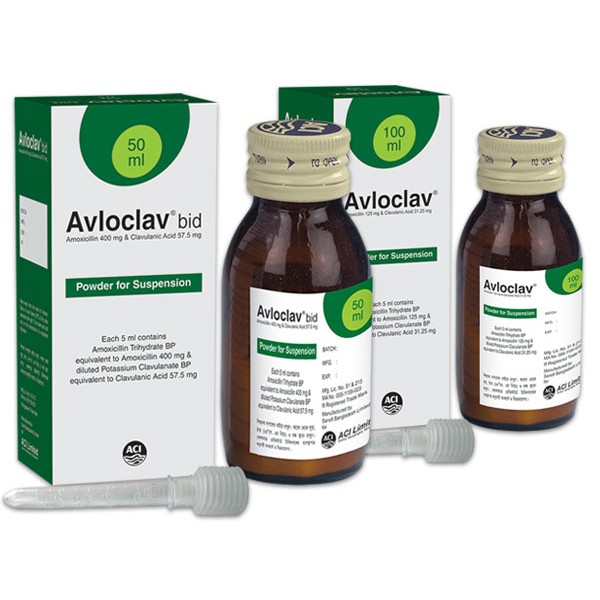
Avloclav 100ml Suspension – Paediatric Co-amoxiclav (125mg+31.25mg/5ml)
| Brand Name | Avloclav 100ml Suspension |
|---|---|
| Generic Name | Amoxicillin 125mg + Clavulanic Acid 31.25mg per 5ml |
| Strength | Amoxicillin 125mg + Clavulanic Acid 31.25mg per 5ml (156.25mg/5ml total) |
| Dosage Form | Powder for Oral Suspension |
| Pack Size | 100ml when reconstituted |
| Manufacturer | ACI Limited, Bangladesh |
| Drug Class | Beta-Lactam Antibiotic + Beta-Lactamase Inhibitor |
| Prescription Required | Yes (Rx) |
| Storage | Dry powder: below 25°C. Reconstituted suspension: refrigerate at 2–8°C, use within 7 days. |
1. About Avloclav Paediatric Suspension
Avloclav 100ml Suspension is the paediatric formulation of Co-amoxiclav manufactured by ACI Limited, Bangladesh. Each 5ml contains Amoxicillin 125mg + Clavulanic Acid 31.25mg (156.25mg combined), providing broad-spectrum coverage against beta-lactamase-producing organisms — the main cause of treatment failure with plain amoxicillin in children's infections. The 100ml bottle provides sufficient volume for a complete 7-day course for children up to approximately 12–15kg. Co-amoxiclav suspension is considered a second-line agent in most paediatric guidelines — used when standard amoxicillin or first-line agents have failed or are likely to fail based on local resistance patterns.
2. When to Use Co-amoxiclav Suspension vs Plain Amoxicillin in Children
Key clinical decision points: (1) Use plain amoxicillin first for uncomplicated community-acquired pneumonia (CAP), otitis media (first episode), and mild sinusitis in children without risk factors — amoxicillin resistance in common respiratory pathogens remains low for Streptococcus pneumoniae (the main CAP pathogen, which is penicillin-sensitive); (2) Escalate to co-amoxiclav when: plain amoxicillin has failed after 48–72 hours; beta-lactamase-producing organisms are suspected (H. influenzae, M. catarrhalis for AOM/sinusitis; S. aureus for skin/wound infections); bite wounds; UTI with gram-negative organisms (E. coli — check local susceptibility first); recurrent AOM; recent antibiotic exposure in past 30 days (increases resistance likelihood); (3) Dose consideration: standard paediatric co-amoxiclav dose (25mg/kg/day amoxicillin component in 2–3 divided doses) is adequate for most indications. High-dose (40–90mg/kg/day) co-amoxiclav is reserved for suspected drug-resistant S. pneumoniae — check with prescriber.
3. Indications in Children
- Acute otitis media (AOM) — second-line (after failed amoxicillin or severe AOM)
- Acute bacterial sinusitis — second-line or first-line when recent antibiotic use
- Lower respiratory tract infection — when beta-lactamase-producing H. influenzae suspected
- Skin and soft tissue infections — bite wounds, infected eczema, impetigo not responding to first-line
- Urinary tract infection — where E. coli susceptibility to amoxicillin-clavulanate confirmed
- Paediatric dental infections
4. Dosage and Administration
Standard dose: 25mg/kg/day of amoxicillin component, given in 2 or 3 divided doses with food. Using the 125+31.25mg/5ml suspension: 5ml contains 125mg amoxicillin. For a 20kg child on 25mg/kg/day TDS: (20 × 25) ÷ 3 = 167mg amoxicillin per dose ≈ 6.7ml per dose TDS. A 100ml bottle provides approximately 10 doses of 6.7ml × 3/day = 5 days — parents should be counselled on the total volume needed for 7 days and whether a second bottle is required. Take with food — clavulanate absorption is enhanced by food, and GI side effects are reduced. Shake well before each use.
5. Reconstitution Instructions
Add cooled boiled water in two portions to the powder: add approximately half the volume first, shake vigorously, then add remaining water to the 100ml mark and shake again until powder is fully dissolved. Store reconstituted suspension in refrigerator (2–8°C) and use within 7 days. Shake well before each dose. Discard any remaining suspension after 7 days — do not continue using even if suspension appears normal. Use the supplied oral dosing syringe for accurate measurement — standard teaspoons are not accurate enough for paediatric dosing. Keep out of reach of children.
6. Common Paediatric Side Effects
Diarrhoea is the most common side effect — occurs in up to 30% of children on co-amoxiclav (more than with plain amoxicillin). This is primarily clavulanate-related. Giving with food reduces but does not eliminate this. Nappy/diaper rash (ammoniacal dermatitis) may worsen with antibiotic-associated diarrhoea. Oral thrush (Candida) occurs in some children — treat with oral nystatin drops if identified. Nausea and vomiting — if persistent, consider whether the child is taking the dose with food. Skin rash: distinguish antibiotic-associated rash (generalised maculopapular, non-urticarial — NOT penicillin allergy) from true allergic urticaria (wheals, angio-oedema). True urticaria requires stopping and allergy evaluation; maculopapular rash typically resolves and does not indicate true allergy.
7. Contraindications and Cautions
Do not use in children with known penicillin or amoxicillin allergy. Previous jaundice or hepatic dysfunction with amoxicillin-clavulanate is a contraindication — use an alternative antibiotic. Co-amoxiclav suspension in children under 3 months: use with caution — limited data, low clavulanate clearance in neonates. Viral infections (viral URTI, viral pharyngitis, influenza): antibiotics including co-amoxiclav are ineffective against viruses — prescribing for viral illness drives resistance and causes unnecessary side effects. Infectious mononucleosis: amoxicillin causes a characteristic widespread maculopapular rash when given for what is mistakenly thought to be bacterial tonsillitis — avoid amoxicillin/co-amoxiclav in suspected EBV infection.
Frequently Asked Questions (FAQ)
Q1: How much Avloclav suspension should I give my child?
The dose is based on your child's weight. The standard dose is 25mg/kg/day of the amoxicillin component, given 3 times a day (or 2 times a day if prescribed BD). Using the 125mg/5ml suspension: multiply your child's weight (in kg) by 25, then divide by 3, then divide by 25 (concentration per ml) to get ml per dose. Example: 10kg child: (10×25)÷3÷25 = 3.3ml three times a day. Your doctor or pharmacist will usually calculate this for you and write it on the label. Always use the supplied dosing syringe — not a kitchen teaspoon. Give with food to reduce stomach upset.
Q2: My child has diarrhoea after starting Avloclav — should I stop it?
Mild to moderate diarrhoea (loose stools, no blood, child feeding reasonably well) is a common and expected side effect of co-amoxiclav and does not require stopping the antibiotic. Continue giving with food and ensure adequate fluid intake (oral rehydration solution if needed for hydration). Diarrhoea typically improves after completing the course. However, stop the antibiotic and see a doctor urgently if: diarrhoea contains blood or mucus; diarrhoea is severe (more than 6–8 watery stools per day); the child has signs of dehydration (dry mouth, no tears, no urination for 8+ hours, sunken eyes); the child develops fever or abdominal pain alongside worsening diarrhoea (possible C. difficile — rare in children but reported).
Q3: How long does reconstituted Avloclav suspension last after mixing?
Once reconstituted (mixed with water), Avloclav suspension must be stored in the refrigerator (2–8°C) and used within 7 days. Do not leave at room temperature — this accelerates degradation of clavulanate. After 7 days, discard the suspension even if there appears to be some remaining — both amoxicillin and clavulanate degrade progressively and potency cannot be guaranteed. Do not freeze. The dry powder before mixing can be stored at room temperature (below 25°C). If you forget to refrigerate the reconstituted suspension for a few hours (e.g., left out overnight), contact your pharmacist — if the ambient temperature was moderate and it was only a few hours, it may still be usable, but it is generally safer to discard and prepare a fresh bottle if significant time at room temperature has occurred.
Q4: My child has been prescribed Avloclav for an ear infection — why not just plain amoxicillin?
Most ear infections (acute otitis media) in children are caused by Streptococcus pneumoniae, Haemophilus influenzae, and Moraxella catarrhalis. Plain amoxicillin remains first-line because it adequately covers pneumococcus (the most common serious cause). Co-amoxiclav is used instead when: (1) Plain amoxicillin has already been tried and failed; (2) The child has had antibiotics in the past 30 days (increases resistant organism likelihood); (3) The child has severe AOM (perforation, discharge, mastoiditis risk); (4) The child attends daycare (higher beta-lactamase-producing H. influenzae carriage). In these situations, beta-lactamase-producing H. influenzae and M. catarrhalis — which are resistant to plain amoxicillin — become much more likely, and co-amoxiclav's clavulanate component overcomes this resistance mechanism. Your doctor's prescription of co-amoxiclav over plain amoxicillin indicates one of these risk factors was identified.