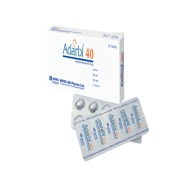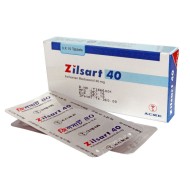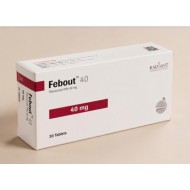
- Stock: In Stock
- Brand: Renata
- Product ID: Azilsartan Medoxomil
🔒 100% Secure Payment | bKash | Nagad | SSLCommerz | COD
⭐ Become a FREE Member: 7% Extra Savings • Free Delivery • Refill Reminders • Priority Support
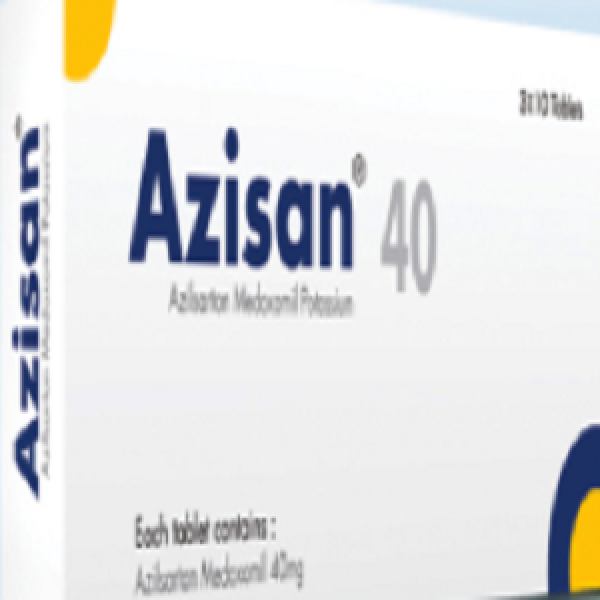
Azisan 40mg Tab — Telmisartan 40mg by Renata for Hypertension and Diabetic Nephroprotection
| Attribute | Details |
|---|---|
| Brand Name | Azisan 40 |
| Generic Name | Telmisartan |
| Strength | 40 mg |
| Dosage Form | Tablet |
| Drug Class | Angiotensin II Receptor Blocker (ARB) |
| Manufacturer | Renata Limited, Bangladesh |
| Route of Administration | Oral |
| Dosing Frequency | Once daily |
About Azisan 40mg Tablet
Azisan 40mg Tab contains telmisartan 40 mg, manufactured by Renata Limited — one of Bangladesh's leading pharmaceutical companies. Telmisartan is an angiotensin II type 1 (AT1) receptor blocker (ARB), a class of drugs that blocks the renin-angiotensin-aldosterone system (RAAS) by competitively antagonising angiotensin II at the AT1 receptor subtype. The result is vasodilation, reduced aldosterone secretion, reduced sodium and water retention, and lower blood pressure. Among ARBs, telmisartan is distinguished by two unique pharmacological properties: it has the longest half-life of any ARB (approximately 24 hours), enabling true once-daily blood pressure control throughout the full 24-hour dosing interval including the critical early morning blood pressure surge; and it is a partial agonist of peroxisome proliferator-activated receptor gamma (PPAR-γ), conferring modest insulin-sensitising effects that may be particularly advantageous in diabetic patients.
Telmisartan in Diabetic Patients: A First-Choice ARB
Hypertension is present in approximately 70–80% of patients with type 2 diabetes and is a major contributor to the excess cardiovascular and renal morbidity in this population. International guidelines including JNC 8, ADA Standards of Care, and ESH/ESC Hypertension Guidelines consistently recommend ACE inhibitors (ACEi) or ARBs as the preferred first-line antihypertensive agents for patients with diabetes — particularly those with proteinuria, microalbuminuria, or established CKD. Telmisartan 40mg (Azisan 40) is a clinically proven choice in this setting. Key clinical evidence: the ONTARGET trial (25,620 patients at high cardiovascular risk including diabetics) showed telmisartan achieved equivalent cardiovascular outcomes to ramipril (ACE inhibitor) but with significantly fewer cough-related discontinuations — making it the preferred alternative for diabetic patients who develop ACEi cough. The TRANSCEND trial demonstrated telmisartan reduced cardiovascular events and renal outcomes in diabetic patients intolerant of ACE inhibitors. Additionally, telmisartan's PPAR-γ partial agonism may modestly improve insulin sensitivity and HbA1c in patients with metabolic syndrome and early type 2 diabetes — effects not shared by most other ARBs.
Diabetic Nephropathy: Telmisartan's Renoprotective Effects
Diabetic nephropathy is the leading cause of chronic kidney disease (CKD) and end-stage renal disease (ESRD) worldwide. Telmisartan (Azisan 40mg) provides renoprotection through multiple mechanisms: (1) haemodynamic: reduces intraglomerular pressure by dilating the efferent arteriole, slowing the progressive glomerular damage caused by hyperfiltration; (2) antiproteinuric: reduces urinary albumin excretion by 30–40% in microalbuminuric patients, slowing the progression from microalbuminuria to macroalbuminuria; (3) anti-inflammatory: RAAS blockade reduces renal production of profibrotic cytokines (TGF-β, connective tissue growth factor); (4) PPAR-γ effects: may reduce lipid deposition in renal mesangial cells. The standard starting dose for diabetic nephroprotection is telmisartan 40mg (Azisan 40) once daily, which may be up-titrated to 80mg in patients with persistent proteinuria who tolerate the lower dose. Monitoring is required: serum potassium (risk of hyperkalaemia, especially with concurrent SGLT-2 inhibitors or potassium-sparing diuretics) and serum creatinine (may rise modestly in the first 2–4 weeks of therapy — a rise of up to 30% from baseline is acceptable and does not require discontinuation).
Blood Pressure Targets in Diabetic Patients
Blood pressure management in diabetes requires careful target-setting. Current guidelines recommend: for most patients with diabetes and hypertension: BP target <130/80 mmHg (ADA 2024), or <140/90 mmHg as an acceptable initial target for patients at lower cardiovascular risk. Telmisartan 40mg (Azisan 40) once daily reduces systolic BP by approximately 10–16 mmHg and diastolic BP by 6–10 mmHg in hypertensive patients. If blood pressure remains above target on telmisartan 40mg alone after 4–6 weeks, options include: up-titrating to telmisartan 80mg (Azisan 80); adding a calcium channel blocker (amlodipine); or adding a thiazide diuretic. The combination of telmisartan + amlodipine is particularly well-studied, achieving superior BP control compared to either agent alone, and is one of the most recommended combination strategies in diabetic hypertension.
Frequently Asked Questions (FAQ)
Q1: How is telmisartan (Azisan 40) different from losartan and other ARBs?
Telmisartan has several advantages over other commonly used ARBs in Bangladesh. Compared to losartan (the most widely used ARB): telmisartan has a longer half-life (24h vs 6–9h for losartan), providing superior 24-hour and early-morning BP control; telmisartan is 3–4 times more potent at the AT1 receptor; telmisartan has the PPAR-γ partial agonism (losartan does not); and telmisartan shows superior 24-hour ambulatory blood pressure control in head-to-head trials. Compared to valsartan: telmisartan shows longer duration of action. Compared to candesartan (considered the most potent ARB): telmisartan has comparable efficacy in most studies. Telmisartan is particularly favoured in diabetic hypertension guidelines precisely because of its combined RAAS blockade + metabolic benefits.
Q2: Can I take Azisan 40mg with my diabetes medicines?
Yes — telmisartan is compatible with all major diabetes medications. No clinically significant pharmacokinetic interactions exist between telmisartan and metformin, sulfonylureas (glibenclamide, glimepiride), DPP-4 inhibitors (sitagliptin, saxagliptin), GLP-1 agonists, or insulin. One pharmacodynamic consideration: SGLT-2 inhibitors (empagliflozin, dapagliflozin) can reduce blood pressure and increase potassium; combined with telmisartan (which also increases potassium slightly via aldosterone suppression), patients on both agents should have potassium monitored periodically, particularly if renal function is impaired. NSAIDs (ibuprofen, diclofenac) can blunt telmisartan's antihypertensive effect and worsen renal function — avoid regular NSAID use with telmisartan if possible.
Q3: I was previously on an ACE inhibitor but developed a cough — is Azisan 40mg appropriate?
Yes — this is one of the most common and appropriate clinical switches. ACE inhibitor-induced cough (caused by bradykinin accumulation) occurs in up to 15–20% of South Asian and East Asian patients — significantly higher than the 5–10% rate in European populations. Telmisartan and other ARBs do not cause bradykinin accumulation and therefore do not cause ACE inhibitor-type cough. The ONTARGET trial directly demonstrated equivalent cardiovascular and renal outcomes for telmisartan versus ramipril in high-risk patients including diabetics, confirming that switching from an ACEi to telmisartan maintains full cardiorenal protection without the cough side effect. When switching: start Azisan 40mg on the day after the last ACEi dose — there is no washout period required.
Q4: What side effects should I monitor for when taking Azisan 40mg?
Telmisartan (Azisan 40) is generally well-tolerated. Important side effects to monitor: hypotension (dizziness, lightheadedness on standing) — particularly after the first dose, in dehydrated patients, or in those on diuretics; hyperkalaemia (elevated blood potassium) — monitor potassium at baseline, 1 month, and then every 6 months, especially in patients with CKD, those on potassium-sparing diuretics, or SGLT-2 inhibitors; acute kidney injury — a small rise in serum creatinine in the first month is expected and acceptable; avoid if creatinine rises by >30% or potassium exceeds 5.5 mmol/L. Contraindications: pregnancy (telmisartan causes fetal harm — must be immediately stopped if pregnancy is confirmed); bilateral renal artery stenosis; concurrent use with aliskiren in diabetic patients is contraindicated.
Medical Disclaimer: Azisan 40mg Tab is a prescription antihypertensive by Renata Limited. Regular blood pressure monitoring, periodic kidney function (creatinine, eGFR) and electrolyte (potassium) checks are required during treatment. Do not discontinue without physician guidance. Contraindicated in pregnancy.