- Stock: In Stock
- Brand: Beximco Pharmaceutical
- Product ID: Amiodarone Hydrochloride
Available Options
🔒 100% Secure Payment | bKash | Nagad | SSLCommerz | COD
⭐ Become a FREE Member: 7% Extra Savings • Free Delivery • Refill Reminders • Priority Support
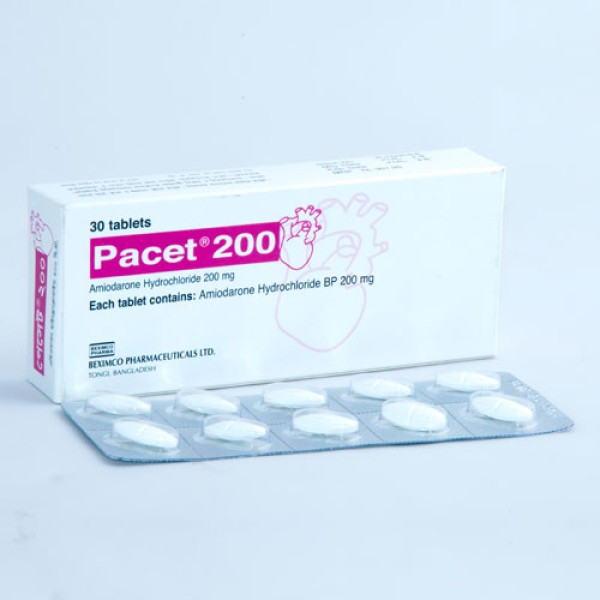
Pacet 200mg Tablet — Amiodarone Hydrochloride 200mg | Beximco Pharmaceuticals
| Generic Name | Amiodarone Hydrochloride 200 mg |
| Dosage Form | Tablet |
| Drug Class | Class III Antiarrhythmic Agent (Vaughan-Williams Classification) |
| Manufacturer | Beximco Pharmaceuticals Ltd. |
| Prescription Status | Prescription Only — Specialist (cardiologist) supervision recommended |
| Monitoring Required | Thyroid, liver, pulmonary, ophthalmologic — mandatory during therapy |
Overview
Pacet 200mg contains Amiodarone — one of the most effective but also most complex antiarrhythmic drugs available. Amiodarone is a class III antiarrhythmic that prolongs the cardiac action potential and refractory period, making it effective against virtually all types of cardiac arrhythmia (both atrial and ventricular). It is the antiarrhythmic of choice for life-threatening ventricular arrhythmias and a first-line option for atrial fibrillation (AF) rate and rhythm control. However, amiodarone has an exceptionally long half-life (40–55 days), extensive tissue accumulation, and a significant multi-organ toxicity profile requiring rigorous baseline evaluation and ongoing monitoring. It must only be initiated and supervised by a cardiologist or physician with cardiac arrhythmia expertise.
Mechanism of Action
Amiodarone has multi-channel blocking effects: (1) Class III (primary): Blocks myocardial K+ channels — prolongs action potential duration and effective refractory period — prevents re-entry arrhythmias; (2) Class I: Sodium channel blockade reduces conduction velocity; (3) Class II: Non-competitive beta-adrenergic blockade reduces heart rate; (4) Class IV: Calcium channel blockade slows AV node conduction; (5) Thyroid hormone inhibition: Structurally similar to T3/T4; blocks peripheral conversion of T4 to T3 — the key source of thyroid toxicity and also part of its antiarrhythmic effect.
Indications
- Atrial Fibrillation (AF) — rhythm control (cardioversion and maintenance of sinus rhythm); rate control
- Ventricular Tachycardia (VT) — both sustained and non-sustained; particularly post-MI VT
- Ventricular Fibrillation (VF) — cardiac arrest protocol (IV amiodarone in ACLS)
- Supraventricular Tachycardia (SVT) — when other agents have failed
- Wolff-Parkinson-White (WPW) Syndrome — to prevent accessory pathway tachycardias
- Prevention of sudden cardiac death — in patients with reduced ejection fraction and prior VT/VF
Dosage and Administration
| Phase | Dose | Duration | Notes |
|---|---|---|---|
| Loading (inpatient) | 200 mg three times daily (TDS) | 1–2 weeks | Under ECG monitoring; hospital or specialist clinic |
| Loading (continued) | 200 mg twice daily (BD) | Next 2–4 weeks | Continue ECG monitoring |
| Maintenance | 200 mg once daily (OD) | Long-term | Lowest effective dose; aim for 100–200 mg/day |
Take with or after food. Avoid grapefruit juice. Take at the same time each day. Due to the very long half-life, missing occasional doses has limited impact — do not double up.
Critical Warning for Diabetic Patients
Diabetes and cardiac arrhythmias frequently coexist — diabetic cardiomyopathy and autonomic neuropathy predispose to AF and other arrhythmias. Key considerations:
- Thyroid dysfunction and blood glucose: Amiodarone-induced hypothyroidism (20–40% of patients on long-term therapy) causes insulin resistance and worsening hyperglycaemia. Amiodarone-induced hyperthyroidism increases metabolic rate and may cause unexplained deterioration in glycaemic control. Monitor TSH/FT4 every 6 months; adjust diabetes medications if thyroid disorder develops.
- Hypoglycaemia masking: Amiodarone's beta-blocking effect can mask the tachycardia that normally warns of hypoglycaemia — monitor blood glucose more frequently, particularly with insulin or sulfonylureas.
- Interaction with sulfonylureas (CYP2C9 inhibition): Amiodarone significantly increases plasma levels of sulfonylureas (glibenclamide, glipizide) metabolised by CYP2C9 — risk of severe prolonged hypoglycaemia. Monitor blood glucose closely and consider reducing sulfonylurea dose or switching to metformin.
- Renal considerations: Diabetics with CKD must have amiodarone use carefully assessed alongside their existing renal regimen.
Multi-Organ Toxicity Monitoring (Mandatory)
| Organ | Toxicity | Monitoring |
|---|---|---|
| Thyroid (most common) | Hypothyroidism (20–40%) or Hyperthyroidism (3–10%) | TSH, FT4 at baseline and every 6 months |
| Lung (most serious) | Pulmonary toxicity — pneumonitis, fibrosis; 1–5% incidence; potentially fatal | CXR at baseline and annually; HRCT if symptomatic |
| Liver | Elevated LFTs; hepatitis; cirrhosis with prolonged high dose | LFTs every 6 months |
| Eye | Corneal microdeposits (nearly universal, usually asymptomatic); optic neuropathy (rare) | Annual ophthalmology; urgent if visual symptoms |
| Skin | Photosensitivity (common); blue-grey discolouration with prolonged use | SPF 50+ sunscreen; protective clothing |
| Cardiac | QT prolongation; Torsades de Pointes (rare) | ECG monitoring; avoid QT-prolonging drugs |
| Neurological | Peripheral neuropathy, tremor, ataxia (rare) | Clinical review; dose reduction if symptomatic |
Drug Interactions (Critical)
| Drug | Interaction | Action |
|---|---|---|
| Warfarin | CYP2C9 inhibition — warfarin accumulates — INR can double or triple — major bleeding risk | Reduce warfarin dose 30–50%; monitor INR daily initially |
| Digoxin | Amiodarone doubles digoxin levels — digoxin toxicity | Reduce digoxin dose by 50%; monitor ECG and levels |
| Sulfonylureas | CYP2C9 inhibition — increased SU levels — severe hypoglycaemia | Monitor BG; reduce SU dose; consider metformin switch |
| Simvastatin | CYP3A4 inhibition — increased statin levels — myopathy/rhabdomyolysis | Limit simvastatin to 20 mg/day; monitor CK |
| Beta-blockers / Verapamil | Additive bradycardia and AV block | Monitor HR and PR interval; reduce doses |
| Fluoroquinolones / Macrolides | Additive QT prolongation — Torsades de Pointes risk | Avoid combination; ECG monitoring if unavoidable |
Contraindications
- Sinus bradycardia or sino-atrial block (without pacemaker)
- Second or third degree AV block (without pacemaker)
- Pre-existing thyroid dysfunction (relative contraindication)
- Pregnancy and breastfeeding (neonatal thyroid dysfunction risk)
- Severe respiratory failure
- Known iodine hypersensitivity
Storage
Store below 25°C, protected from light. Keep in original packaging. Keep out of reach of children.
FAQ
Q: Why does amiodarone need such intensive monitoring?
Amiodarone is 37% iodine by weight and accumulates extensively in multiple organs (fat, liver, lungs, thyroid, skin, corneas, peripheral nerves) over months to years. This accumulation is what makes it highly effective — long duration of action — but also what causes multi-organ toxicity that can develop slowly and insidiously. Regular monitoring detects toxicity before it becomes irreversible.
Q: I am diabetic and on glibenclamide. My cardiologist wants to start amiodarone — what should I know?
Alert your diabetologist immediately. Amiodarone inhibits CYP2C9 — the enzyme that metabolises glibenclamide — causing it to accumulate to higher plasma levels and risk severe prolonged hypoglycaemia. Your diabetologist may reduce the glibenclamide dose, switch you to metformin (unaffected by this interaction), or increase the frequency of blood glucose monitoring. Additionally, amiodarone-induced hypothyroidism (very common with long-term use) worsens glycaemic control and requires insulin or OHA dose adjustment.
Q: Can I stop amiodarone if I develop a side effect?
Never stop amiodarone abruptly without medical guidance — sudden discontinuation can precipitate dangerous arrhythmias. If you develop new cough or breathlessness (possible pulmonary toxicity), visual changes (possible optic neuropathy), or severe fatigue (possible thyroid dysfunction), contact your physician immediately. Due to amiodarone's very long half-life (up to 55 days), drug effects persist for weeks to months after stopping.
Medical Disclaimer: This information is for educational purposes only and does not constitute medical advice. Amiodarone is a high-risk antiarrhythmic requiring specialist initiation and rigorous multi-organ monitoring. Never start, stop, or adjust amiodarone without cardiologist guidance. Diabetic patients must inform their diabetes physician before commencing amiodarone therapy.