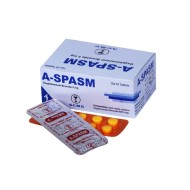
- Stock: Out Of Stock
- Brand: Acme Laboratories Limited
- Product ID: Oxyphenonium Bromide
🔒 100% Secure Payment | bKash | Nagad | SSLCommerz | COD
⭐ Become a FREE Member: 7% Extra Savings • Free Delivery • Refill Reminders • Priority Support
This Item is for pre order
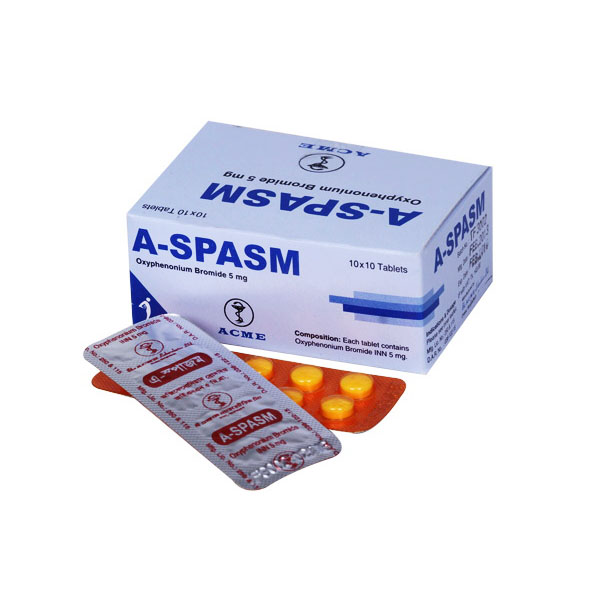
A-Spasm 5mg Tablet — Oxyphenonium Bromide | Beximco Pharmaceuticals
| Generic Name | Oxyphenonium Bromide 5mg |
| Drug Class | Quaternary Ammonium Anticholinergic / Antispasmodic |
| Manufacturer | Beximco Pharmaceuticals Ltd. |
| Route | Oral (Tablet) |
| Prescription Status | Prescription Required |
Overview
A-Spasm 5mg contains Oxyphenonium Bromide — a quaternary ammonium anticholinergic antispasmodic. Unlike tertiary amines (atropine, dicycloverine), oxyphenonium is a permanently charged quaternary ammonium compound that does not readily cross the blood-brain barrier, resulting in fewer CNS side effects (less sedation, less confusion). It is used for the management of peptic ulcers (as adjunctive therapy to reduce gastric acid secretion and relieve associated spasm), irritable bowel syndrome, renal colic, and biliary colic. The peripheral selectivity makes it preferable in elderly patients and those sensitive to CNS anticholinergic effects.
Mechanism of Action
Oxyphenonium bromide competitively blocks muscarinic (M1, M2, M3) receptors on smooth muscle and glandular tissue. M3 receptor blockade in the GI tract reduces smooth muscle contraction (antispasmodic), decreases gastric motility, and reduces gastric acid secretion (antisecretory). M1 blockade in gastric parietal cell-adjacent ganglia further reduces acid output. As a quaternary ammonium compound, it is poorly lipid-soluble and does not penetrate the CNS, limiting central anticholinergic adverse effects compared to atropine or hyoscine.
Indications
- Peptic ulcer disease — adjunctive therapy to reduce gastric hypersecretion and relieve spasm
- Irritable Bowel Syndrome (IBS) — abdominal cramping and spasm
- Biliary colic — smooth muscle relaxation in biliary tract
- Renal colic — ureteric smooth muscle relaxation
- Pylorospasm
- Hyperhidrosis (excessive sweating — off-label)
Dosage
| Indication | Dose | Frequency | Notes |
|---|---|---|---|
| Peptic ulcer / GI spasm (adults) | 5–10mg | 3–4 times daily | Before meals and at bedtime |
| IBS / colic | 5mg | 3–4 times daily | 30 min before meals |
| Elderly | 5mg | 2–3 times daily | Lower dose — reduced clearance |
Take 30 minutes before meals for optimal antispasmodic effect on post-meal GI activity. Maximum 60mg/day in adults.
Critical Diabetic Patient Information
- Gastroparesis risk: Oxyphenonium reduces GI motility via M3 blockade. Diabetic patients with autonomic neuropathy already have delayed gastric emptying (gastroparesis). Adding an anticholinergic agent can significantly worsen gastroparesis — causing increased bloating, nausea, early satiety, and erratic glucose absorption. Use only under physician guidance when the indication is clear and gastroparesis has been excluded
- Erratic glucose absorption: If gastroparesis is present or develops, carbohydrate absorption becomes unpredictable — causing post-meal hypoglycaemia (delayed absorption from slow gastric emptying) followed by late hyperglycaemia. This significantly complicates insulin therapy management
- Urinary retention in diabetic men: Diabetic autonomic neuropathy affecting the bladder (diabetic cystopathy) combined with anticholinergic bladder effects increases urinary retention risk — particularly in older men with concurrent BPH
- Reduced CNS effects vs. dicycloverine: As a quaternary ammonium compound, oxyphenonium causes fewer CNS side effects (less sedation, confusion) than tertiary amine anticholinergics — potentially better tolerated in older diabetics
- Peptic ulcer and diabetes: Diabetics on NSAIDs or aspirin for cardiovascular prevention are at elevated peptic ulcer risk. Oxyphenonium may be used as part of an ulcer symptom management regimen — but PPIs (omeprazole, pantoprazole) are the primary treatment
Side Effects
| System | Side Effect | Severity |
|---|---|---|
| Anticholinergic (peripheral) | Dry mouth, reduced sweating, urinary hesitancy, constipation, blurred vision | Common — dose-dependent |
| GI | Constipation (from reduced gut motility), nausea | Common — Mild |
| Cardiovascular | Tachycardia (at high doses) | Uncommon |
| CNS | Mild dizziness (less than tertiary anticholinergics due to poor BBB penetration) | Uncommon — Mild |
| Ocular | Blurred vision, difficulty focusing | Common — Mild |
| Serious (rare) | Acute angle-closure glaucoma, severe urinary retention | Rare — Serious |
Drug Interactions
| Drug | Interaction |
|---|---|
| Other anticholinergics (antihistamines, TCAs, antipsychotics) | Additive anticholinergic effects — avoid combination |
| Metoclopramide / domperidone | Antagonistic — oxyphenonium opposes prokinetic effect |
| Amantadine | Enhanced anticholinergic effect |
| Antacids | May reduce oxyphenonium GI absorption — separate by 1–2 hours |
Contraindications
- Known hypersensitivity to oxyphenonium or quaternary ammonium compounds
- Narrow-angle glaucoma
- Myasthenia gravis
- Obstructive uropathy or bladder neck obstruction
- Paralytic ileus or severe GI obstruction
- Toxic megacolon
- Diabetic gastroparesis (relative — use with extreme caution only under specialist guidance)
Storage
Store below 30°C. Protect from light and moisture. Keep out of reach of children.
Frequently Asked Questions
Q: How is A-Spasm (oxyphenonium) different from Buscopan (hyoscine butylbromide)?
A: Both are quaternary ammonium anticholinergics that don't readily cross the blood-brain barrier. Hyoscine butylbromide (Buscopan) has a shorter duration and is mainly used for acute colic; oxyphenonium has a longer duration suitable for regular dosing in peptic ulcer and IBS management.
Q: Can I take A-Spasm if I have diabetes?
A: Diabetics with gastroparesis or autonomic neuropathy should avoid anticholinergics unless clearly indicated and under physician guidance — they can significantly worsen gastroparesis. Diabetics without GI complications can generally use it at standard doses with monitoring.
Q: Does A-Spasm cure peptic ulcers?
A: No — it relieves symptoms (spasm, pain) and reduces acid secretion but does not eradicate H. pylori (the main cause of most peptic ulcers). Definitive treatment requires H. pylori eradication therapy (triple therapy with PPI + antibiotics).
Medical Disclaimer: A-Spasm 5mg (Oxyphenonium Bromide) is a prescription anticholinergic antispasmodic. Contraindicated in narrow-angle glaucoma, myasthenia gravis, and obstructive uropathy. Diabetics with gastroparesis should avoid unless directed by a physician. May impair ability to drive. This information is for educational purposes only. Always follow your physician's instructions.