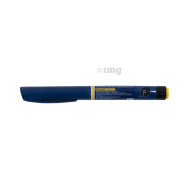
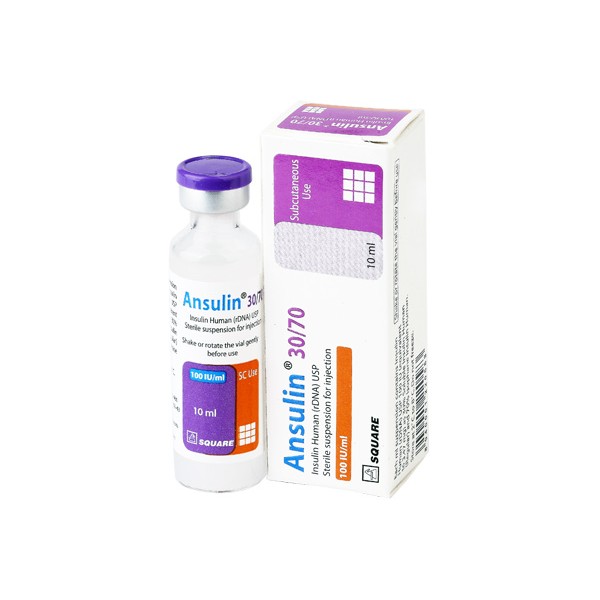
- Stock: Out Of Stock
- Brand: Square Pharmaceuticals
- Product ID: Insulin Human [rDNA] + Isophane Insulin Human
Available Options
🔒 100% Secure Payment | bKash | Nagad | SSLCommerz | COD
⭐ Become a FREE Member: 7% Extra Savings • Free Delivery • Refill Reminders • Priority Support
This Item is for pre order
| Generic Name | Regular Insulin Human + Isophane Insulin Human |
| Strength | 30%+70% in 100 IU/ml |
| Dosage Form | Injection (Suspension for Subcutaneous Use) |
| Manufacturer | Square Pharmaceuticals PLC |
| Therapeutic Class | Insulin Preparation (Intermediate-Acting, Pre-Mixed) |
| Pack Size | 10 ml Vial |
Overview
Ansulin 30/70 is a pre-mixed human insulin suspension containing 30% Regular (short-acting) Insulin Human and 70% Isophane (intermediate-acting) Insulin Human, manufactured by Square Pharmaceuticals PLC. The combination provides both a rapid onset of action and a longer duration of glucose control, making it suitable for twice-daily dosing in patients with diabetes mellitus.
Indications
Ansulin 30/70 Injection is indicated for:
- Treatment of all patients with type 1 diabetes
- Treatment of patients with type 2 diabetes who are not adequately controlled by diet and/or oral hypoglycemic agents
- Initial stabilization of diabetes in patients with diabetic ketoacidosis, hyperosmolar non-ketotic syndrome, and during periods of stress such as severe infections and major surgery in diabetic patients
- Treatment of gestational diabetes
Pharmacology
The blood glucose lowering effect of insulin results from facilitated glucose uptake following binding to receptors on muscle and fat cells, together with simultaneous inhibition of hepatic glucose output. Insulin has a half-life of only a few minutes in the bloodstream with no profound plasma protein binding. After subcutaneous injection of this pre-mixed preparation, onset of action begins within 30 minutes, peak plasma levels are attained between 1-3 hours, and the duration of action is approximately 18-24 hours.
Dosage and Administration
Dosage is individualized and determined by the physician according to patient needs.
- Average total daily insulin requirement for maintenance therapy in type 1 diabetic patients: 0.5 to 1.0 IU/kg; in pre-pubertal children: 0.7 to 1.0 IU/kg
- Requirements may be higher with insulin resistance (e.g., puberty, obesity) and lower with residual endogenous insulin production or during partial remission
- Initial dosage for type 2 diabetic patients is often lower: 0.3 to 0.6 IU/kg/day
- An injection should be followed within 30 minutes by a meal or snack containing carbohydrates
Administration: Usually given subcutaneously in the abdominal wall, thigh, gluteal, or deltoid region. Abdominal wall injection ensures faster absorption. Injection sites within an anatomic region should be rotated to avoid lipodystrophy. The suspension must be mixed thoroughly (rolled gently between the hands) until uniformly white and cloudy before each injection, and should not be used if clumps or solid particles are visible.
Interaction
Concomitant use of other drugs may influence insulin requirements. Substances that may reduce insulin requirement include oral hypoglycemic agents, MAO inhibitors, non-selective beta-blockers, ACE inhibitors, salicylates, and alcohol. Substances that may increase insulin requirement include thiazides, glucocorticoids, thyroid hormones, beta-sympathomimetics, growth hormone, and danazol. Beta-blockers may mask hypoglycemia symptoms; alcohol may intensify and prolong the hypoglycemic effect.
Contraindications
Should never be given to patients with hypoglycemia or hypersensitivity to human insulin or any of the excipients.
Side Effects
Hypoglycemia is the most frequent adverse effect and may occur if the insulin dose exceeds requirements. Lipodystrophy may occur at injection sites with failure to rotate sites. Generalized hypersensitivity (rash, itching, sweating, gastrointestinal upset, angioneurotic oedema, breathing difficulty, palpitation, hypotension) is potentially life-threatening though rare. Transient oedema may occur upon initiation of therapy.
Pregnancy and Lactation
There are no restrictions on treating diabetes with insulin during pregnancy, as insulin does not cross the placental barrier. Both hypoglycemia and hyperglycemia from inadequately controlled diabetes increase the risk of fetal malformation and death in utero. Insulin requirements usually fall in the first trimester and rise during the second and third trimesters, returning rapidly to pre-pregnancy levels after delivery. Insulin treatment poses no risk to a nursing infant, though maternal dosage or diet may require adjustment.
Precautions and Warnings
Inadequate dosing or discontinuation, especially in type 1 diabetes, may lead to hyperglycemia and, if untreated, diabetic ketoacidosis, which can be life-threatening. Transferring a patient to another type or brand of insulin must be done under strict medical supervision, as changes in strength, manufacturer, type, species, or method of manufacture may require a dosage adjustment. Patients traveling across time zones should consult their doctor regarding insulin and meal timing.
Storage Conditions
Store between 2°C and 8°C (in a refrigerator); do not freeze. Keep in the outer carton to protect from light, and protect from excessive heat or sunlight. Once in use, a vial may be kept below 25°C (not refrigerated) for up to 6 weeks, or below 30°C for up to 4 weeks.
Frequently Asked Questions
Q: What is the difference between the 30/70 ratio in this insulin?
A: It means each ml contains 30% fast-acting Regular Insulin Human and 70% intermediate-acting Isophane Insulin Human, giving both quick onset and longer-lasting glucose control in a single injection.
Q: Can I switch brands of insulin on my own?
A: No. Any change in insulin brand, strength, or type should only be made under strict medical supervision, as it may require a dosage adjustment.
This content is for informational purposes only and is not a substitute for professional medical advice. Please consult a registered physician before starting, stopping, or changing any medication.