- Stock: In Stock
- Brand: Beximco Pharmaceutical
- Product ID: Linezolid
🔒 100% Secure Payment | bKash | Nagad | SSLCommerz | COD
⭐ Become a FREE Member: 7% Extra Savings • Free Delivery • Refill Reminders • Priority Support
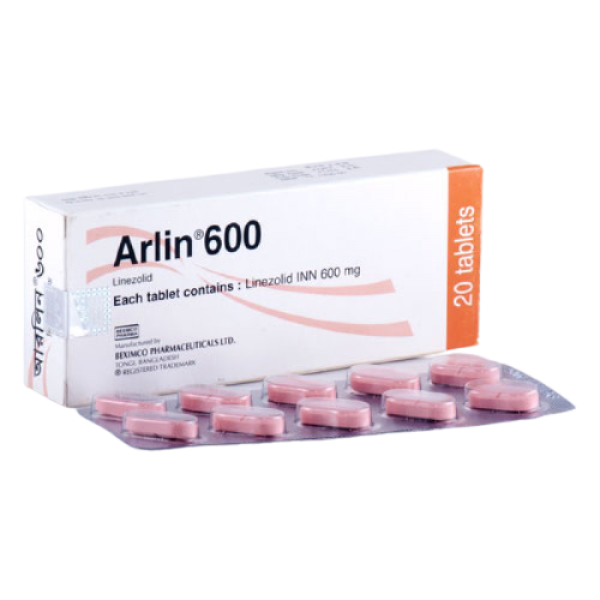
Arlin 600mg Tablet — Linezolid 600mg | Beximco Pharmaceuticals
| Generic Name | Linezolid 600 mg |
| Dosage Form | Film-coated Tablet |
| Drug Class | Oxazolidinone Antibiotic |
| Manufacturer | Beximco Pharmaceuticals Ltd. |
| Prescription Status | Prescription Only — Specialist Use / Infectious Disease |
| Oral Bioavailability | ~100% — uniquely allows step-down from IV to oral with no loss of efficacy |
Overview
Arlin 600mg contains Linezolid — the first clinically approved oxazolidinone antibiotic, offering a unique and critically important mechanism of action distinct from all other antibiotic classes. Linezolid is active against virtually all clinically relevant drug-resistant Gram-positive bacteria including MRSA (methicillin-resistant Staphylococcus aureus), VRSA (vancomycin-resistant S. aureus), VRE (vancomycin-resistant enterococci), and penicillin-resistant Streptococcus pneumoniae. Its most clinically distinctive feature is near-complete oral bioavailability (~100%), making it one of the very few antibiotics where oral therapy is therapeutically equivalent to IV — enabling definitive outpatient treatment of MRSA and VRE infections that would otherwise require prolonged IV vancomycin hospitalisation. Linezolid also has activity against Mycobacterium tuberculosis and is used as a key component of MDR-TB and XDR-TB regimens.
Mechanism of Action
Linezolid's mechanism is unique — it inhibits bacterial protein synthesis at the 50S ribosomal subunit by binding to the 23S ribosomal RNA of the 50S subunit and preventing formation of the 70S initiation complex. This site and mechanism are completely different from all other ribosomal antibiotics (aminoglycosides, macrolides, tetracyclines, chloramphenicol), meaning no cross-resistance with any existing antibiotic class. Linezolid is predominantly bacteriostatic against staphylococci and enterococci (inhibits growth without killing), but bactericidal against streptococci. Because of its unique ribosomal binding site, it also inhibits mammalian mitochondrial ribosomes (which are prokaryotic in origin) — explaining its key adverse effects including thrombocytopenia, lactic acidosis, and peripheral neuropathy with prolonged use.
Spectrum of Activity
| Organism | Coverage |
|---|---|
| MRSA (Methicillin-resistant S. aureus) | Excellent — first-line oral alternative to IV vancomycin |
| VRE (Vancomycin-resistant Enterococcus) | Excellent — only reliable oral option for VRE |
| Streptococcus pneumoniae (incl. penicillin-resistant) | Excellent |
| VISA / VRSA | Active |
| MDR-TB and XDR-TB | Active (off-label; WHO-recommended component) |
| Gram-negative bacteria | None — not active against any Gram-negatives |
| Anaerobes | Limited activity |
Indications
- MRSA infections — skin and soft tissue (SSTI), pneumonia, bacteraemia, diabetic foot infections
- VRE infections — UTI, bacteraemia, wound infections — only reliable oral option
- Community-acquired pneumonia (CAP) — covers S. pneumoniae including penicillin-resistant strains
- Hospital-acquired pneumonia (HAP) — MRSA pneumonia
- Complicated skin and soft tissue infections — including infected diabetic foot ulcers with MRSA
- MDR-TB / XDR-TB — core component of WHO Group C regimens
- Step-down from IV vancomycin — uniquely possible due to 100% oral bioavailability
Dosage and Administration
| Indication | Dose | Frequency | Duration |
|---|---|---|---|
| MRSA SSTI (uncomplicated) | 600 mg | Twice daily (BD) | 10–14 days |
| MRSA pneumonia | 600 mg | Twice daily | 10–14 days |
| VRE infections | 600 mg | Twice daily | 14–28 days depending on site |
| CAP (moderate severity) | 600 mg | Twice daily | 10–14 days |
| MDR-TB (specialist) | 600 mg | Once or twice daily | Months to years per WHO/NTP protocol |
| Paediatric (5–11 years) | 10 mg/kg | Every 8 hours | As per indication |
| Paediatric (<5 years) | 10 mg/kg | Every 8 hours | Use oral suspension |
Take with or without food. Take at the same time each day for consistent blood levels. Avoid tyramine-rich foods (aged cheese, fermented meats, certain wines, soy sauce, broad beans) — linezolid is a reversible MAO inhibitor and tyramine accumulation can cause hypertensive crisis. Limit tyramine intake to <100 mg per meal during treatment.
Critical Warnings for Diabetic Patients
- Lactic acidosis — critical interaction with metformin: Linezolid inhibits mitochondrial function by binding mitochondrial ribosomes — impairing oxidative phosphorylation and increasing lactate production. This effect is additive with metformin's known mechanism (metformin also inhibits mitochondrial complex I and can cause lactic acidosis independently). When linezolid is prescribed to a diabetic patient on metformin, metformin must be withheld for the duration of linezolid therapy. Monitor lactate levels and renal function. Alert: the clinician prescribing linezolid must be informed that the patient is on metformin
- Serotonin syndrome risk: Linezolid is a reversible MAO inhibitor — SSRIs (fluoxetine, sertraline, escitalopram) and SNRIs (venlafaxine, duloxetine) are commonly prescribed for diabetic neuropathy, depression, and anxiety in diabetic patients. Concurrent use with linezolid carries a serious risk of serotonin syndrome (agitation, hyperthermia, rigidity, tremor, cardiovascular instability, potentially fatal). Unless clinically essential and no alternative exists, SSRI/SNRI should be stopped and a washout period observed before linezolid
- Peripheral neuropathy warning: Linezolid causes peripheral neuropathy with prolonged use (>28 days) — by the same mitochondrial ribosome inhibition mechanism. Diabetic patients already have pre-existing peripheral neuropathy; linezolid can significantly worsen neuropathic symptoms. Monitor for new or worsening tingling, numbness, or weakness in hands/feet. Stop linezolid if new peripheral neuropathy or worsening of existing neuropathy is detected
- Thrombocytopenia: Platelet count must be monitored weekly — linezolid commonly causes thrombocytopenia (platelet count <150 × 10⁹/L) especially in prolonged courses or in patients with baseline low platelets. Stop if platelets fall below 100 × 10⁹/L
- Optic neuropathy: Prolonged linezolid use (>28 days) can cause optic neuropathy — presenting as progressive visual loss. Diabetic patients already have diabetic retinopathy risk; urgent ophthalmology referral if any visual symptoms develop during linezolid therapy
- Blood glucose in MRSA diabetic foot infections: MRSA foot infections in diabetic patients are associated with high amputation risk — optimal glycaemic control during antibiotic therapy is critical for healing; target HbA1c <7.5% during wound care and antibiotic treatment
Drug Interactions (Critical)
| Drug | Interaction | Action |
|---|---|---|
| Metformin | Additive lactic acidosis risk via mitochondrial inhibition | WITHHOLD metformin for duration of linezolid therapy |
| SSRIs / SNRIs (sertraline, fluoxetine, duloxetine, venlafaxine) | Serotonin syndrome risk — MAO inhibition + serotonergic drug | Avoid combination; stop SSRI/SNRI with washout if linezolid essential |
| Tramadol, pethidine, fentanyl | Serotonin syndrome risk | Avoid; use alternative analgesia |
| Sympathomimetics (pseudoephedrine, adrenaline) | MAO inhibition — hypertensive crisis | Avoid decongestants and adrenaline-containing preparations |
| Tyramine-rich foods | MAO inhibition — hypertensive crisis | Restrict tyramine <100 mg/meal (see dietary guidance) |
| Rifampicin | CYP induction — reduces linezolid levels by ~30% | Avoid combination; consider dose increase under specialist guidance |
Monitoring Requirements
- Full blood count (FBC) including platelets — weekly for courses exceeding 2 weeks
- Serum lactate — if symptoms of lactic acidosis develop (nausea, abdominal pain, weakness)
- Visual acuity and colour vision — monthly for courses exceeding 4 weeks
- Blood glucose — more frequently during antibiotic therapy for infection
- Renal and hepatic function — at baseline and during prolonged therapy
Storage
Store below 25°C in a dry place. Protect from light and moisture. Keep in original pack. Keep out of reach of children.
FAQ
Q: I am a diabetic with MRSA in my foot wound. My doctor prescribed linezolid tablets instead of IV vancomycin. Is oral treatment really as effective?
Yes — this is one of linezolid's most important clinical advantages. Unlike vancomycin (which must be given IV as oral vancomycin is not absorbed for systemic infections), linezolid has ~100% oral bioavailability — meaning tablet blood levels are virtually identical to IV levels. This allows MRSA infections to be treated with tablets at home, avoiding weeks of hospitalisation for IV vancomycin. However, severe systemic MRSA infections (bacteraemia, endocarditis) still typically require IV linezolid or IV vancomycin initially before step-down to oral.
Q: I take sertraline for diabetic neuropathy-related depression. Is it safe to take linezolid?
This is a serious interaction that requires physician assessment. Linezolid is a MAO inhibitor — combining it with sertraline or any SSRI/SNRI carries a risk of serotonin syndrome, which can be life-threatening (symptoms: agitation, confusion, rapid heart rate, high temperature, muscle rigidity, tremor). If linezolid is clinically essential, the sertraline may need to be temporarily stopped with an appropriate washout period. Never stop an SSRI abruptly without physician guidance. Your prescribing physician must be informed of all medications before starting linezolid.
Q: I take metformin. What happens if I need linezolid?
Metformin should be withheld during linezolid therapy. Both drugs impair mitochondrial function — linezolid by binding mitochondrial ribosomes, metformin by inhibiting complex I of the mitochondrial respiratory chain. Together they significantly increase the risk of lactic acidosis — a dangerous buildup of lactate in the blood. Your physician will prescribe an alternative glucose-lowering medication (e.g., insulin or a DPP-4 inhibitor) while you are on linezolid, and restart metformin after completing the course.
Medical Disclaimer: This information is for educational purposes only. Linezolid has serious drug interactions and monitoring requirements. Diabetic patients on metformin or SSRIs/SNRIs must inform their prescribing physician before starting linezolid. Never self-prescribe or self-discontinue antibiotics. Prescription required.