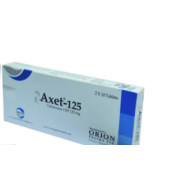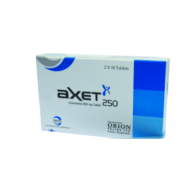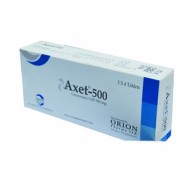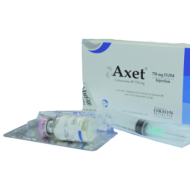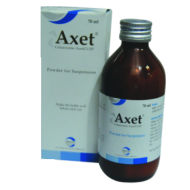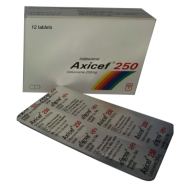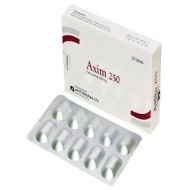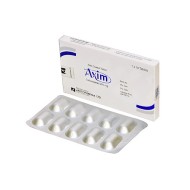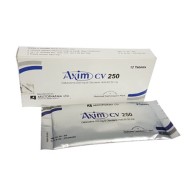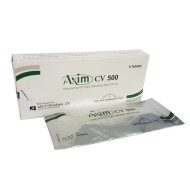
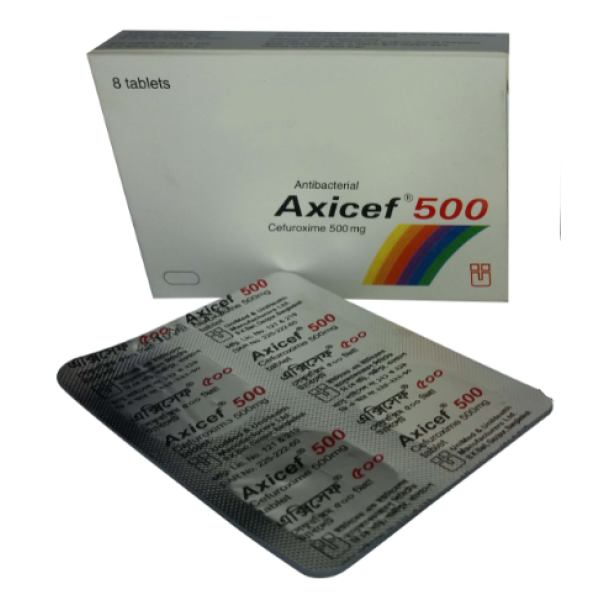
- Stock: 2-3 Days
- Brand: Unimed Unihealth MFG. Ltd.
- Product ID: Cefuroxime Axetil
🔒 100% Secure Payment | bKash | Nagad | SSLCommerz | COD
⭐ Become a FREE Member: 7% Extra Savings • Free Delivery • Refill Reminders • Priority Support
This Item is for pre order
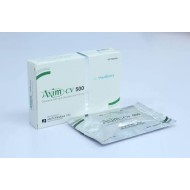
Axicef 500 mg Tablet (Cefuroxime Axetil) — Clinical Overview
| Brand Name | Axicef 500 mg Tab |
|---|---|
| Generic Name | Cefuroxime Axetil |
| Manufacturer | ACI Limited, Bangladesh |
| Strength | 500 mg per tablet |
| Dosage Form | Film-coated Tablet |
| Pack Size | 10 tablets per strip |
| Drug Class | Second-generation Cephalosporin (Beta-lactam Antibiotic) |
| Prescription Status | Prescription Only Medicine (POM) |
What is Axicef 500 mg?
Axicef 500 mg Tab is a higher-dose formulation of cefuroxime axetil, a second-generation oral cephalosporin antibiotic manufactured by ACI Limited, Bangladesh. The 500 mg dose is prescribed when greater antibiotic exposure is required — typically for more severe or deeply-seated infections, or for infections caused by organisms with higher minimum inhibitory concentrations (MICs) that require a higher drug concentration to be effectively eliminated.
Like the 250 mg strength, Axicef 500 mg is an ester prodrug that is hydrolyzed to active cefuroxime in the gut mucosa. Bioavailability is increased by ~40% when taken with food, making food co-administration mandatory for optimal therapeutic outcomes.
When is the 500 mg Dose Required?
The choice between 250 mg and 500 mg doses of cefuroxime axetil is guided by infection severity, site of infection, and causative pathogen characteristics:
- Acute exacerbations of chronic bronchitis (AECB) in COPD: 500 mg twice daily is recommended to achieve bronchial secretion concentrations sufficient to eradicate H. influenzae and M. catarrhalis, which may have higher MICs in patients with repeated antibiotic exposure.
- Severe sinusitis: When infection extends beyond the antrum or when first-line therapy has failed, 500 mg twice daily provides higher sinus mucosal drug levels.
- Mild community-acquired pneumonia (CAP): 500 mg twice daily provides tissue concentrations needed to treat S. pneumoniae and H. influenzae in the lower respiratory tract.
- Early disseminated Lyme disease: 500 mg twice daily for 20 days is the standard oral regimen for Lyme borreliosis with erythema migrans.
- Skin and soft tissue infections: More extensive cellulitis or infected surgical wounds may require 500 mg twice daily to achieve effective tissue and skin concentrations.
How Does Cefuroxime Axetil Work?
Cefuroxime inhibits bacterial cell wall synthesis by binding to penicillin-binding proteins (PBPs), blocking peptidoglycan cross-linking and causing bacterial lysis. It is a time-dependent antibiotic — efficacy depends on maintaining free drug concentrations above the MIC for at least 40–50% of the dosing interval. At 500 mg twice daily, higher peak plasma concentrations (Cmax ~7–10 μg/mL) ensure that time above MIC is maintained for a broader range of organisms and strains with higher MICs, providing bactericidal activity against more challenging infections.
Cefuroxime is stable against many plasmid-mediated beta-lactamases from H. influenzae (TEM-1, TEM-2) and M. catarrhalis (BRO-1, BRO-2), which commonly cause respiratory tract infections.
Diabetes and Higher-Dose Antibiotic Therapy
Diabetic patients often require the higher 500 mg dose for several reasons:
- Impaired drug distribution: Microvascular disease in diabetes reduces antibiotic penetration into peripheral tissues (skin, subcutaneous tissue, bone). Higher serum concentrations from 500 mg dosing help compensate for reduced tissue perfusion, particularly in lower limb infections.
- Diabetic foot infections (DFIs): Mild-to-moderate non-limb-threatening DFIs often involve MSSA, streptococci, and occasionally Gram-negative organisms. Cefuroxime axetil 500 mg twice daily is an acceptable oral option per IWGDF guidelines when IV therapy is not required.
- AECB in diabetics with COPD: Diabetics have a higher prevalence of COPD. During acute bronchitis exacerbations, 500 mg twice daily achieves sputum concentrations of ~1–2 μg/mL, above the MIC90 of most H. influenzae and M. catarrhalis strains.
- Stress hyperglycaemia: Severe infections cause pronounced cortisol release, significantly raising blood glucose. Aggressive antibiotic therapy with the 500 mg dose may lead to faster infection resolution and earlier glucose stabilisation.
Dosage and Administration
- AECB / severe sinusitis: 500 mg twice daily × 7–10 days
- Community-acquired pneumonia: 500 mg twice daily × 7–14 days
- Early Lyme disease: 500 mg twice daily × 20 days
- Skin / soft tissue infections (moderate): 500 mg twice daily × 7–14 days
Always take with food to maximise bioavailability. Swallow tablets whole — do not crush or chew. Complete the full prescribed course. Renal dose adjustment: CrCl 10–30 mL/min → consider 250 mg twice daily; CrCl <10 mL/min → 250 mg once daily.
Drug Interactions
- Probenecid: Increases cefuroxime plasma levels by blocking renal tubular secretion
- PPIs / H2-blockers / antacids: Reduce absorption; partially offset by taking with food
- Warfarin: May potentiate anticoagulant effect; monitor INR
- Oral contraceptives: Reduced efficacy due to gut flora changes; use barrier contraception
- Nephrotoxic agents: Monitor renal function when combining with NSAIDs, aminoglycosides
Side Effects
- Common: Diarrhoea, nausea, vomiting, headache, abdominal pain, rash. Higher doses may increase GI side effect frequency.
- Uncommon: Elevated liver enzymes (ALT/AST), eosinophilia, positive Coombs' test
- Rare: Anaphylaxis, Stevens-Johnson syndrome, Clostridioides difficile colitis
Contraindications
- Known hypersensitivity to cefuroxime, cephalosporins, or any excipient
- History of severe immediate penicillin hypersensitivity (anaphylaxis) — ~1–2% cross-reactivity
Frequently Asked Questions (FAQ)
When is 500 mg needed instead of 250 mg cefuroxime axetil?
The 500 mg dose is used for more severe infections or when higher tissue antibiotic concentrations are required — particularly for acute exacerbations of chronic bronchitis (AECB), community-acquired pneumonia, Lyme disease, and moderate skin infections. The 250 mg dose is adequate for uncomplicated UTIs, tonsillitis, and mild sinusitis. Your doctor will determine which dose is appropriate based on your infection type and severity.
Can I take Axicef 500 for bronchitis (AECB)?
Yes. Cefuroxime axetil 500 mg twice daily is a guideline-supported option for acute exacerbations of chronic bronchitis (AECB). It covers the three most common AECB pathogens: H. influenzae (including beta-lactamase-producing strains), M. catarrhalis, and S. pneumoniae. A 5–10 day course is typically prescribed. Note that viral bronchitis does not benefit from antibiotics; treatment should only be initiated when a bacterial cause is confirmed or strongly suspected.
How long should I take Axicef 500 for a chest infection?
For AECB: 5–10 days. For community-acquired pneumonia: 7–14 days depending on response. For Lyme disease: 20 days. Symptoms typically improve within 48–72 hours. Do not stop treatment early when you feel better — complete the full course to prevent bacterial resistance and relapse. If there is no improvement after 72 hours, contact your doctor as the causative organism may require a different antibiotic.
Can Axicef 500 be used for diabetic foot infections?
Axicef 500 mg twice daily can be considered for mild-to-moderate non-limb-threatening diabetic foot infections (DFIs) caused by susceptible MSSA or Streptococcus species. However, severe DFIs, limb-threatening infections, suspected osteomyelitis, or infections with Gram-negative or anaerobic organisms require intravenous (IV) combination antibiotic therapy and surgical review. IWGDF guidelines recommend tailoring antibiotic choice to culture/sensitivity results wherever possible.