- Stock: In Stock
- Brand: Square Pharmaceuticals
- Product ID: Ketoprofen
🔒 100% Secure Payment | bKash | Nagad | SSLCommerz | COD
⭐ Become a FREE Member: 7% Extra Savings • Free Delivery • Refill Reminders • Priority Support
| Generic Name | Ketoprofen |
|---|---|
| Strength | 100 mg |
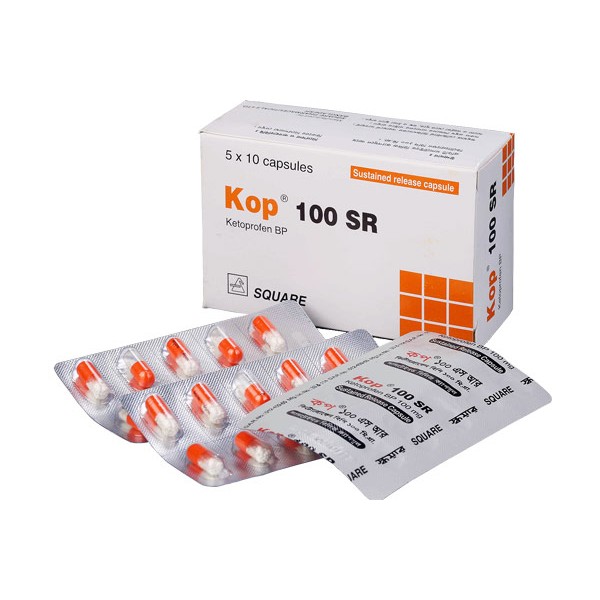
| Dosage Form | Sustained Release Capsule |
| Manufacturer | Square Pharmaceuticals PLC |
| Therapeutic Class | Non-steroidal Anti-inflammatory Drugs (NSAIDs), Drugs for Osteoarthritis, Drugs used for Rheumatoid Arthritis |
| Pack Size | 5 × 10 capsules (50's) |
Overview
Kop SR (Ketoprofen) 100 mg Sustained Release Capsule is a non-steroidal anti-inflammatory drug (NSAID) manufactured by Square Pharmaceuticals PLC. Ketoprofen inhibits prostaglandin synthesis, stabilizes lysosomal membranes, and exhibits antibradykinin activity, providing anti-inflammatory, analgesic, and antipyretic effects. The sustained-release formulation allows for prolonged drug delivery, reducing dosing frequency. Kop SR is indicated for rheumatoid arthritis, degenerative joint diseases (osteoarthritis), musculoskeletal and joint disorders (tendinitis, sprains), and pain management including dental pain, headache, and primary dysmenorrhea.
Dosage and Administration
Anti-inflammatory: Starting dose 150–300 mg/day in 3 divided doses; maintenance dose usually 100–200 mg/day. Once-daily SR dosing may be considered at the maintenance dose. Maximum daily dose: 300 mg. Pain and primary dysmenorrhea: 25–50 mg every 6–8 hours as needed (max 300 mg/day). Elderly patients: use a reduced initial dose and maintain at the minimum effective dose. Take with food or fluids to reduce gastrointestinal side effects. Hepatic and renal impairment: use minimum effective dose with careful monitoring.
Interaction
Avoid concurrent use with other NSAIDs, high-dose aspirin (increased GI bleeding risk), and anticoagulants (warfarin, heparin, dabigatran, apixaban, rivaroxaban — increased bleeding risk). Monitor closely if combined with lithium (raised lithium levels), methotrexate >15 mg/week (haematologic toxicity), cyclosporin or tacrolimus (nephrotoxicity), and SSRIs (GI bleeding risk). NSAIDs may blunt the effect of antihypertensives (ACE inhibitors, beta-blockers, diuretics). Probenecid may markedly reduce Ketoprofen plasma clearance.
Contraindications
Contraindicated in patients with hypersensitivity to ketoprofen, aspirin, or other NSAIDs (including those with aspirin-induced asthma). Also contraindicated in severe heart failure, active or history of peptic ulcer/GI bleeding, severe hepatic or renal insufficiency, and during the third trimester of pregnancy.
Side Effects
Common: dyspepsia, nausea, abdominal pain, vomiting, diarrhea, constipation, flatulence, gastritis. Uncommon: headache, dizziness, somnolence, rash, pruritus, edema. Rare: peptic ulcer, hepatitis, blurred vision, tinnitus, paraesthesia, asthma. Unknown: GI hemorrhage and perforation, pancreatitis, anaphylaxis, renal failure, atrial fibrillation, Stevens-Johnson syndrome, toxic epidermal necrolysis.
Pregnancy and Lactation
Avoid use during the first and second trimesters unless clearly necessary. Contraindicated during the third trimester of pregnancy. Not recommended for nursing mothers.
Precautions and Warnings
Use with caution in patients with GI disease history (ulcerative colitis, Crohn's disease). Monitor renal function at the start of treatment in high-risk patients (heart failure, cirrhosis, renal impairment, diuretic users). Monitor liver enzymes during long-term therapy. May mask signs of infection (fever, inflammation). NSAIDs may impair female fertility. The anti-inflammatory and antipyretic properties may mask usual signs of disease progression. Avoid in patients attempting to conceive.
Storage Conditions
Protect from light. Store below 30°C. Keep out of the reach of children. Dispense only on prescription of a registered physician.
Frequently Asked Questions
Q: What does "SR" mean in Kop SR?
A: "SR" stands for Sustained Release — the capsule is formulated to release ketoprofen gradually over an extended period, allowing for less frequent dosing and more consistent blood levels compared to immediate-release forms.
Q: Should Kop SR be taken with food?
A: Yes — take Kop SR with food or fluids to minimize gastrointestinal side effects such as nausea and stomach discomfort.