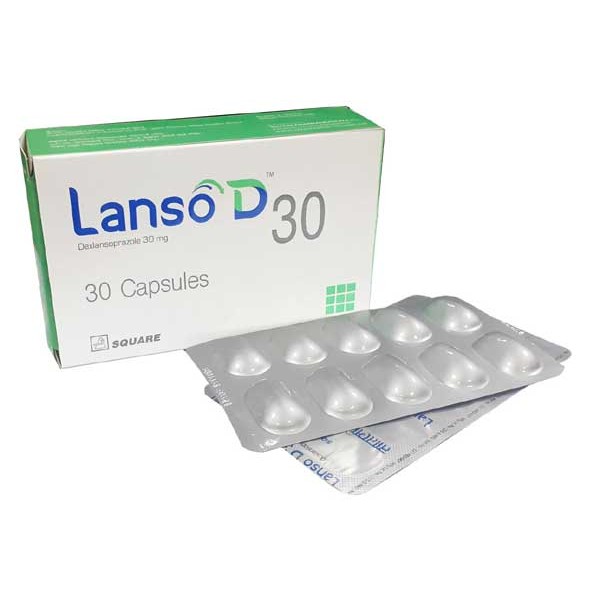
- Stock: In Stock
- Brand: Square Pharmaceuticals
- Product ID: Dexlansoprazole
🔒 100% Secure Payment | bKash | Nagad | SSLCommerz | COD
⭐ Become a FREE Member: 7% Extra Savings • Free Delivery • Refill Reminders • Priority Support
| Generic Name | Dexlansoprazole |
|---|---|
| Strength | 30 mg |
| Dosage Form | Capsule (Enteric Coated) |
| Manufacturer | Square Pharmaceuticals PLC |
| Therapeutic Class | Proton Pump Inhibitor |
| Pack Size | 6×10 (60 capsules) |
Overview
Lanso D 30 mg Capsule contains Dexlansoprazole, a Proton Pump Inhibitor (PPI) manufactured by Square Pharmaceuticals PLC. It is a Dual Delayed Release (DDR) formulation containing two types of enteric-coated granules with different pH-dependent dissolution profiles, resulting in two distinct absorption peaks for prolonged acid suppression. Dexlansoprazole is the R-enantiomer of lansoprazole and works by specifically inhibiting the H+/K+-ATPase enzyme system (proton pump) in the gastric parietal cells, thereby blocking the final step of gastric acid secretion.
Lanso D 30 mg is indicated for: maintenance of healed erosive esophagitis (EE) and relief of heartburn for up to 6 months; and symptomatic non-erosive gastroesophageal reflux disease (GERD) for 4 weeks.
Dosage and Administration
Maintenance of healed erosive esophagitis and relief of heartburn: 30 mg once daily.
Symptomatic non-erosive GERD: 30 mg once daily for 4 weeks.
Lanso D can be taken without regard to food and should be swallowed whole. Alternatively, the capsule may be opened and the intact granules sprinkled onto one tablespoon of applesauce and swallowed immediately — granules should not be chewed. If a dose is missed, it should be taken as soon as possible unless it is nearly time for the next dose; a double dose should never be taken.
Interaction
Lanso D may interact with Atazanavir (reduced antiretroviral efficacy — avoid combination), Warfarin (increased anticoagulant effect — monitor INR), Tacrolimus (increased plasma levels — monitor), Clopidogrel (reduced antiplatelet activity via CYP2C19 inhibition), and Methotrexate (reduced renal clearance — use with caution). No clinically significant food interactions have been reported.
Contraindications
Lanso D is contraindicated in patients with known hypersensitivity to Dexlansoprazole, other proton pump inhibitors, or any component of the formulation.
Side Effects
Common side effects include diarrhea, abdominal pain, nausea, vomiting, and flatulence. Less common effects may include headache, upper respiratory tract infection, and nasopharyngitis. Long-term use may be associated with hypomagnesemia, bone fractures, and Clostridium difficile-associated diarrhea.
Pregnancy and Lactation
Lanso D is classified as Pregnancy Category B. There are no adequate and well-controlled studies in pregnant women. Animal reproduction studies have not demonstrated fetal risk. The drug should be used during pregnancy only if clearly needed. There are no adequate and well-controlled studies in lactating women. Caution should be exercised when administering Lanso D to a nursing mother.
Precautions and Warnings
Symptomatic response to Lanso D does not preclude the presence of gastric malignancy — appropriate investigation should be conducted. Long-term PPI use is associated with an increased risk of Clostridium difficile-associated diarrhea, osteoporosis-related bone fractures, and hypomagnesemia; periodic monitoring is advised. Concomitant use with Methotrexate requires caution due to potential for elevated methotrexate levels. Safety and effectiveness have not been established in patients below 12 years of age. No dose adjustment is necessary for elderly patients or those with renal impairment. A maximum daily dose of 30 mg should be considered in patients with moderate hepatic impairment.
Storage Conditions
Store below 30°C in a dry place, protected from light. Keep out of reach of children.
Frequently Asked Questions
Q: What makes Lanso D different from regular lansoprazole?
A: Lanso D contains Dexlansoprazole, the R-enantiomer of lansoprazole, formulated using Dual Delayed Release (DDR) technology. This creates two absorption peaks, providing more prolonged and consistent suppression of gastric acid compared to conventional lansoprazole.
Q: Can Lanso D be taken with or without food?
A: Yes, Lanso D can be taken without regard to meals, which offers flexible dosing convenience. It should be swallowed whole, or the granules may be sprinkled on food — but never chewed.