- Stock: Pre-Order
- Brand: Opsonin Pharma Limited
- Product ID: Azithromycin
🔒 100% Secure Payment | bKash | Nagad | SSLCommerz | COD
⭐ Become a FREE Member: 7% Extra Savings • Free Delivery • Refill Reminders • Priority Support
This Item is for pre order
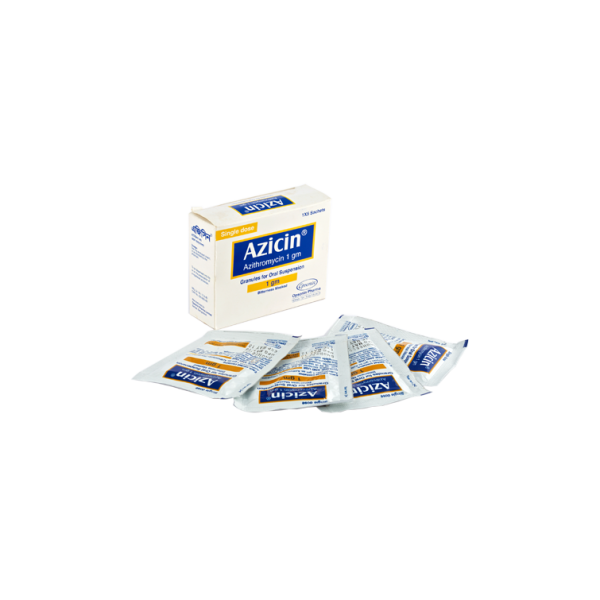
Azicin 1gm Sachet — Azithromycin Single-Dose Oral Granules
| Attribute | Details |
|---|---|
| Brand Name | Azicin |
| Generic Name | Azithromycin |
| Strength | 1 g (1000 mg) |
| Dosage Form | Oral Granules / Sachet (for oral suspension or direct administration) |
| Pack Size | 1 sachet |
| Drug Class | Macrolide Antibiotic |
| Manufacturer | Opsonin Pharma Limited, Bangladesh |
| Route of Administration | Oral |
About Azicin 1gm Sachet
Azicin 1gm Sachet contains azithromycin 1000 mg (1 g) in granule form for oral administration, manufactured by Opsonin Pharma Limited, Bangladesh. The 1g single-dose sachet formulation was developed to maximise treatment adherence for indications where a complete course of therapy can be achieved with a single oral dose — the most adherence-friendly regimen possible. Unlike tablet formulations that require 3–5 day courses, Azicin 1gm Sachet delivers the full therapeutic dose in one administration, eliminating missed doses, dose-stacking errors, and course incompletion. The granule formulation can be dissolved in water or swallowed directly, making it convenient for patients who have difficulty swallowing tablets. Azithromycin's unique pharmacokinetic profile — tissue concentrations 10–100 times higher than plasma concentrations, sustained for 5–7 days after a single 1g dose — makes single-dose therapy clinically effective for susceptible organisms.
Clinical Indications for the 1g Single Dose
Sexually transmitted infections (STIs): Azithromycin 1g single oral dose is the WHO-recommended first-line treatment for uncomplicated Chlamydia trachomatis urogenital infection (chlamydial urethritis, cervicitis). A single 1g dose achieves cure rates exceeding 97% for uncomplicated genital chlamydia. It is also used as co-therapy with ceftriaxone for syndromic management of urethral discharge (to cover chlamydial co-infection in gonococcal urethritis). Traveller's diarrhoea: Azithromycin 1g single dose is first-line therapy for moderate-to-severe traveller's diarrhoea, particularly in South/Southeast Asia where fluoroquinolone-resistant Campylobacter is prevalent. A single 1g dose reduces symptom duration from 3–4 days to less than 24 hours in clinical trials. Community-acquired pneumonia (CAP): While standard azithromycin CAP dosing uses a 3–5 day course, the 1g sachet is sometimes used off-label for selected mild outpatient CAP in patients expected to have poor adherence to multi-day courses. Non-gonococcal urethritis (NGU): 1g single dose is standard treatment for Mycoplasma genitalium-associated NGU and mixed-cause NGU where chlamydia is a likely pathogen.
Pharmacokinetic Basis for Single-Dose Efficacy
Azithromycin's suitability for single-dose therapy is grounded in its exceptional pharmacokinetics. After a 1g oral dose, azithromycin rapidly distributes from the bloodstream into tissues via active cellular uptake by phagocytes (neutrophils, macrophages): tissue concentrations in the lung, genitourinary tract, tonsils, and lymph nodes reach 10–100 times the corresponding plasma concentration within hours. These tissue concentrations are bactericidal for susceptible organisms at MICs below 0.5 mg/L, and remain above this threshold for 5–7 days after a single 1g dose. For Chlamydia trachomatis — an obligate intracellular organism — the intracellular concentration achieved by azithromycin in infected cells is particularly relevant; azithromycin accumulates in Chlamydia-containing vacuoles within host cells. The elimination half-life of 68 hours means significant drug remains in tissues long after the single dose is administered, providing a sustained post-antibiotic effect.
Administration Instructions
The 1g sachet is taken as a single oral dose. Empty the contents of the sachet into a glass. Add approximately 60 mL (one-third cup) of water and stir until the granules are fully suspended. Drink the entire suspension immediately after preparation — do not allow it to stand before drinking. Rinse the glass with an additional small amount of water and drink the rinse to ensure the full dose is consumed. The sachet may also be taken with food — unlike some azithromycin formulations, the 1g sachet granule formulation is not significantly affected by food. For STI indications, both sexual partners should be treated simultaneously to prevent reinfection. Refrain from unprotected sexual contact for 7 days after treatment and until the partner is also treated.
STI Treatment in the Diabetic Population
People with diabetes have increased susceptibility to genital tract infections, including Chlamydia trachomatis urethritis and cervicitis, due to hyperglycaemia-associated impairment of mucosal immunity, altered vaginal microbiota (in women), and the immune dysfunction associated with chronic diabetes. Effective single-dose treatment with Azicin 1gm Sachet is important in this population because: untreated chlamydial infection can ascend to cause pelvic inflammatory disease (in women) or epididymo-orchitis (in men); repeated antibiotic courses are more disruptive to diabetic patients' complex medication regimens than a single-dose treatment; and the certainty of adherence with a single observed dose is especially valuable in a population already managing multiple medications.
Frequently Asked Questions (FAQ)
Q1: Is one 1g sachet sufficient to treat chlamydia?
Yes — azithromycin 1g single oral dose achieves cure rates exceeding 95–97% for uncomplicated genital chlamydia (C. trachomatis urogenital infection) in clinical trials and WHO systematic reviews. This is the standard WHO-recommended first-line regimen for uncomplicated chlamydia. However, "uncomplicated" means confined to the lower genital tract (urethra, cervix, vagina); infections involving the upper genital tract (pelvic inflammatory disease, epididymo-orchitis) require longer courses. For rectal chlamydia (lymphogranuloma venereum), a longer course (doxycycline 21 days) is required as azithromycin 1g is insufficient. Confirm cure with a test-of-cure (repeat NAAT test) 3–5 weeks after treatment if symptoms persist or recurrence is possible.
Q2: Can Azicin 1gm Sachet be used for traveller's diarrhoea?
Yes — azithromycin 1g single dose is the preferred treatment for moderate-to-severe traveller's diarrhoea in travellers to South Asia and Southeast Asia, where fluoroquinolone-resistant Campylobacter jejuni is now prevalent. Clinical trials show a 1g single dose reduces symptom duration from 3–4 days to less than 24–30 hours and achieves microbiological cure in over 90% of bacterial traveller's diarrhoea cases. It is effective against Campylobacter (including quinolone-resistant strains), enterotoxigenic E. coli, Shigella, and Salmonella. For mild traveller's diarrhoea (uncomfortable but not incapacitating), oral rehydration without antibiotics is preferred; antibiotic treatment is reserved for moderate-to-severe disease.
Q3: Should both partners be treated when one is diagnosed with chlamydia?
Yes — simultaneous treatment of all sexual partners from the preceding 60 days (or the most recent partner if the last contact was more than 60 days ago) is essential. Without partner treatment, reinfection is almost inevitable, as chlamydia is highly transmissible with unprotected sex. Both partners should take Azicin 1gm Sachet (or the standard 7-day doxycycline alternative) simultaneously. Avoid unprotected sexual contact for 7 days after treatment and until both partners are asymptomatic. Partner notification and treatment is a public health as well as clinical obligation.
Q4: What are the side effects of Azicin 1gm single dose?
The most common side effects of the 1g single dose are gastrointestinal: nausea (reported in 10–20% of patients), abdominal pain, and diarrhoea. These are dose-dependent and more frequent with the 1g dose than with the lower doses used for respiratory infections. Taking the sachet with food significantly reduces GI side effects without substantially affecting efficacy. Vomiting within 1 hour of taking the sachet may reduce drug absorption; if this occurs, contact the prescribing clinician about whether a repeat dose is needed. Headache and dizziness are occasionally reported. Serious allergic reactions (anaphylaxis, Steven-Johnson syndrome) are very rare but require immediate medical attention.
Medical Disclaimer: Azicin 1gm Sachet for STI treatment should be used with physician or sexual health clinic guidance. Partner notification, simultaneous treatment, and test-of-cure are components of standard STI management. Resistance testing may be indicated for treatment failures. This product requires a prescription.