- Stock: In Stock
- Brand: Beximco Pharmaceutical
- Product ID: Bisoprolol Fumarate
🔒 100% Secure Payment | bKash | Nagad | SSLCommerz | COD
⭐ Become a FREE Member: 7% Extra Savings • Free Delivery • Refill Reminders • Priority Support
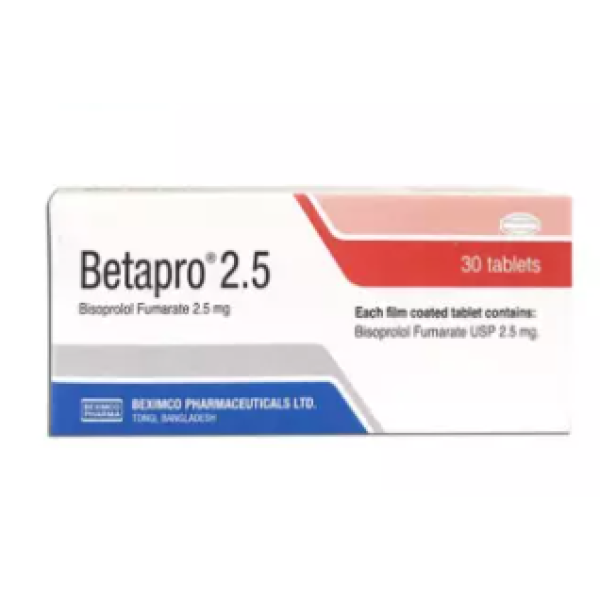
Betapro 2.5 mg Tablet — Bisoprolol Fumarate | Beximco Pharmaceuticals
| Generic Name | Bisoprolol Fumarate |
| Strength | 2.5 mg |
| Dosage Form | Film-Coated Tablet |
| Manufacturer | Beximco Pharmaceuticals Ltd. |
| Therapeutic Class | Cardioselective Beta-1 Adrenergic Blocker |
| Pack Size | 30 Tablets per Box |
| Availability | In Stock — Available Online |
Overview
Betapro 2.5 mg Tablet contains Bisoprolol Fumarate 2.5 mg, manufactured by Beximco Pharmaceuticals Ltd. Bisoprolol is one of the most cardioselective beta-1 adrenergic blockers available, with high specificity for the heart's beta-1 receptors compared to beta-2 receptors in the lungs — making it safer for patients with mild-to-moderate respiratory conditions than older beta-blockers like atenolol or propranolol. The 2.5 mg dose is primarily used as the starting (initiation) dose for heart failure (where beta-blockers must be introduced very gradually) and for elderly or frail patients with hypertension requiring gentle blood pressure reduction.
Indications
- Stable Chronic Heart Failure with Reduced EF (HFrEF) — initiation dose; titrate up to 10 mg
- Hypertension — starting dose in elderly or sensitive patients
- Stable Angina — reduces heart rate and myocardial oxygen demand
- Hypertension in T2DM — cardioselective; use with caution (blunts hypoglycaemia tachycardia at higher doses)
- Atrial Fibrillation (rate control) — reduces ventricular rate
Key Benefits
- Highest cardioselectivity among beta-blockers — minimal effect on lung beta-2 receptors
- Once-daily dosing — excellent adherence
- Proven mortality reduction in heart failure (CIBIS-II trial)
- Safe in mild asthma/COPD compared to non-selective beta-blockers (use with caution)
- No significant effect on blood glucose at low doses — better for diabetic patients than atenolol
- Manufactured under WHO-GMP standards by Beximco Pharmaceuticals
Pharmacology
Bisoprolol selectively blocks beta-1 adrenergic receptors in the myocardium, reducing heart rate (negative chronotropy), myocardial contractility (negative inotropy), and cardiac conduction velocity (negative dromotropy). The result is reduced cardiac output and blood pressure. By reducing heart rate and myocardial oxygen demand, Bisoprolol relieves angina. In heart failure, the paradoxical long-term benefit — reduced remodelling, improved EF, and mortality reduction — occurs through neurohormonal modulation (blocking chronic sympathetic overstimulation of the failing heart). At 2.5 mg, the cardiovascular effects are gentle, making it the ideal starting point for dose titration in heart failure.
Dosage & Administration
| Indication | Starting Dose | Titration Target |
|---|---|---|
| Stable Heart Failure (HFrEF) | 1.25 mg once daily (if available) or 2.5 mg | Target 10 mg once daily over weeks-months |
| Hypertension | 2.5–5 mg once daily | Up to 10–20 mg once daily |
| Stable Angina | 5 mg once daily | Up to 10–20 mg once daily |
| Elderly / Sensitive patients | 2.5 mg once daily | Titrate slowly based on tolerability |
Take once daily, in the morning, with or without food. Never stop abruptly — always taper the dose.
Special Populations
- Diabetic Patients: Bisoprolol is more cardioselective than atenolol and has less effect on glucose metabolism. However, at higher doses, it may still blunt hypoglycaemia-related tachycardia. Monitor glucose regularly if on insulin or sulfonylureas.
- Elderly: Start at 2.5 mg; titrate very carefully. Increased risk of bradycardia and falls.
- Renal Impairment: Dose reduction required if eGFR <20 ml/min — do not exceed 10 mg/day.
- Hepatic Impairment: Use with caution; dose reduction may be needed. Do not exceed 10 mg/day.
- Asthma/COPD: Bisoprolol is relatively safe in mild-moderate airway disease due to its high cardioselectivity, but use with caution. Avoid in severe obstructive airways disease.
- Pregnancy: Category C — use only if benefit outweighs risk. May cause fetal bradycardia and growth restriction.
Contraindications
- Decompensated heart failure requiring IV inotropes
- Cardiogenic shock
- Second or third-degree AV block (without pacemaker)
- Sick sinus syndrome
- Severe bradycardia (HR <50 bpm)
- Severe hypotension
- Severe asthma or bronchospasm
- Peripheral arterial occlusive disease (advanced)
- Untreated phaeochromocytoma
Drug Interactions
| Drug | Interaction |
|---|---|
| Verapamil / Diltiazem (IV) | Risk of severe bradycardia and AV block — avoid combination |
| Clonidine | Rebound hypertension on withdrawal — taper clonidine first |
| Antiarrhythmics (amiodarone, digoxin) | Additive AV nodal depression — monitor ECG and heart rate |
| Insulin / Sulfonylureas | Bisoprolol may mask hypoglycaemia tachycardia — monitor glucose |
| NSAIDs | Reduce antihypertensive effect |
| Adrenaline (Epinephrine) | Relative bradycardia and hypertension risk — use with caution |
Side Effects
Common: Bradycardia, dizziness, fatigue, cold extremities, headache, nausea, diarrhoea.
Uncommon: Sleep disturbance, depression, muscle weakness, bronchospasm (in susceptible patients).
Rare: AV block, severe hypotension, Raynaud's phenomenon, psoriasiform skin reactions.
Pregnancy & Lactation
Pregnancy: Category C. May cause fetal bradycardia, hypoglycaemia, and intrauterine growth restriction — use only when benefit outweighs risk.
Lactation: Use with caution; bisoprolol excretion in breast milk is low but data are limited.
Storage
- Below 30°C, protected from moisture and sunlight. Keep in original blister. Out of reach of children.
Frequently Asked Questions
Q1: What is Betapro 2.5 mg used for?
Betapro 2.5 mg (Bisoprolol) is used as a starting dose for heart failure, hypertension, and angina. The 2.5 mg dose allows physicians to initiate beta-blocker therapy very gently — particularly important in heart failure, where beta-blockers must be started at the lowest dose and titrated slowly to avoid worsening.
Q2: Why does my doctor start with 2.5 mg if higher doses are available?
In heart failure, the paradox of beta-blockers is that while they ultimately improve heart function and save lives, starting too high can acutely worsen the condition. The 2.5 mg dose allows the heart to adapt gradually. Your physician will increase the dose every 2–4 weeks as tolerated, aiming for 10 mg/day.
Q3: Is Bisoprolol (Betapro) safe for diabetic patients?
Bisoprolol is more diabetes-friendly than atenolol or propranolol because of its high cardioselectivity. It has less effect on blood glucose and lipid metabolism. However, it can still blunt the heart-rate warning of hypoglycaemia, so monitor your glucose regularly if you take insulin or sulfonylureas.
Q4: Can I stop Betapro 2.5 mg if I feel fine?
Never stop abruptly. Sudden withdrawal can cause rebound hypertension, chest pain, or heart attack. If you wish to stop, your physician will reduce the dose gradually over 1–2 weeks.
Q5: Is Betapro 2.5 mg prescription-only?
Yes — Rx medicine. Upload your prescription when ordering from DiabetesStore.com.bd.
Medical Disclaimer: Educational purposes only. Always consult a registered physician or pharmacist before starting, changing, or stopping any medication.