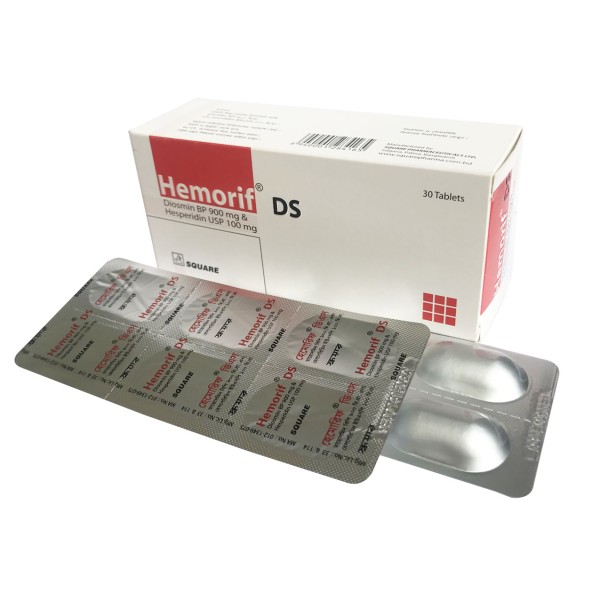
- Stock: In Stock
- Brand: Square Pharmaceuticals
- Product ID: Micronised Diosmin + Hesperidin
🔒 100% Secure Payment | bKash | Nagad | SSLCommerz | COD
⭐ Become a FREE Member: 7% Extra Savings • Free Delivery • Refill Reminders • Priority Support
| Generic Name | Diosmin + Hesperidin |
|---|---|
| Strength | 900 mg + 100 mg |
| Dosage Form | Film-coated Tablet |
| Manufacturer | Square Pharmaceuticals PLC |
| Therapeutic Class | Phlebotonic & Vascular protecting preparation |
| Pack Size | 5 x 6 (30's) |
Overview
Hemorif DS Tablet is the double-strength formulation containing Diosmin 900 mg and Hesperidin 100 mg. As a phlebotonic and vascular-protecting agent, this combination reinforces venous tone by prolonging the activity of parietal noradrenaline, reducing venous capacitance, distensibility, and emptying time. It protects the microcirculation by reducing leukocyte activation and inhibiting the release of inflammatory mediators (free radicals and prostaglandins), normalising capillary permeability and strengthening capillary resistance. Hemorif DS also improves lymphatic drainage by increasing lymph flow and lymph oncotic pressure. The DS formulation allows once-daily dosing for most indications, offering greater convenience than the standard-strength tablet. Indicated for acute and chronic haemorrhoidal disease and chronic venous insufficiency of the lower limbs.
Dosage and Administration
Acute haemorrhoid: 1 tablet three times daily for the first 4 days, followed by 1 tablet twice daily for 3 days, then 1 tablet once daily as maintenance dose.
Relapse of internal haemorrhoid and chronic haemorrhoid: 1 tablet once daily for 3 months.
Chronic venous insufficiency: 1 tablet once daily for 2–6 months.
Leg wounds: 1 tablet once daily for 2 months.
Tablets should be taken at meal times. If haemorrhoidal symptoms do not resolve within 15 days, consult a physician.
Interaction
No evidence of drug incompatibility or clinically significant drug interactions has been reported in clinical trials for Diosmin and Hesperidin. Patients on concurrent medications should consult their physician before use.
Contraindications
Hemorif DS is contraindicated in patients with known hypersensitivity to Diosmin, Hesperidin, or any other component of the formulation. Chronic venous insufficiency and its complications must be diagnosed and managed under physician supervision.
Side Effects
Hemorif DS is generally well tolerated. Occasional gastric disorders and neurovegetative disorders (feelings of discomfort) have been reported. In such cases, discontinuation of treatment is not typically required.
Pregnancy and Lactation
Experimental studies have not demonstrated any teratogenic effect in animals, and no harmful effects in humans have been reported. However, in the absence of data on excretion into breast milk, breastfeeding is not recommended during treatment.
Precautions and Warnings
If haemorrhoidal symptoms do not disappear within 15 days, the patient should consult a physician. As a precaution, Hemorif DS is not recommended for patients with a history of cancer, as no specific clinical studies have been performed in this population. More than 20 years of clinical use and animal studies have not found evidence of carcinogenicity or mutagenicity when used as recommended.
Storage Conditions
Keep below 30°C temperature, away from light and moisture. Keep out of the reach of children.
Frequently Asked Questions
Q: What is the difference between Hemorif and Hemorif DS?
Hemorif DS (Double Strength) contains twice the active ingredients — Diosmin 900 mg and Hesperidin 100 mg — compared to the standard Hemorif tablet (Diosmin 450 mg + Hesperidin 50 mg). The DS formulation allows for simplified once-daily dosing in most indications and is used for both acute and chronic haemorrhoids and chronic venous insufficiency.
Q: How long should Hemorif DS be taken for chronic venous insufficiency?
For chronic venous insufficiency, Hemorif DS is typically taken as 1 tablet once daily for 2 to 6 months depending on the severity of the condition and the physician's assessment. Treatment duration should be guided by a physician, and the condition should be monitored throughout therapy.