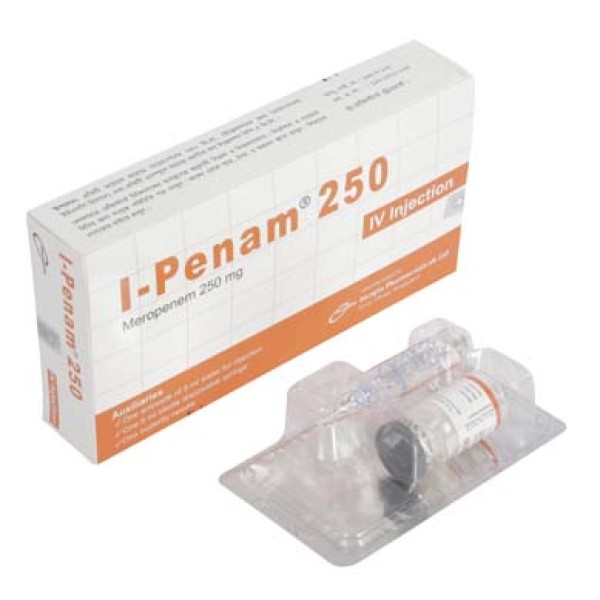
- Stock: Out Of Stock
- Brand: Incepta Pharmaceuticals
- Product ID: Meropenem
🔒 100% Secure Payment | bKash | Nagad | SSLCommerz | COD
⭐ Become a FREE Member: 7% Extra Savings • Free Delivery • Refill Reminders • Priority Support
This Item is for pre order
I-Penam 250mg IV Injection — Meropenem 250mg | Beximco Pharmaceuticals
| Generic Name | Meropenem Trihydrate 250 mg (equivalent to Meropenem 250 mg) |
| Dosage Form | Powder for IV Infusion / Injection |
| Drug Class | Carbapenem (Beta-lactam Antibiotic) — Broadest Spectrum Antibiotic Class |
| Manufacturer | Beximco Pharmaceuticals Ltd. |
| Prescription Status | Prescription Only — ICU / Hospital Specialist Use |
| Route | Intravenous (IV) — bolus or infusion |
Overview
I-Penam 250mg contains Meropenem — a carbapenem antibiotic representing the broadest-spectrum class of beta-lactam antibiotics currently available. Carbapenems are generally reserved as last-resort or empirical therapy for the most severe hospital-acquired infections, multi-drug resistant (MDR) bacterial infections, and infections caused by ESBL-producing organisms (extended-spectrum beta-lactamase producers) that are resistant to third-generation cephalosporins and many other antibiotics. Meropenem covers virtually all clinically relevant aerobic Gram-positive and Gram-negative bacteria as well as anaerobes — making it uniquely valuable for empirical therapy in critically ill patients with unknown causative organisms, and for definitive therapy of resistant Gram-negative infections including ESBL-producing E. coli, Klebsiella pneumoniae, and Pseudomonas aeruginosa. The 250mg strength is used for paediatric dosing and in patients with significant renal impairment requiring dose reduction.
Mechanism of Action
Meropenem inhibits bacterial cell wall synthesis by binding to all penicillin-binding proteins (PBPs) with high affinity, blocking peptidoglycan transpeptidation and causing lysis. Unlike earlier beta-lactams, meropenem has an extraordinary stability to almost all beta-lactamase enzymes — including AmpC beta-lactamases, extended-spectrum beta-lactamases (ESBLs), and most serine carbapenemases — explaining its activity against organisms resistant to all other beta-lactams. It is not active against MRSA (lacks affinity for PBP2a) and is susceptible to metallo-carbapenemases (NDM-1, VIM) — the mechanism of carbapenem-resistant Enterobacteriaceae (CRE), a critical emerging problem.
Spectrum of Activity
| Category | Coverage | Key Pathogens |
|---|---|---|
| Gram-positive aerobes | Good | Streptococci, S. pneumoniae, S. aureus (MSSA — NOT MRSA) |
| Gram-negative aerobes (including resistant) | Excellent | ESBL-producing E. coli and Klebsiella, Pseudomonas aeruginosa, Acinetobacter, Enterobacter, Serratia, H. influenzae |
| Anaerobes | Excellent | Bacteroides fragilis, Clostridium spp., Peptostreptococci |
| MRSA | None | Use vancomycin or linezolid |
| CRE (NDM-1 producers) | None | Use colistin, tigecycline, or combination therapy |
| Enterococcus | Limited | Not reliable against E. faecium |
Indications
- Hospital-Acquired Infections — pneumonia (HAP/VAP), bacteraemia, sepsis of unknown/resistant aetiology
- ESBL-producing organism infections — definitive therapy for ESBL E. coli and Klebsiella UTI, pneumonia, bacteraemia
- Febrile neutropenia — empirical monotherapy in immunocompromised patients (oncology, post-BMT)
- Complicated intra-abdominal infections — peritonitis, complicated appendicitis, bowel perforation
- Complicated skin and soft tissue infections — polymicrobial, necrotising fasciitis, severe diabetic foot infections
- Bacterial meningitis — Gram-negative meningitis resistant to cephalosporins
- Complicated UTI / Pyelonephritis — ESBL or MDR Gram-negative organisms
- Pseudomonas aeruginosa infections — HAP, VAP, bloodstream infection
Dosage and Administration
| Indication | Adult Dose | Frequency |
|---|---|---|
| Moderate infections (UTI, skin) | 500 mg | Every 8 hours IV |
| Severe infections / pneumonia / sepsis | 1 g | Every 8 hours IV |
| Bacterial meningitis / Pseudomonas | 2 g | Every 8 hours IV |
| Febrile neutropenia | 1 g | Every 8 hours IV |
| CrCl 26–50 mL/min | Standard dose | Every 12 hours |
| CrCl 10–25 mL/min | Half dose | Every 12 hours |
| CrCl <10 mL/min / dialysis | Half dose | Every 24 hours |
| Paediatric (3 months–12 years) | 10–40 mg/kg | Every 8 hours IV |
Reconstitute with sterile water for injection (5 mL per 250mg vial) then dilute in 50–250 mL NS. Infuse IV over 15–30 minutes (standard) or 3–4 hours extended infusion for Pseudomonas or resistant organisms (optimises pharmacodynamic target attainment). Meropenem is stable for 1 hour at room temperature once reconstituted — prepare fresh doses. Do not mix with other medications.
Critical Notes for Diabetic Patients
- ESBL infections in diabetics: Diabetic patients with recurrent UTIs and prior antibiotic exposure — particularly those treated repeatedly with fluoroquinolones or cephalosporins — are at high risk of harbouring ESBL-producing E. coli or Klebsiella. When a culture shows ESBL production, meropenem is the definitive treatment of choice
- Severe diabetic foot infections: Necrotising fasciitis, gas-forming deep tissue infections, and polymicrobial severe diabetic foot infections require the broadest available antibiotic coverage — meropenem provides this, covering Gram-positives, Gram-negatives, and anaerobes simultaneously
- Renal dose adjustment — critical in diabetics: Meropenem is entirely renally cleared — dose reduction is mandatory in renal impairment. Diabetic nephropathy is very common; always check eGFR/creatinine before and during meropenem therapy
- Seizure risk: Unlike imipenem/cilastatin, meropenem has a very low seizure threshold risk — but dose reduction in renal impairment is still essential to prevent CNS toxicity
- Antibiotic stewardship — carbapenem stewardship: Carbapenems are last-resort antibiotics; indiscriminate use drives carbapenem-resistant bacteria (CRE), which have very limited treatment options. Meropenem should only be used when culture results or clinical severity genuinely warrant it — de-escalate to narrower-spectrum agents as soon as culture and sensitivity allow
Side Effects
| Side Effect | Frequency |
|---|---|
| Nausea, vomiting, diarrhoea | Common |
| Injection site inflammation / phlebitis | Common |
| Elevated LFTs (transient) | Common |
| Skin rash, urticaria | Uncommon |
| Anaphylaxis | Rare (~1% cross-reactivity with penicillin) |
| C. difficile colitis | Uncommon (all broad-spectrum antibiotics) |
| Seizures / neurotoxicity | Rare (much less than imipenem; dose-reduce in renal impairment) |
| Thrombocytopenia, neutropenia | Rare (prolonged courses) |
Contraindications
- Known hypersensitivity to meropenem or carbapenems
- Use with caution in penicillin allergy (~1% cross-reactivity)
Storage
Store unreconstituted vials below 25°C, protected from light. Once reconstituted and diluted in NS, stable for 1 hour at room temperature or 8 hours refrigerated. Prepare fresh doses for each administration. Keep out of reach of children.
Medical Disclaimer: This information is for educational purposes only. Meropenem is a last-resort carbapenem antibiotic restricted to ICU and specialist hospital use — it must be administered under strict physician supervision in a hospital setting. Never self-administer. Prescription required.