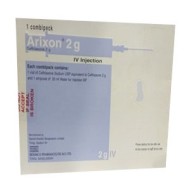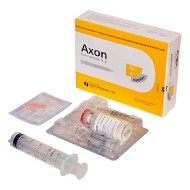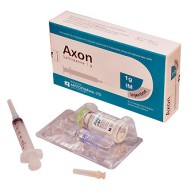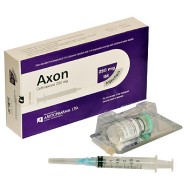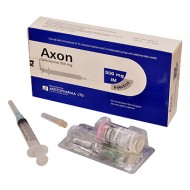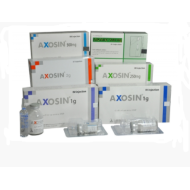
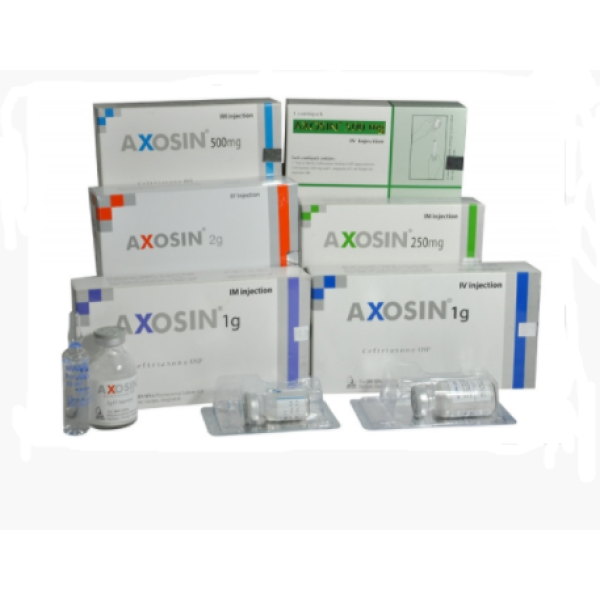
- Stock: In Stock
- Brand: Ibn-Sina Pharmaceuticals Ltd.
- Product ID: Ceftriaxone
🔒 100% Secure Payment | bKash | Nagad | SSLCommerz | COD
⭐ Become a FREE Member: 7% Extra Savings • Free Delivery • Refill Reminders • Priority Support
This Item is for pre order
Axosin IM 250mg Injection (Ceftriaxone Sodium) — Clinical Overview
| Attribute | Details |
|---|---|
| Brand Name | Axosin |
| Generic Name | Ceftriaxone Sodium |
| Strength | 250 mg |
| Dosage Form | Powder for Intramuscular (IM) Injection |
| Drug Class | Third-generation Cephalosporin Antibiotic |
| Manufacturer | ACI Limited, Bangladesh |
| Route of Administration | Intramuscular (IM) |
| Pack Size | Single vial |
What Is Axosin IM 250mg?
Axosin IM 250mg contains ceftriaxone sodium 250 mg in powder form for intramuscular injection, manufactured by ACI Limited — one of Bangladesh's leading pharmaceutical companies. This lower-dose formulation is particularly suited to outpatient clinic settings, paediatric weight-based dosing, and specific adult indications where 250 mg constitutes the complete therapeutic dose, eliminating the need for dose splitting from a larger vial.
Ceftriaxone belongs to the third-generation cephalosporin class and kills bacteria by disrupting cell wall synthesis through PBP (penicillin-binding protein) inhibition. Its broad-spectrum coverage includes gram-positive cocci (Streptococcus, Staphylococcus), gram-negative rods (E. coli, Salmonella, Klebsiella, Haemophilus influenzae), and Neisseria species. The long half-life of 6–9 hours allows once-daily IM dosing — convenient for patients in outpatient or clinic-based settings who return daily for injection.
Clinical Indications for Axosin IM 250mg
The 250 mg dose is specifically indicated for: uncomplicated gonorrhoea (single 250 mg IM dose per WHO guidelines — complete treatment in one injection); paediatric infections where weight-based dosing calculates to approximately 250 mg (e.g., a 5 kg infant requiring 50 mg/kg = 250 mg); mild-to-moderate community-acquired infections in outpatient settings including skin and soft tissue infections, cellulitis, impetigo with systemic signs, and wound infections; lower respiratory tract infections requiring injectable therapy; and acute otitis media failing oral antibiotic therapy in children (50 mg/kg IM single dose or 3-day course).
The 250 mg vial is particularly useful in primary care clinics and upazila health complexes where precise paediatric dosing is required without wastage of larger vials.
Enteric Fever (Typhoid) — Empirical Injectable Therapy
Enteric fever caused by Salmonella typhi and S. paratyphi remains endemic in Bangladesh. While oral fluoroquinolones and azithromycin are first-line for uncomplicated typhoid, injectable ceftriaxone is recommended for: severe typhoid (high fever, altered consciousness, intestinal complications); suspected or confirmed fluoroquinolone-resistant typhoid (increasingly common in Bangladesh and South Asia); patients who cannot take oral medication; and when rapid bactericidal action is required to prevent complications. Ceftriaxone 60–80 mg/kg/day IV or IM (maximum 4g/day) for 10–14 days is the treatment of choice for severe typhoid per WHO guidelines. The 250 mg vial allows precise dosing for children in outpatient or district hospital settings.
Paediatric Weight-Based Dosing Guide
For clinicians managing children at primary and secondary care level in Bangladesh, weight-based ceftriaxone dosing with the 250 mg vial is practical and cost-effective:
Standard paediatric dose: 50–100 mg/kg/day IM once daily (maximum 2g/day for non-meningitis indications). Practical examples: 2.5 kg neonate (caution — see warnings below): 125 mg; 5 kg infant: 250 mg (one full vial); 10 kg child: 500–1000 mg; 20 kg child: 1000–2000 mg. For acute otitis media treatment failure: 50 mg/kg single IM dose (maximum 1g) — one 250 mg vial for a 5 kg infant, two vials for a 10 kg child. Reconstitute the 250 mg vial with 0.9 mL of 1% lidocaine solution for IM use, yielding approximately 250 mg/mL. Administer deep IM into the anterolateral thigh in infants and toddlers, or the gluteal muscle in older children and adults.
Neonatal caution: ceftriaxone should not be used in neonates with jaundice (hyperbilirubinaemia) or those receiving calcium-containing IV fluids. Seek specialist guidance for neonatal use.
Reconstitution Protocol for IM Administration
Proper reconstitution is essential for effective IM delivery and patient comfort. For Axosin IM 250mg: draw up 0.9 mL of 1% lidocaine hydrochloride solution into a syringe. Inject the lidocaine into the vial of Axosin 250mg powder. Swirl gently — do NOT shake vigorously — until fully dissolved. The resulting solution will be approximately 1 mL at 250 mg/mL concentration. Withdraw the full volume and administer as a single deep IM injection into the gluteus maximus (upper outer quadrant) or vastus lateralis (anterolateral thigh). For children, the anterolateral thigh is preferred. Lidocaine reduces injection site pain significantly; patients should still be warned of mild transient discomfort. Do NOT use this lidocaine-reconstituted solution intravenously.
Outpatient Injectable Antibiotic Therapy in Bangladesh
Many infections in Bangladesh are managed in outpatient settings — government dispensaries, private clinics, upazila health complexes — where IV infusions are impractical but injectable antibiotics are needed when oral therapy fails or is inappropriate. Axosin IM 250mg is ideally suited to this context. Once-daily IM dosing means patients attend the clinic once per day for their injection rather than being admitted to hospital, reducing costs for both patient and healthcare system. ACI Limited's quality assurance and cold-chain distribution ensures that Axosin IM 250mg reaches district and sub-district health facilities with maintained potency. Compared to imported ceftriaxone brands, Axosin provides equivalent clinical efficacy at a locally manufactured price point.
Skin and Soft Tissue Infections — Practical Management
Skin and soft tissue infections (SSTIs) are among the most common presentations at community clinics in Bangladesh, often caused by Staphylococcus aureus and Streptococcus pyogenes. When oral antibiotics (flucloxacillin, co-amoxiclav) fail or cellulitis is extensive, IM ceftriaxone provides reliable gram-positive and gram-negative coverage. Typical regimen for moderate cellulitis: ceftriaxone 1g IM once daily for 5–7 days, transitioning to oral step-down therapy once improvement is confirmed (usually after 2–3 days of parenteral treatment). The 250 mg vial is particularly relevant for children weighing 5–10 kg presenting with infected wounds, impetigo with systemic features, or lymphadenitis requiring parenteral antibiotics.
Frequently Asked Questions (FAQ)
Q1: Is the Axosin IM 250mg vial the same medicine as Axon 250mg?
Yes. Both Axosin and Axon are brand names for ceftriaxone sodium manufactured by ACI Limited, Bangladesh. The drug substance, formulation, quality standards, and clinical efficacy are identical. ACI markets the same ceftriaxone under two brand names to serve different distribution channels. Clinicians and pharmacists can use either brand interchangeably based on availability and price preference.
Q2: Can the 250mg vial be used for adults, or is it only for children?
Adults may use the 250 mg dose for specific indications — most notably, uncomplicated gonorrhoea (single 250 mg IM dose per WHO STI treatment guidelines). For most other adult infections (pneumonia, pyelonephritis, sepsis), the standard adult dose is 1–2g daily, which would require four to eight 250 mg vials per dose — making the 1g or 2g vial more economical and practical for adults.
Q3: How should unused reconstituted Axosin 250mg be disposed of?
Once the vial has been reconstituted, any unused portion should be discarded immediately. Ceftriaxone IM solution (reconstituted with lidocaine) should not be stored for later use or re-used, as sterility cannot be guaranteed after initial reconstitution. Dispose of the used vial, needle, and syringe in a puncture-resistant sharps container according to local medical waste disposal guidelines.
Q4: What should be done if a patient develops a rash after receiving Axosin IM injection?
A skin rash after ceftriaxone may indicate a drug hypersensitivity reaction. Mild urticaria (hives) may be managed with antihistamines. However, any sign of severe allergic reaction — widespread rash progressing rapidly, throat swelling, difficulty breathing, drop in blood pressure (anaphylaxis) — requires immediate emergency treatment with IM epinephrine (adrenaline), IV fluids, and corticosteroids. Patients with known penicillin allergy have a 1–2% cross-reactivity risk with cephalosporins; always ask about penicillin allergy before prescribing ceftriaxone.
Medical Disclaimer: This information is provided for healthcare professional reference and patient education purposes only. Axosin IM 250mg is a prescription-only injectable antibiotic. Dosage and indication must be determined by a qualified healthcare provider. Self-administration of injectable antibiotics without medical supervision is unsafe. Always consult a licensed physician or pharmacist.